
The image that scientific research conjures is that of a lab coat-clad scientist hunched over cell cultures or mixing unknown chemicals in a fume hood. I bet you wouldn’t believe it if I told you my summer research experience was more like a 9-to-5 desk job — running Excel formulas across five spreadsheets and refilling my coffee mug every two hours.
Coming into Princeton, I was undecided about my academic and research interests. I had done wet-lab chemistry research in high school and enjoyed it, but I also liked computer science and wasn’t ready to leave it behind either. Thus, early on, I set out to gain both experimental and computational research experience. A first-year seminar on computational molecular modelling led me to continue this work over the summer through a High Meadows Environmental Institute (HMEI) internship. This semester, I am turning to the experimental side, conducting independent work on making porous materials called zeolites for natural gas purification and carbon capture. Working on both theory and experiments has given me a clearer picture of what research looks like from either side, and I hope my experience helps if you’re also drawn to both.
Day-to-day
As you would expect, computational research lends itself to a more regular schedule: you come in and leave at set times, work at your desk for most of the day, and take a regular lunch break. If there isn’t pressing work or you have errands to take care of, you can even work remotely (theoretically, you could stay in pajamas all day!).
Lab work, by contrast, can be erratic. Depending on the procedure, you might be stuck at the bench for hours or have to come in at odd times to continue your experiment — I take great care to time mine so that no one needs to come in at 2 am to pull my samples. Running around can be exhausting, but it also provides more variety than a desk job does.
Getting started
Theoretical work usually has a high bar to entry. Computational tools are often developed on complex math and physics, and although you do not need to understand the theory to use them, doing so can meaningfully advance your research. Before even writing any code, my fellow interns and I spent hours deriving equations and sketching out models to gain a clear idea of what we were implementing.
On the other hand, lab techniques are often picked up as you go — even before you fully understand how an apparatus works, you learn it almost by muscle memory, and deeper understanding comes later. Either way, procedures can get complicated fast, and a well-written standard operating procedure (SOP) will quickly become your best friend!
Getting results
In the lab, when it rains, it pours. Perhaps you added the wrong reagent or used the wrong apparatus; sometimes, a machine breaks and it isn’t even your fault, but now you’ve lost days or weeks of progress. But nothing compares to that feeling when you walk in and discover that your experiment finally worked. That my results are literally my handiwork makes a successful experiment much more gratifying than watching code compile on a screen.
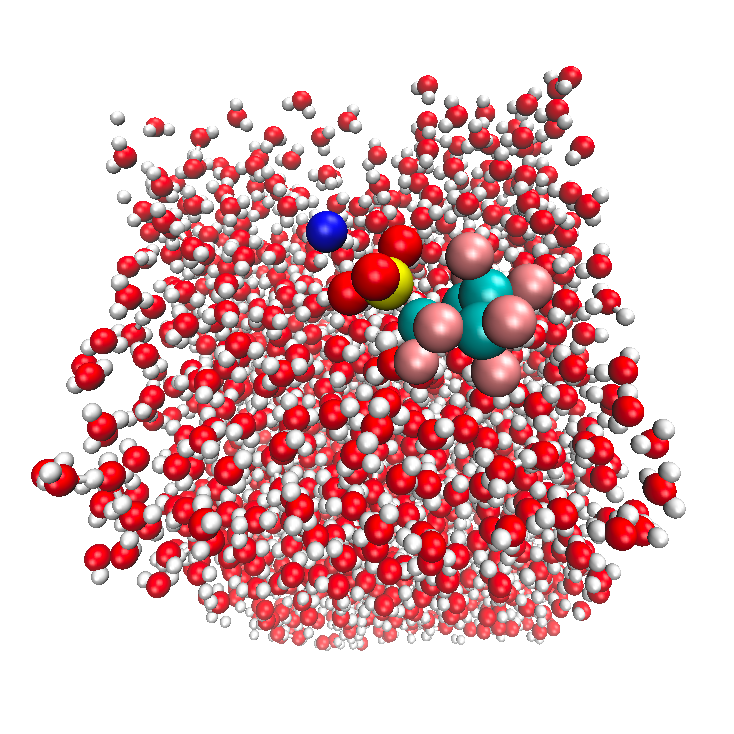
That’s not to say that computational work doesn’t have its own rewards. Writing code that works can take a long time, and seeing invisible atoms rendered on your screen is an incredible feeling. And once the code runs, the results come in much faster than any experiment could.
Whichever approach you choose, your research experience is what you make of it. I’ve jammed out to Britney Spears with my labmates while making lab samples, and laughed until I cried over a simulation demo gone extremely wrong. In fact, my favorite takeaway from my experience is that you don’t have to choose — theory can inform experiments, and vice versa. Part of my computational summer research actually involved making real samples of mud so we could study how different environmental conditions affect its viscosity, which in turn made our models more accurate. So, whether you’re a lifelong experimentalist or a die-hard computationalist, if you’re even a little curious about the other side, go for it — you might discover, like I did, that the most rewarding research happens somewhere in between.
— Mai Tran, Engineering Correspondent