
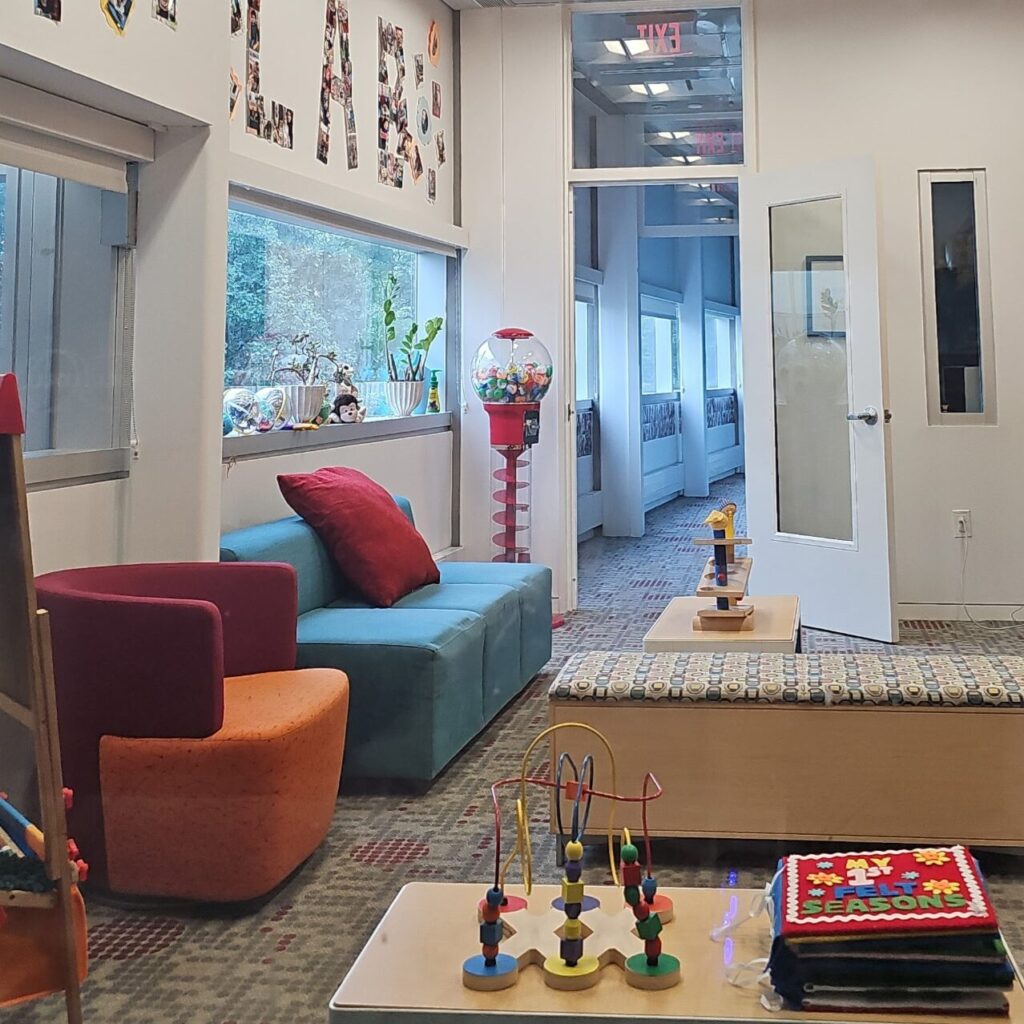
Often, when we picture research, we think of beakers or microscopes. However, the study of humans looks very different. I hope to shine light on social science research, specifically psychology research, at Princeton using my experience at the Princeton Baby Lab.
This summer, I worked alongside five other research assistants in the Princeton Baby Lab, Princeton’s developmental psychology lab. All of the projects in the Baby Lab work towards understanding how we learn language during development. However, the projects used a variety of methods to approach this question.
For example, a visiting junior (from the University of Pittsburg) had returned to the Baby Lab to continue his work on one of the lab’s most important projects: 1KD (the 1,000 days project). The raw data for 1KD is hours of footage of 15 families in their homes over the course of around 1,000 days. After going through significant training on privacy, he worked to code hundreds of 15 second clips for different behaviors and conditions. This work, which may seem tedious, is necessary to make the thousands of hours of footage usable for future researchers inside and outside our lab.
Videos are a popular type of raw data in psychology. A visiting international research assistant and I worked to transcribe. Unlike 1KD, the footage was not taken in a natural setting (like families homes). Instead, the videos we were annotating were recordings of experiments done in the lab. These experiments were focused on the use of language during play sessions. Part of the study’s goal was to observe the kind of language kids were exposed to in these contexts. This is why we were transcribing the parent’s speech in these study sessions.
Another research assistant, a fellow Princeton student, was also focusing on parent speech. However, instead of focusing on the words parents used, he was focused on the amount of stress syllables they used. Stress syllables are emphasized syllables, and studying them allows us to learn more about the role of linguistic rhythm in language development. He was able to apply his musical ear as he listened to hundreds of short audio clips recorded during experimental sessions in the lab.
Most of the examples I have listed so far have a clear connection to language learning: their focus on the environments children develop language in and their analysis of the words spoken around them. However, these recordings are not the only tools used to assess children’s ability to learn new words.
The last research assistant was a senior from the University of Richmond’s psychology department. She had previously worked with eye tracking experiments. These experiments involve a computer zoning in on your pupil and following it as it looks across a screen at various stimuli. She was able to apply her previous experience by running eye tracking experiments with toddlers. These kids would hear novel (fake) names for different pictures on the screen, and then were told to look at the picture that the video asked for. Despite working in the same lab as us, she had a very different summer experience. Instead of working with recordings, she worked directly with kids and an experimental tool.
I also worked with an experimental tool. I worked on a project that utilized fNIRS (or functional near infrared spectroscopy), a neuroimaging technology which uses light to measure brain activity. My grad student’s primary interest is in analyzing the brain activity of babies to better understand brain development, a goal more connected to neuroscience than psychology. This project is one example of how psychology and neuroscience are closely related, including in research.
This summer, I did not just learn more about developmental psychology. I learned about how researchers examine skills that seem innate. Honing in on the specific words parents were using through the transcription process, for example, made me much more aware of my own use of language. The methods I highlight above look at something that many of us take for granted, language, and examine it under a (metaphorical) microscope. This focus on seemingly natural processes is what drew me to developmental psychology in the first place and continues to fuel my interest in studying the human brain.
– Jamilah Araf, Social Sciences Correspondent