
What is the point of studying abroad? Why would you want to leave the Princeton bubble? For me at least, studying abroad in Panamá through the Ecology and Evolutionary Biology (EEB) department was definitely my saving grace. I needed a break from the cold New Jersey winters and from the structured academic life here. So I guess, why should someone who wants to go into research study abroad? What if there aren’t any opportunities to do research abroad? Well, that just depends on the program you do! I was lucky that the EEB department offered a semester-long field research-based course (OIP link), but there are also other study abroad field-based programs out there, like the School for Field Studies! So, if you still aren’t sure if studying abroad is right for you, let me try and convince you further!
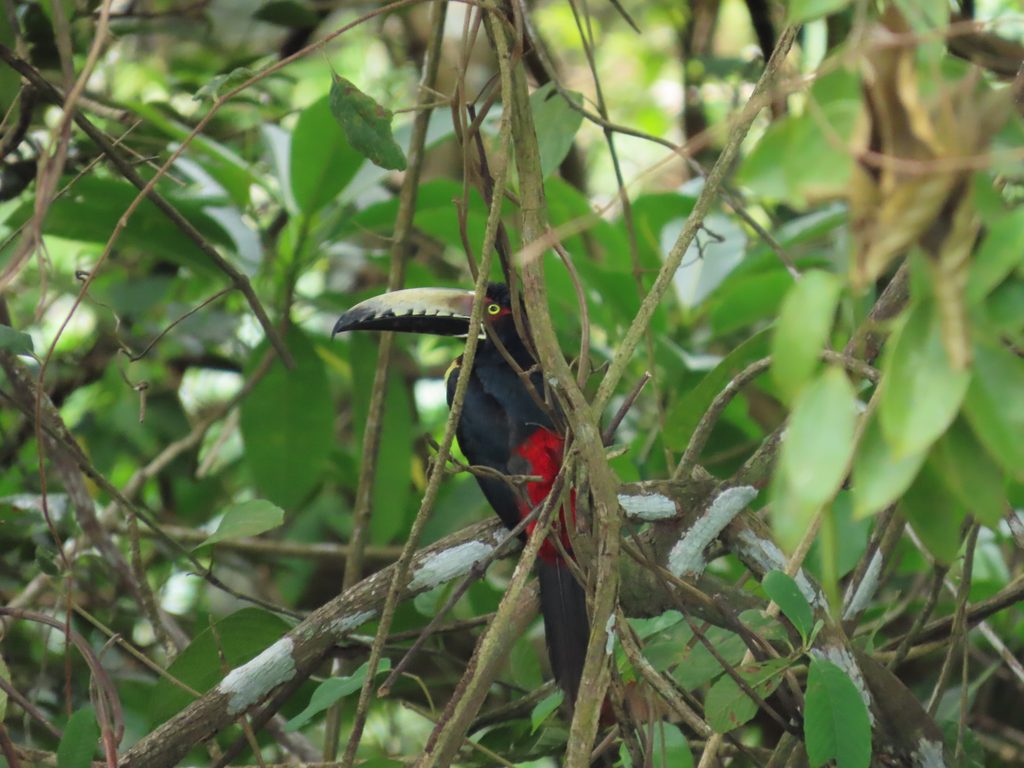
The first (and most obvious reason) I would suggest for someone to do field research abroad is that you can experience a different biome. Before I studied abroad, the only field work I had done was in temperate systems, so I had no experience in other fields. The Panamá field semester was in a tropical ecosystem, so I got to see and experience a wide variety of organisms and interactions I wouldn’t have otherwise seen. It is widely known that ecosystems near the equator experience a higher diversity of organisms, but learning about this in class didn’t really sink in as much as when we were actually there. Every day when I walked to class, I would always make sure to bring my camera, as there was always some animal hanging around the path. And staying in that area for an extended period of time allowed me to see and experience much more than if I only visited for a week or two. It’s always good to try new things, and as a field researcher, I would argue that the more experience, the better you are at discovering what you like/don’t like.
The second reason for doing research abroad is that you become fully immersed in it. Particularly for field biologists, part of your year will be spent for a long time in the field, doing research. In our case, most of our time was spent on Barro Colorado Island (BCI), a small island off the coast of mainland Panamá. On this island, a variety of research was being done a couple of steps outside our dorms. Throughout the island, BCI has a series of trails that people use to find their organism of interest. These trail systems were diverse and extensive, with some having very high hills, others having an easy straight walk, and some having you walk across small streams. We used these trails mostly every day, going out into the field for our various classwork. This included doing a biodiversity survey to find all the organisms we could, following coatis (mammals belonging to the raccoon family) and recording their vocalizations, setting out quadrats (large gridded squares) to measure diameter at breast height of trees and lianas, and recording leaf-cutter ant behaviors at different distances from their colony. This immersion allowed me to learn a lot more about the environment I was working in and the processes involved in it.
Another reason for doing research abroad is that you can meet scientists from all over the world! It’s easy to meet researchers at Princeton, particularly if you work in a lab with them, but making international connections is always advantageous as well. At BCI, we had a communal dining hall where students on the islands ate at the same times/same location as the staff scientists and other graduate students doing research. Because of this, we got to eat meals with people much more knowledgeable and experienced in field research than us, and in turn got to know them and their topics of study better. BCI also had weekly talks called Bambi seminars, where scientists doing research at the Smithsonian Tropical Research Institute (STRI) could present their work and get questions from the audience. In addition to the Bambi seminars, STRI had weekly Tupper talks, where scientists all over the world could come and present their research. These talks were a good place to network and meet new people that we wouldn’t have otherwise met in the United States. Meeting new people and sharing the same love for science and discovery, even though you’re from different countries, was very rewarding and allowed me to feel a stronger sense of belonging in Panamá.
If you’re still on the fence about studying abroad after reading this article, please visit the Office of International Programs! They have a lot of great resources if you are interested or unsure about studying abroad. But if you are interested in field research, or just research in general, do not let that be the reason why you don’t study abroad. There are plenty of ways to study abroad and also do research at the same time, and it can honestly be more rewarding to do research somewhere other than the orange bubble.
— Maya Cabrera, Natural Sciences Correspondent