
I am a Classics major on the pre-medical track, which means I spend roughly equal parts of my intellectual life in ancient texts and clinical/STEM spaces. Most people, when I tell them this, assume I’m describing a contradiction – humanities on one side, medicine on the other, and me shuttling awkwardly between them. How can my work with Ancient Greek and Latin texts possibly inform my time with patients who live in a modern world and are treated with modern medicine? How can all the time I’ve spent thinking about literature, philosophy, and art from different time periods be relevant to my day-to-day life, or my future career as a physician?
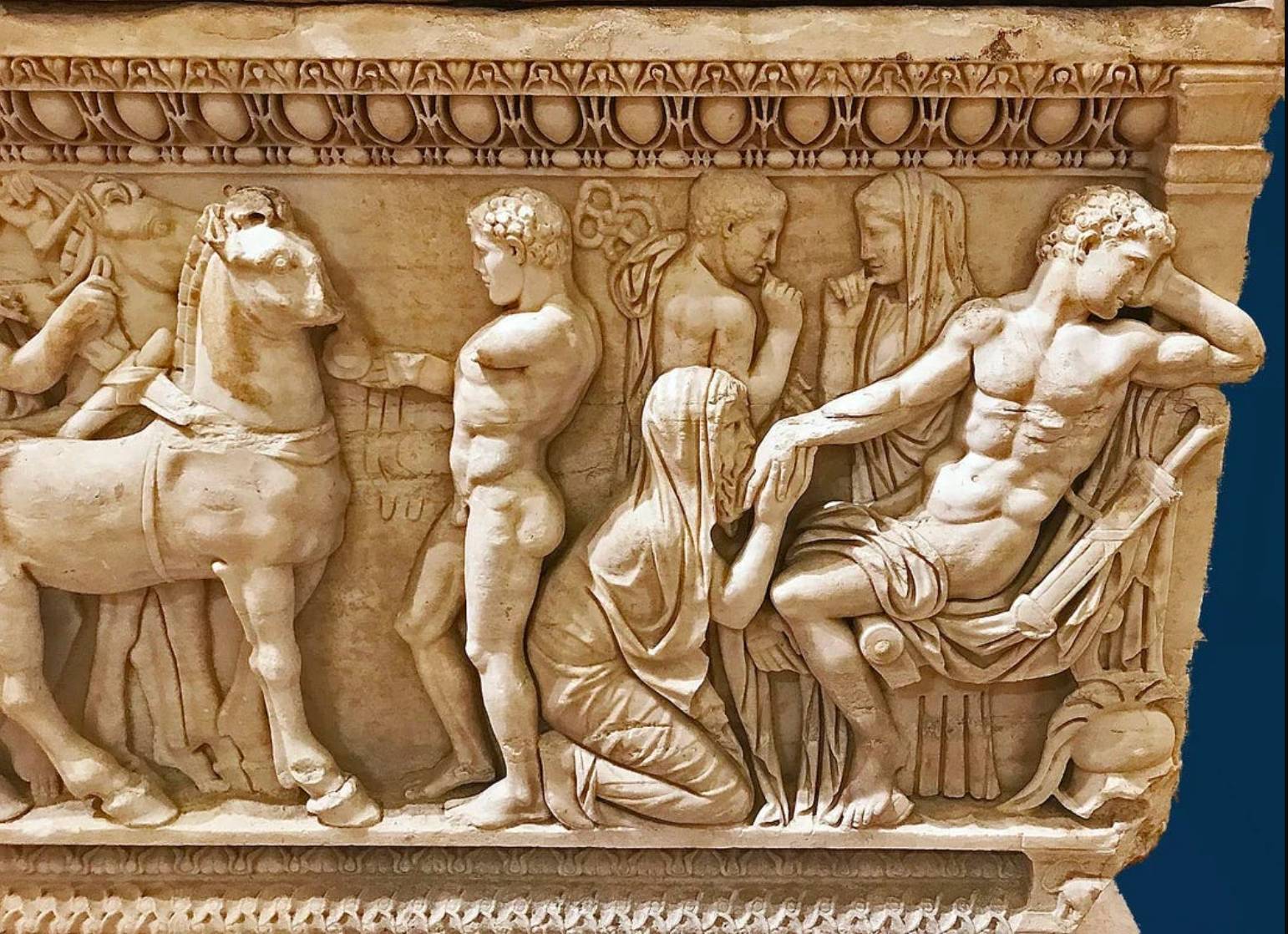
One of my favorite moments in literature occurs near the end of Homer’s Iliad. Achilles has just killed Hector, the Trojan prince, in revenge over the death of his beloved companion. He has desecrated Hector’s body and refused to let the people of Troy mourn their hero. Priam, the king of Troy and Hector’s father, slips through enemy lines in the dead of night and kneels at Achilles’ feet to beg for his son’s body back. The passage reads:
τὼ δὲ μνησαμένω ὃ μὲν Ἕκτορος ἀνδροφόνοιο
κλαῖ᾽ ἁδινὰ προπάροιθε ποδῶν Ἀχιλῆος ἐλυσθείς,
αὐτὰρ Ἀχιλλεὺς κλαῖεν ἑὸν πατέρ᾽, ἄλλοτε δ᾽ αὖτε
Πάτροκλον: τῶν δὲ στοναχὴ κατὰ δώματ᾽ ὀρώρει.
And the two of them mourning, one [Priam] for the man-slaying Hector,
curled up at the feet of Achilles, was weeping thickly,
but Achilles wept for his father, and also
for Patroclus: their wailing stirred up the house.
Homer begins with the dual participle to describe them: τὼ δὲ μνησαμένω, (toh de mnesameno) describing them united as one. A caesura, or metrical break, appears after this word, creating a brief pause as they’re united in grief before the verse pulls them apart. ὃ μὲν… αὐτὰρ (ho men…. autar) – “while he does this, the other one does that,” separates their grief into private tributaries. Priam mourns for Hector, Achilles remembers his own father, and Patroclus. The passage concludes by gathering their sobs back into one: στοναχὴ (stonaché) is in the singular, though still belonging to both (τῶν, or ton, denotes plural possession) as their cries echo through the home.
I love this passage because it demonstrates how suffering is at once irreducibly private and still capable of creating contact between people who share nothing else. Priam and Achilles cannot grieve together in any simple sense. They are on opposite sides of a war; Priam mourns Achilles’ bitterest enemy. Yet they weep together, and they are briefly united in this.
I did not fully appreciate this until I encountered it outside the text.
I volunteer at a free clinic associated with a church, which provides free healthcare to patients who are low-income, undocumented, or navigating addiction and recovery. Before each session, a preacher leads a prayer with everyone in the waiting room. Patients hold hands with each other, eyes closed. People begin describing what burdens them (often extending far beyond the health problems for which they’re at the clinic), sharing their pains and consoling one another. They infuse each other with their own strength and resilience.
Though not Christian myself, this scene always fills me with extraordinary inspiration, calling to mind those lines in the Iliad. I am reminded of the unshareability of much of our pains, despite our desire for companionship as we endure life’s challenges. As I interact with the patients through my work, I thus work to earn their trust and lend a kind ear if they want to discuss their challenges. Empathy is a learnable skill, even for problems which I myself have never experienced, nor can I really solve. Reflecting and applying lessons learned from texts I’ve read has helped me cultivate that skill.
I can think of dozens of such examples in the literature and philosophy I’ve read as part of my coursework here at Princeton. These texts are a source of wisdom for us about the things that matter most in any human life, including a life in medicine. If we take the literary and philosophical lessons we study seriously enough to let them change our behavior, we bring something into our professional lives that no amount of technical training provides on its own.
We are given a tremendous gift and opportunity at Princeton to broaden our intellectual horizons. It is our responsibility and challenge to transform these lessons into our everyday lives as we eventually leave and head out into the world.
–Gabriel Ascoli, Humanities Correspondent
