Digital Mapping in the Humanities and Social Sciences

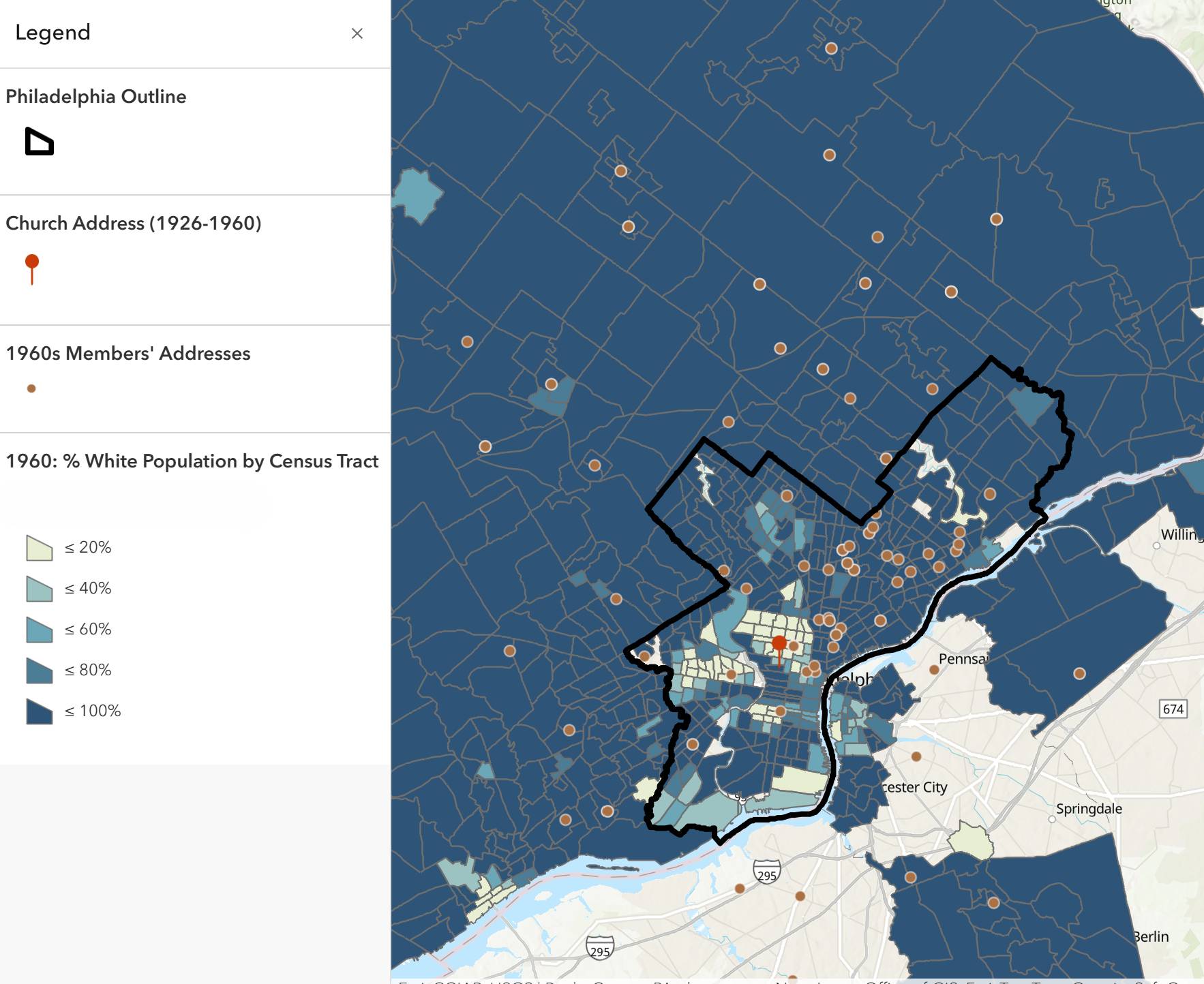
A map of church members' residential address, racial demographic data in each census tract, and an outline of Philadelphia in 1960
This is one of the maps I generated for my project. It demonstrates that, in the 1960s, most church members lived in predominantly white areas and many lived outside of the city of Philadelphia.

In my junior paper, I explored how the racial demographics of a Philadelphia church transformed from exclusively White to predominantly Black within a few short years. I started this project in the archive, looking for any documents that could point to when and how the church’s congregation began to transform. In minutes recorded of church meetings, I identified a period of white flight, where the neighborhood around the church became increasingly non-White, and, in response, many of the church’s White members relocated to the suburbs. I knew that I could describe this congregational migration in a written narrative, but I also wanted my readers to be able to visualize it, so I turned to digital mapping. 

Continue reading Digital Mapping in the Humanities and Social Sciences