
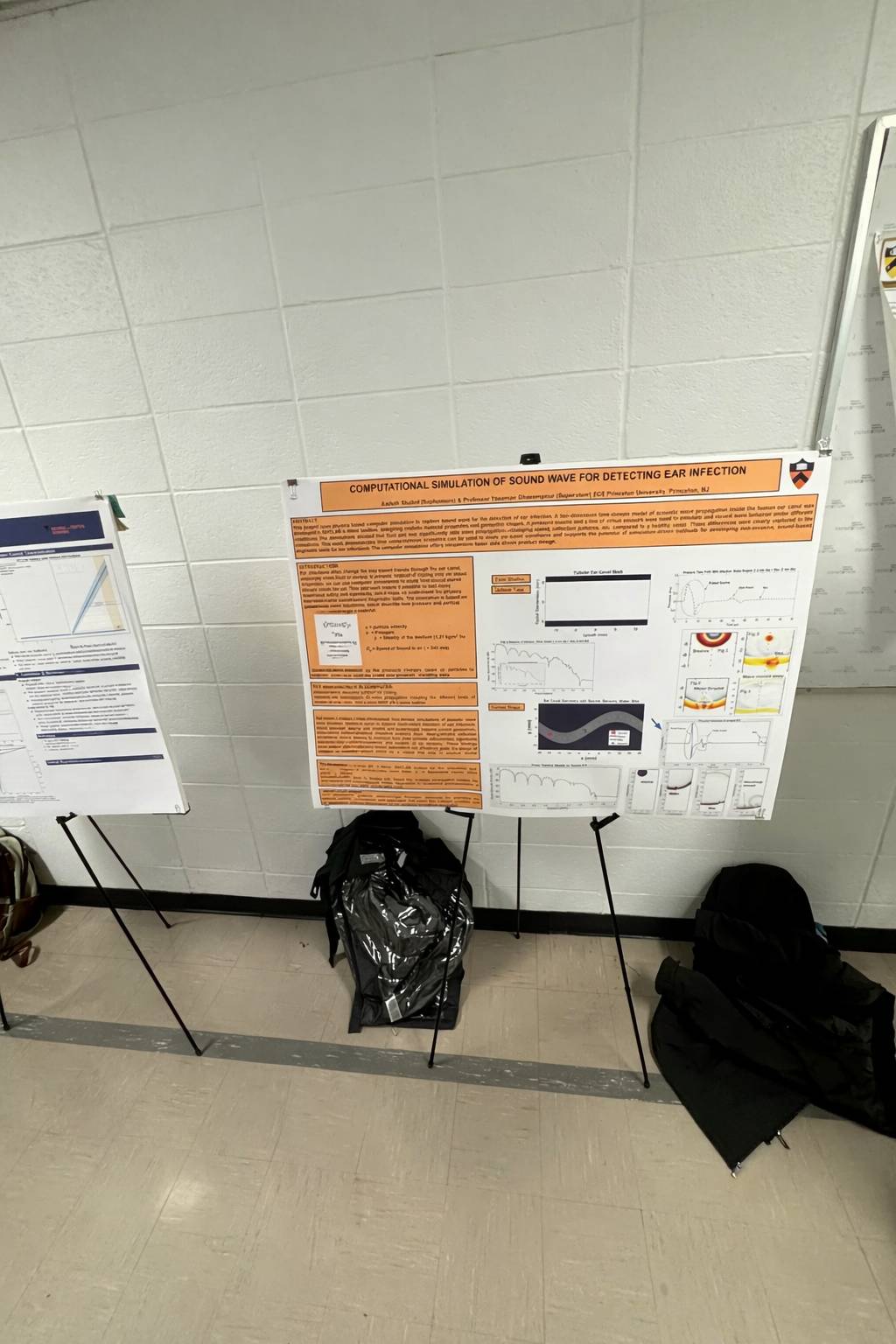
Last semester, as a sophomore in the Electrical and Computer Engineering Department, I completed my first independent research project as part of the Sophomore Independent Work (ECE 298) with Swan Labs, a lab that works on next-generation wireless systems by combining electromagnetics, signal processing, and system-level design to build fast, intelligent, secure, and adaptable wireless technologies. While I had done research in high school before, this was my first time engaging in research within a truly structured academic setting. The experience felt fundamentally different from anything I had done previously, and it reshaped how I understand what research really means.
Unlike traditional coursework, this experience asked me to take full ownership of a research problem, from defining the question to building simulations, debugging code, and interpreting results. My project explored whether sound waves could be used to help detect infections in the ear canal, offering a more objective approach than traditional visual diagnosis.
Ear infections are incredibly common, yet diagnosing them often relies on otoscopic inspection, which can be subjective and sometimes inconclusive. I was drawn to the idea of approaching this problem through physics and computation. By studying how sound waves propagate through the ear canal under healthy, fluid-filled, and wax-blocked conditions, I wanted to see whether infections left behind identifiable acoustic signatures.
Getting Started with Research
From the beginning, this project felt different from my other classes. There was no step-by-step guide and no single correct answer. I started by reading background literature on ear anatomy, acoustics, and existing diagnostic methods. I had to think carefully about how to represent a biological system in a computational model and decide which assumptions were reasonable while still capturing meaningful physics.
I built two-dimensional models of the ear canal, including a straight tube and a curved, S-shaped geometry that more closely resembles real anatomy. Every design choice mattered. Grid resolution, material properties, and geometry all affected how sound waves behaved in the simulations.
Learning Through Simulation
Most of my work took place in MATLAB using the k-Wave toolbox. I implemented time-domain simulations of acoustic wave propagation and worked directly with the physics equations that govern sound waves. Debugging quickly became a major part of the learning process. When simulations behaved unexpectedly, I had to slow down, revisit the equations, and understand what the model was actually doing.
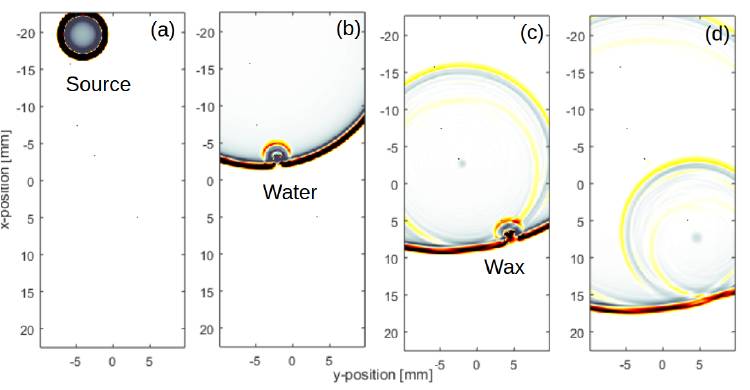
One of the most rewarding parts of the project was being able to visualize the results. Watching sound waves travel through the ear canal and reflect off fluid or wax obstructions made the physics feel much more intuitive. By placing virtual sensors along the canal, I analyzed pressure-time signals and frequency spectra and saw clear differences between healthy and infected conditions.
Ending the Semester with a Poster Session
The course culminated in a poster presentation that brought together both sophomore and junior independent work. Standing next to my poster and explaining my research to professors and peers was one of the highlights of the semester. It was exciting to talk through my project, answer questions, and see how others engaged with the ideas behind it.
Equally inspiring was walking around the room and learning about everyone else’s research. For example, a particularly striking topic was research on Large Language Models (LLMs) and attempting to make smaller and less hefty models. Other topics also included robotic sports mechanics, biosensors and biotechnology, and implementing Neuralink networks, among many others. Seeing the range of topics and approaches reminded me how many directions research can take and how creative and thoughtful my classmates were in their work.
Why I Recommend this Course to Sophomores
Looking back, I would strongly encourage more sophomores to take this course and try research early on. It is a great learning opportunity and a supportive introduction to what research actually looks like in an academic setting. You do not need to have a polished idea or an extensive background going in. The course is designed to help you learn by doing and to grow into the research process over time.
Before this course, I had been exposed to research in high school. Through AP Research, I completed an independent project, and during an internship with EMAnalytic, I worked on applied research that eventually led to a published paper. Those experiences were incredibly valuable and gave me confidence that I enjoyed research. At the same time, they were very different from the kind of academic research this course introduced me to.
In high school and during my internship, the research questions were more clearly defined, and the goals were often tied to a final product or deliverable. There was a stronger emphasis on application and outcomes, and I usually had a clearer sense of what success looked like. In contrast, this course asked me to operate with much more uncertainty. I had to define the scope of my project, justify my assumptions, and decide how to model a complex physical system with no guarantee that my approach would work the first time.
One of the biggest challenges for me was adjusting to that level of openness. When simulations failed or results were unclear, there was no immediate answer key or external benchmark to rely on. I had to learn how to debug patiently, revisit the physics, and trust the process even when progress felt slow. That shift from executing a plan to creating one from scratch was difficult at first, but it ultimately helped me grow the most.
This experience helped me build confidence in working independently, communicating technical ideas, and navigating open-ended problems in a way that felt much closer to real academic research. For sophomores who may have done research before and for those who have not, this course offers a low-pressure but meaningful introduction to research. It creates space to make mistakes, ask questions, and develop the habits needed for more advanced independent work later on.
Looking Ahead
By the end of the semester, I had developed a computational framework that could highlight acoustic differences between healthy and infected ear canal conditions. More importantly, I gained confidence in my ability to tackle complex problems without a predefined path.
This sophomore independent work experience reminded me that engineering is not just about equations or code. It is about curiosity, persistence, and learning how to communicate ideas. Being able to share my work during the poster session and learn from others made the experience feel complete, and it left me excited to continue exploring research in the future.
— Aishah Shahid, Engineering Correspondent
