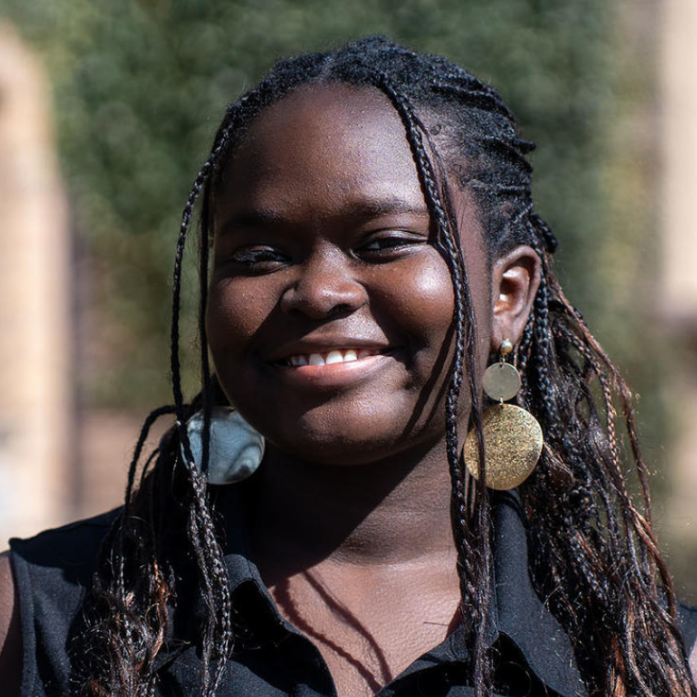
This summer, Khadija Ndiaye, an Electrical and Computer Engineering major, stayed at Princeton to explore a question that affects nearly everyone but often goes unnoticed: how can we keep people comfortable inside buildings while using less energy?
As an undergraduate researcher at Princeton’s Andlinger Center for Energy and the Environment, Khadija worked with the C.H.A.O.S. Lab (Cooling Heating Architecturally Optimized Systems Laboratory) and the Z.E.R.O. Lab (Zero-carbon Energy systems Research and Optimization Lab). Her research brought together ideas from engineering, human physiology, and energy systems to investigate how the human body stores and transfers heat and how that ability could ultimately help buildings use energy more efficiently.
At the center of the project was a surprisingly simple idea. Just as materials can absorb, store, and release heat, so can people. By better understanding this process, researchers may be able to rethink when and how buildings need to be heated and cooled.
Thinking Beyond the Thermostat
Heating and cooling systems are typically designed around maintaining comfortable indoor temperatures. But the amount of energy required to do that, as well as the cost of that energy, can vary significantly throughout the day.
Khadija’s research considered another possibility: rather than waiting until electricity demand and prices are high to heat or cool a space, what if buildings and their occupants could effectively store some of that thermal energy ahead of time?
The idea relies on thermal capacity, or the ability of something to absorb and store heat. By pre-heating or pre-cooling buildings and the people within them when electricity is less expensive, some heating and cooling demand could potentially be shifted away from peak hours. Later, when electricity becomes more expensive or the electrical grid is under greater strain, the stored thermal energy could help maintain comfortable conditions without requiring the same level of immediate energy consumption.
Understanding whether that idea could work, however, first required understanding something much more complicated: the human body.
Modeling the Human Body
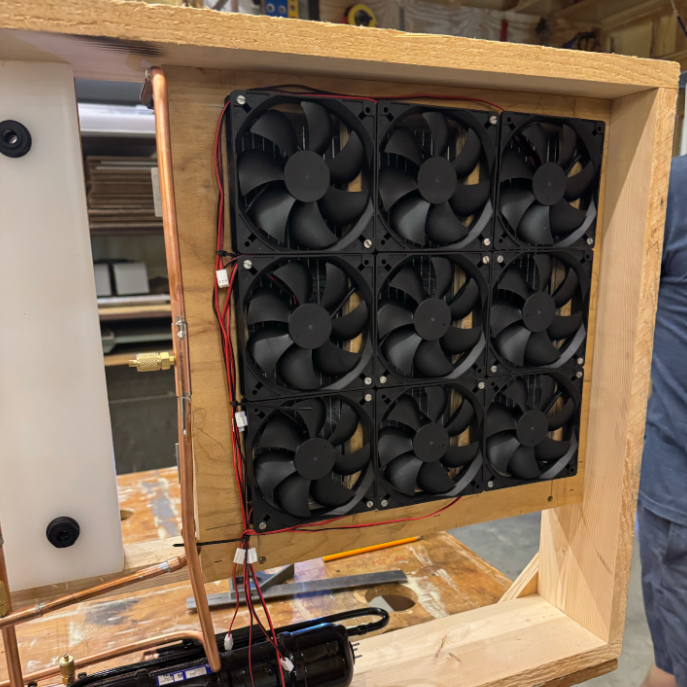
Within the C.H.A.O.S. Lab, Khadija focused on modeling how heat is transferred and stored within the human body.
Humans continuously exchange heat with their surroundings, and thermal comfort depends on much more than simply the temperature displayed on a thermostat. Khadija’s work sought to better understand these transient heat-transfer processes, particularly how the body’s temperature changes over time in response to its environment.
The ultimate goal was to determine how much heat, measured in watts, needs to be provided to occupants to achieve and maintain comfortable thermal conditions.
That understanding could allow heating and cooling systems to respond not simply to the temperature of a room, but to how people actually experience and store heat. Instead of treating occupants as passive recipients of heating and cooling, the research considers them as part of the building’s larger thermal system.
From One Person to the Energy Grid
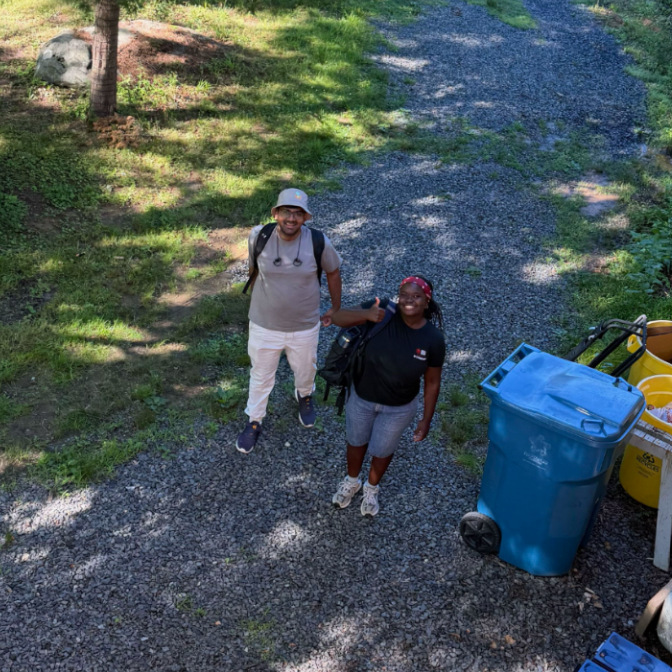
Khadija’s work with the Z.E.R.O. Lab allowed her to consider the same problem on a much larger scale.
While her work with the C.H.A.O.S. Lab focused on understanding heat transfer at the level of the human body, the Z.E.R.O. Lab considers how energy systems can operate efficiently while transitioning toward a zero-carbon future.
There, Khadija explored how the thermal model could eventually be incorporated into a Capacity Expansion Model, or CEM. These models help researchers understand how energy systems can meet future demand and what combination of resources may be needed to do so.
By representing buildings and their occupants as sources of thermal capacity, researchers could potentially give the electrical grid greater flexibility over when energy is consumed. During periods when electricity supply is limited or delayed, some heating and cooling demand could be shifted to another time while still maintaining comfortable conditions for occupants.
In this way, a question about how one person stores heat could eventually contribute to a much larger question about how communities manage energy.
Learning to Question Everything
Although Khadija spent the summer developing technical models, one of her most important lessons had less to do with any particular equation or engineering method.
“I think one of the most important things I learned this summer was to question everything,” she reflected.
That meant questioning scientific facts and research papers, but also conversations with fellow researchers and even her own assumptions. She found that some of her biggest breakthroughs occurred when she slowed down and broke an idea apart, asking herself what she was actually trying to understand and why.
Research also required learning how to define the scope of an open-ended problem. Throughout the summer, Khadija strengthened her ability to read and interpret research spanning physiology and engineering, establish milestones, and decide which questions were most important to pursue.
Unlike a classroom problem, however, research did not necessarily have an answer waiting at the end.
“By nature, we’re trying to answer questions that no one knows, so there is a lot of uncertainty throughout the process,” Khadija explained.
Rather than seeing that uncertainty as something to eliminate immediately, she learned to become more comfortable working within it. A promising direction might ultimately lead nowhere, while an unexpected question could open an entirely new path.
“Being comfortable tackling that uncertainty and following certain paths without knowing exactly where they might lead is essential to uncovering new ideas and knowledge,” she said.
Looking Forward
Khadija’s summer research demonstrated how engineering problems can connect across dramatically different scales. Understanding something as personal as the way a human body experiences heat can have implications for the way a building operates and, eventually, for how an entire electrical grid manages demand.
The experience also gave her a different understanding of what it means to conduct research. Progress was not always about immediately finding the correct answer. Sometimes it meant challenging an assumption, reconsidering a question, or becoming comfortable enough with uncertainty to follow an idea without knowing where it would end.
For Khadija, that process of questioning became one of the most valuable parts of the summer.
Her work with the C.H.A.O.S. and Z.E.R.O. Labs ultimately showed that making our energy systems more efficient may require thinking differently not only about the buildings around us, but also about the people inside them.
— Aishah Shahid, Engineering Correspondent