Categories
Independent Work Present & Publish Findings

Celebrating Senior Theses: An Interview with Claire Ashmead ‘17

In our spring series, Senior Theses: A Celebration, we take a moment in the interlude between thesis deadlines and graduation to appreciate the diverse, personal, and impactful work of seniors’ capstone research projects.

~~~~~~

Claire Ashmead completed two theses this spring: for her History concentration, a comparative study of McCarthyism and the Chinese Cultural Revolution, and, for her Creative Writing certificate, a novella entitled The Camel-Hair Coat. Here she reflects on writing and revising, family and loss, and the completion of her first book.  
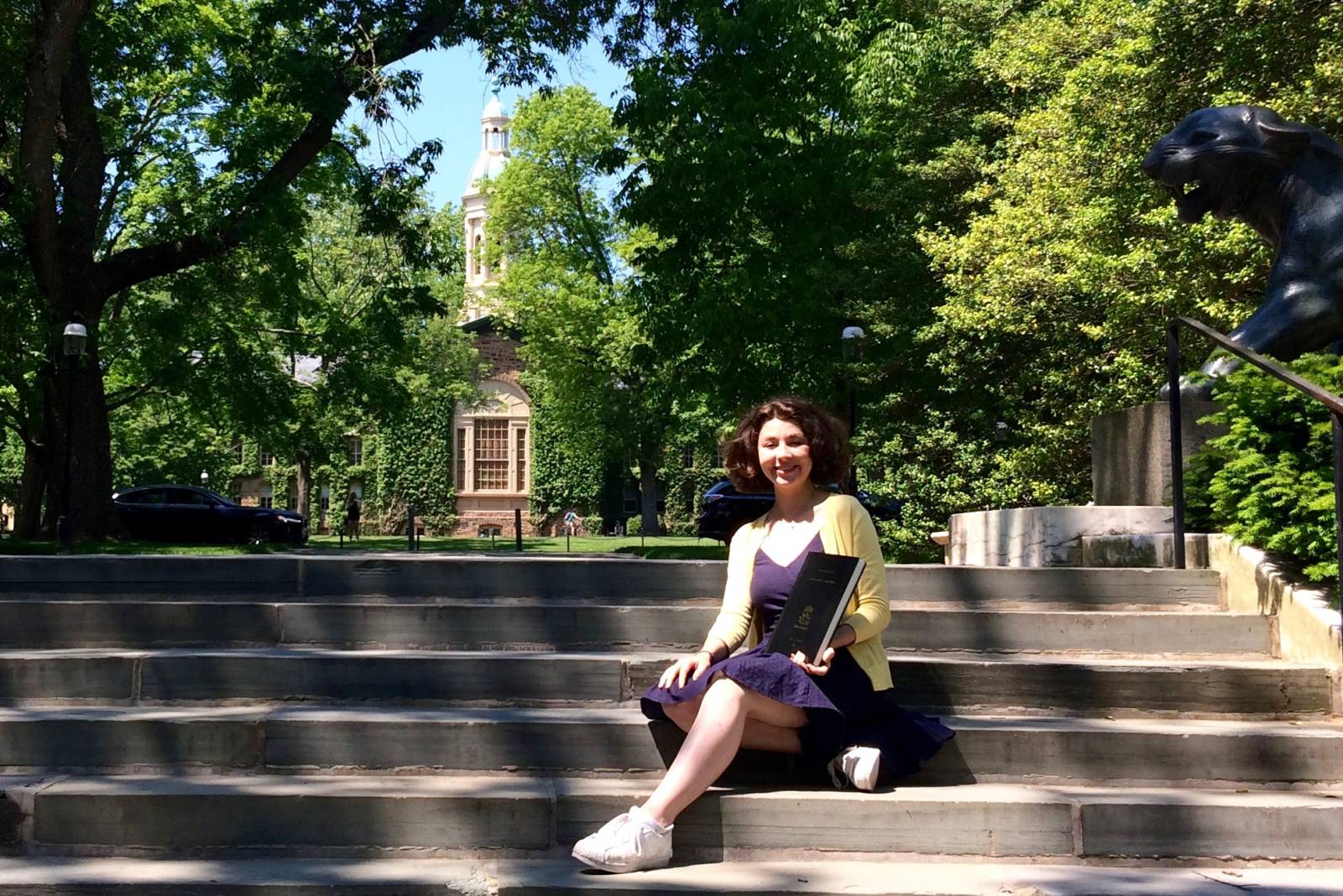
“Any creative product is more bound up with your soul than an academic product. My creative writing thesis is about my relationship with the women in my family, my relationship with space itself.”

What is your novella, The Camel-Hair Coat, about?
It follows a girl, Daphne, who, four years ago, under mysterious circumstances, lost her mother in a terrible accident. Her intense grief over her mother’s death and profound yearning to know why her mother was taken away from her summons the ghost of her mother back from the dead. Daphne is faced with this choice: she can bring her mother back to reality, which she has wanted more desperately than she’s ever wanted anything before, but with terrible consequences for the rest of her family – her sister and grandmother. The price of bringing somebody back might be the exchange of other people you love, and even yourself. But if you really miss somebody – what wouldn’t you do?

How would you distill the book’s themes into a few words?
Grief, wishes, and growing up.

What was the hardest part of writing the book?
How much I had to revise. The book underwent a dramatic transformation, in part because I had two advisers: Joyce Carol Oates in the fall and then Jeffrey Eugenides in the spring. They’re completely different writers, which for me I think ended up being great: Joyce Carol Oates really tries to pull your creativity out of you, and she encouraged me to envision an alternative reality that ended up being a little confusing. Jeffrey Eugenides, on the other hand, is a very linear storyteller. When I gave him my draft, he told me he didn’t really understand what was going on, and that I needed to rewrite.

It was February, and I was hearing from my adviser that the 140 pages I’d generated needed to go. But in another sense that actually felt great.

At first that was very scary. It was February, and I was hearing from my adviser that the 140 pages I’d generated needed to go. But in another sense that actually felt great. I’d had the sneaking suspicion that the story needed a major change, and I wasn’t sure in what way. So I decided to structure it like a four-act play, where each act takes place in one day of one season. Once I had that structure, it was like, bingo! I know how this is going to develop.

In the second writing, I only kept maybe 3% of the words I’d previously written. But because I’d already created the spaces and characters in my head, writing the story the second time around actually took almost no effort, and required much less editing.

How did you juggle writing two separate theses?
It was all about time management. I also really believe that just getting words on a page is so crucial. Often people feel like writing needs to be perfect when it comes out onto the page. My experience writing for Princeton Triangle Club has taught me that actually the hardest part is just starting, and as soon as you begin to write, your thoughts become clearer.

Also, the processes of the two theses were very different, which was helpful – if they were the same it probably would’ve been much more difficult for me to do the two. For my creative thesis, I wrote almost every day. With creative writing, I want to explore characters and change dialogue, so the earlier I get it out, the better. In history, it’s a very different beast: I like getting all of my secondary source reading and research done, getting it all into my head, and then putting it out onto the page. I would research for months and months, and then sit down and write a chapter in a day or two.

Describe your happy place as a writer.
I have a two-room single in Edwards, so I have a room with my bed, and then another with a desk, facing the window. I wake up early, at 6 or 7 a.m., and would either go for a run or just go get coffee at Rojo’s, and then come to my desk in my little monastic sanctuary and write.
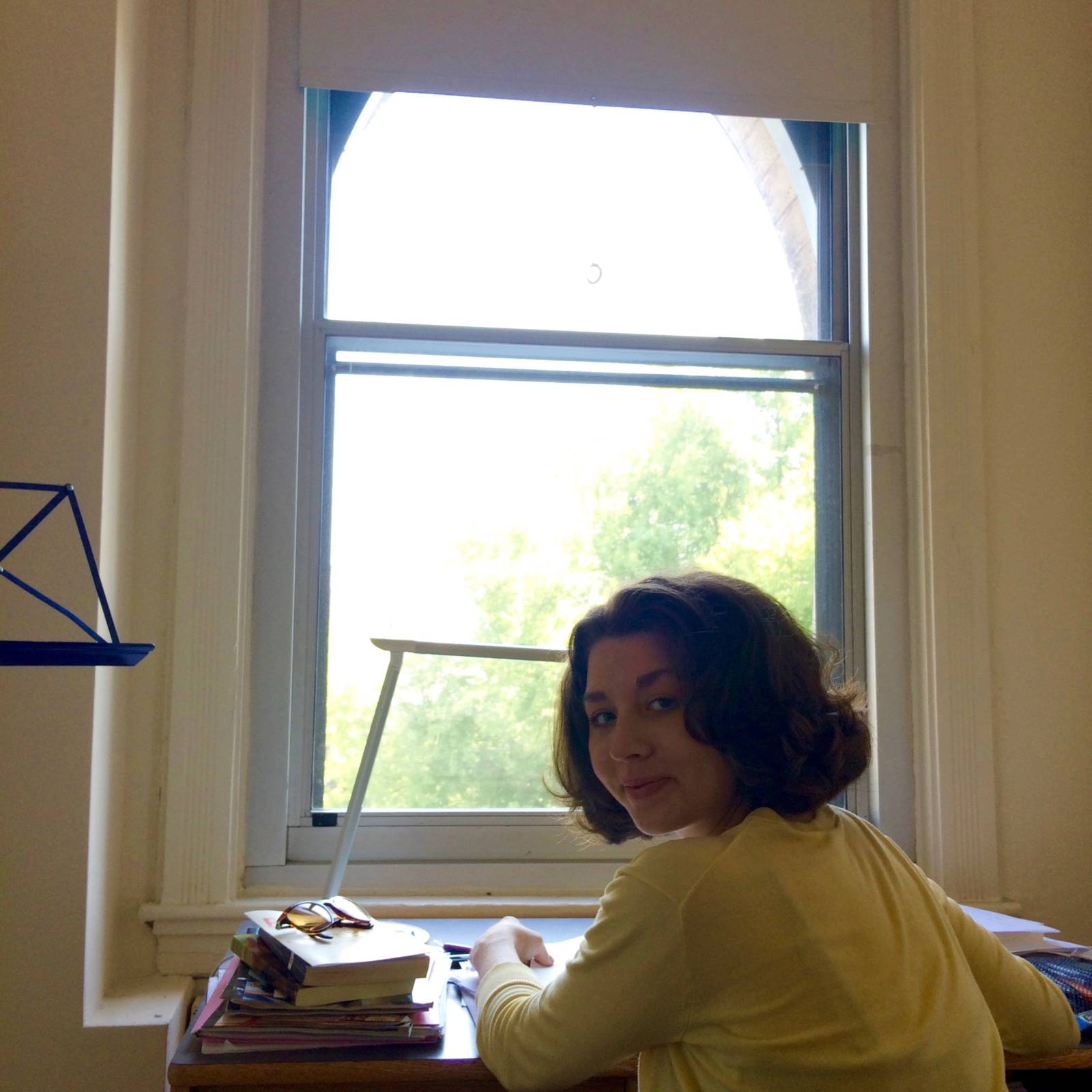
Claire in the “monastic sanctuary” where she drafted her thesis by hand. “I don’t like writing on lined paper,” she told me. “It’s art – I mean, you wouldn’t draw on lined paper, right? You might want to go off in any direction!”

The first time I write something, I write in pen, by hand, on blank sheets of unlined paper. The great thing about writing by hand is that it’s physically exhausting, so you only say what you need to say, and the words you pick are more exact and intentional.

I’d sit down and write for about an hour and a half every morning, which would be about five double-spaced typed pages, sometimes more. The first sentence can sometimes be difficult, but as you start writing, you reenter the world. It’s like learning to ride a bike: you remember it, and you just push forward on the momentum of describing the scene.

The first sentence can sometimes be difficult, but as you start writing, you reenter the world. It’s like learning to ride a bike: you remember it, and you just push forward on the momentum of describing the scene.

Do you have a favorite section of the book?
A lot of the book was plot that I just had to get through, and then there were a few scenes that made me feel that they were exactly why I wrote the book. Here are two paragraphs, after Daphne’s mother has come back and she is able to speak with her mother again.

Her mother took her hands. “At least you’ll have your father to walk you down the aisle. Mine was gone by the time I was your age. I missed him so much.”

“What’s it like?” Daphne asked. “Missing somebody?”

“You know, I’ve never thought about it.” Her mother frowned. “I’d say missing somebody is like remembering to pick up milk at the grocery store. Most of the time, you don’t think about it at all. And then all of a sudden the thought will just occur to you. I’ve got to pick up milk at the grocery store. And the thought will occur to you once a week, every month, every year, for forever. I’ve got to pick up milk at the grocery store. There, that’s it. I think about my father every day.”

If you’d like to read more of The Camel-Hair Coat, you can find it archived – with all senior theses – on the senior thesis digital archive, where it will be available starting after graduation on June 6th, 2017.

— Zoe Sims, Natural Sciences Correspondent
Categories
Conduct Research Independent Work

Retracing my Research Journey

When you’re about to graduate, you spend a lot of time thinking about the future. But you also spend a lot of time thinking about the past.

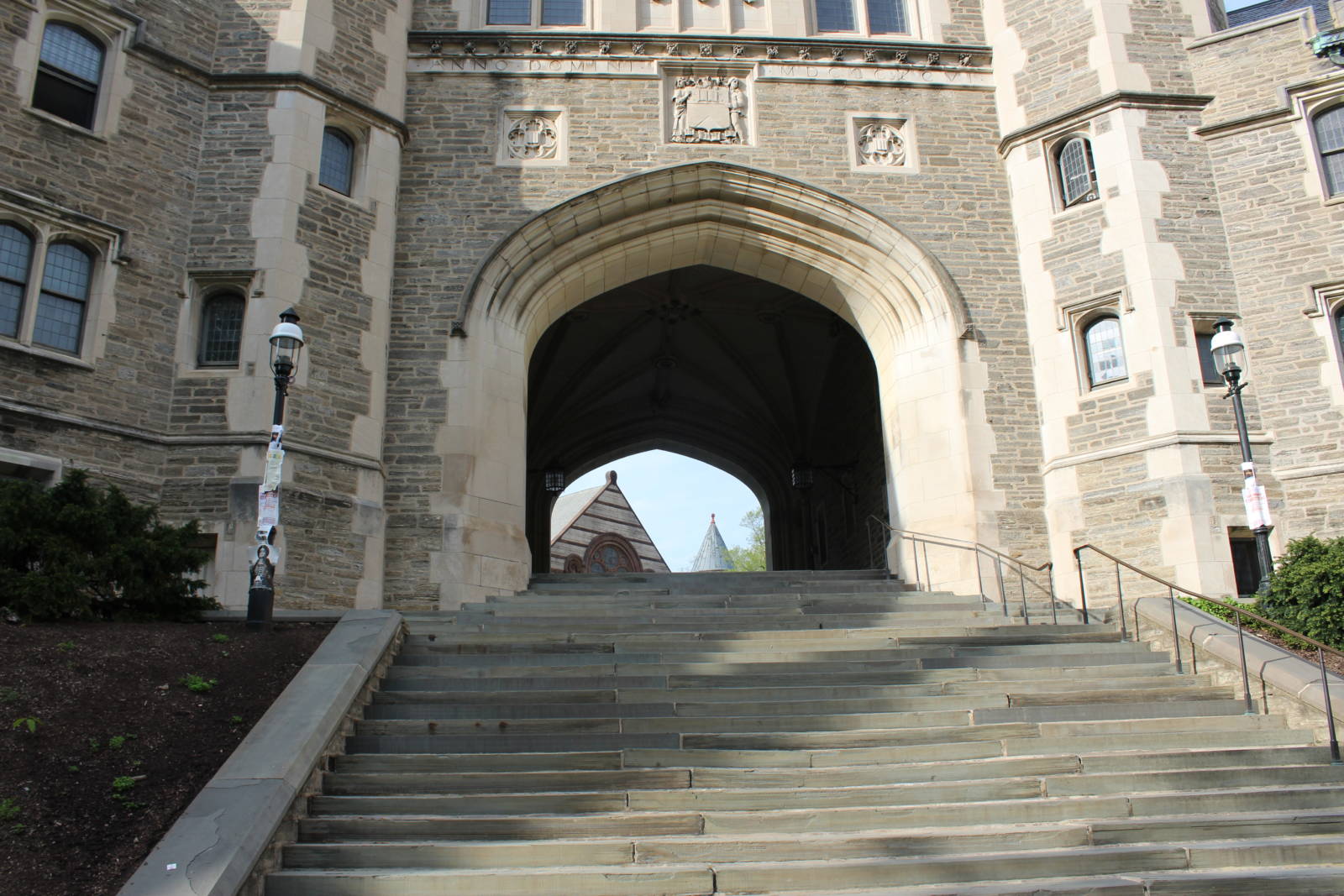
Metaphorical steps were climbed in the journey that inspired this post. Literal steps were climbed to get pictures for it.

Often, this can slip into abstract nostalgia (which I am certainly guilty of). Other times, however, this is focused on something oddly specific. Something you spent a lot of time on. Something like … well, PCUR.

Over the past few days, I’ve thought a lot about the posts I’ve written since my sophomore year. I figured it would be fun to retrace my research journey with the benefit of hindsight.

So that’s what I did.

Categories
Independent Work

Celebrating Senior Theses: An interview with Alex Ford ’17

In our spring series, Senior Theses: A Celebration, we take a moment in the interlude between thesis deadlines and graduation to appreciate the diverse, personal, and impactful work of seniors’ capstone research projects.

~~~~~~

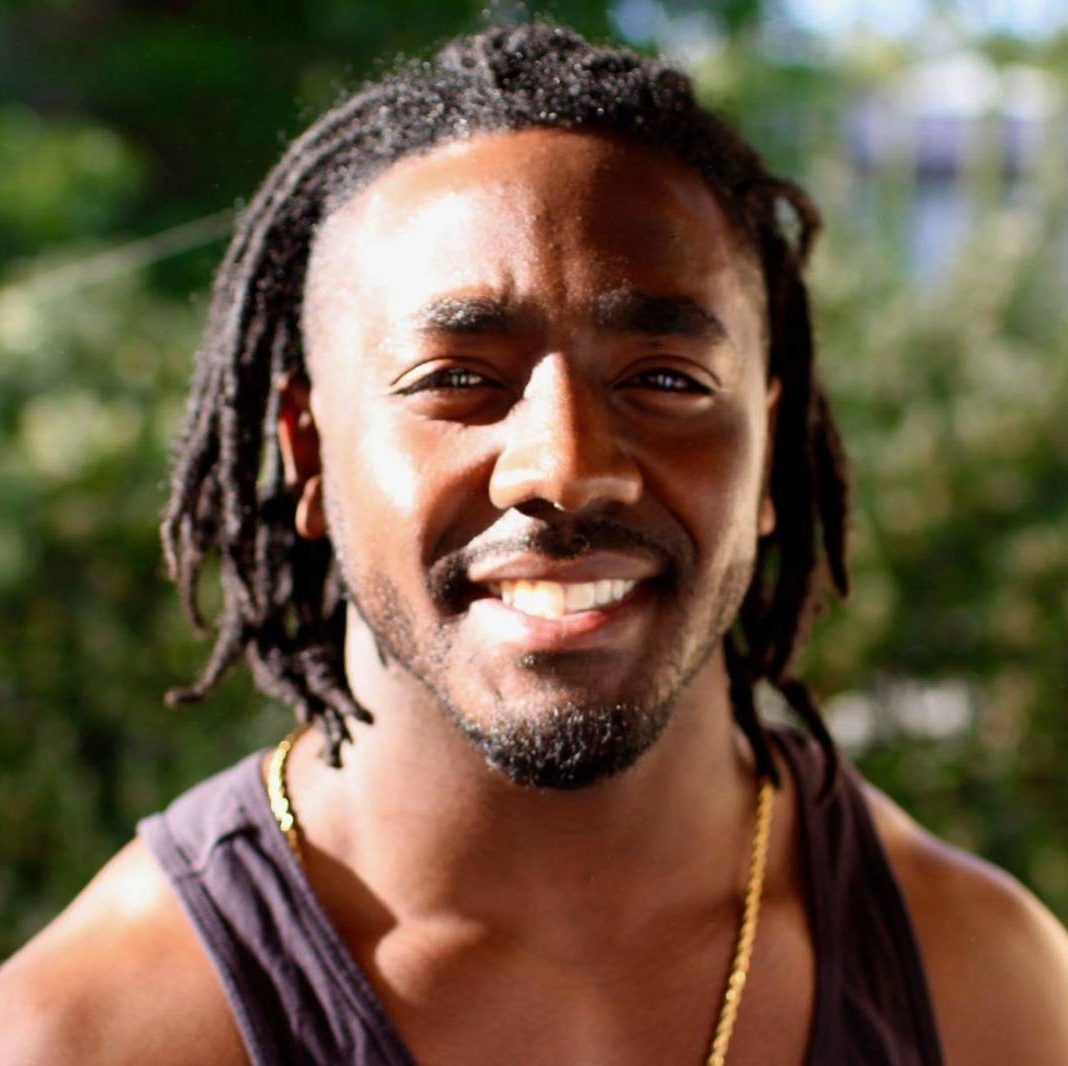
Alex Ford, a senior from Los Angeles

On Thursday, April 20th, the University Student Government presented Zanmim, a short film by Alex Ford ’17 who is a concentrator in Sociology and has a certificate in film studies. After completing both of his theses (a film and a research paper on Haiti), Alex agreed to sit down with PCUR  to talk more about his work. Here’s what he had to say:

Categories
Independent Work

When Work is Playtime: Reflections on the Creative Process

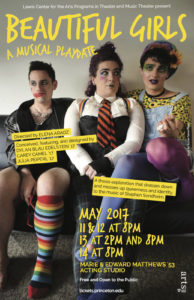
In between classes, extracurriculars, and my Spanish and Portuguese thesis, I’ve spent the last year developing a new musical that runs Thursday May 11 through Sunday May 14 — Beautiful Girls: A Musical Playdate. Developed with two other theater certificate students, the play uses music by Stephen Sondheim to explore themes of friendship, queerness, and identity, and how all of these can and cannot be distilled in the clothes we wear. Looking back on this yearlong project, I realize it has helped me reconnect with what makes both research and creative work so fulfilling: the freedom to explore, improvise, and think beyond what has already been made.

The show runs only 45 minutes. Tickets are free, and may be reserved at: https://tickets.princeton.edu/Online/default.asp

When we started the project, we knew just a couple things about the show: 1) There would be only three actors: the three thesis students. 2) We would use songs by the versatile composer Stephen Sondheim. 3) We would queer this material by performing songs from a number of Sondheim’s shows, regardless of each character’s gender, personality, or “type.”

At our first production meeting, Vince, the music director, suggested it could be wildly fun to put our own mark on each song: adding voice parts to solos, layering different songs on top of each other, or even changing musical styles. This would require weekly sessions for musical improvisation. Rather than calling these “music rehearsals,” which implied some sort of set music to learn, we decided to call them “musical playdates.”

Categories
Independent Work

Productivity Apps: Which Ones Can Help You Through the Rest of the Semester

My favorite productivity app!

With the end of the semester and summer around the corner, it is hard to keep track of work when all you want to do is spend time outside. That said, there are still ways of staying on top of your daily tasks while keeping your plans to lounge in the grass. As opposed to giving tips on how to make your work sessions as efficient as possible, this week, I’d like to recommend a few apps to help manage your work.

Categories
Independent Work

Tackling Big Projects: The Power of the Done List

This week, I’m finishing my thesis. It feels like a small miracle (or maybe a big one) to be putting the final touches on this project — the longest one I’ve ever started, let alone finished. But I should tell you that I sort of lied in the title of this post: there has been no tackling involved.

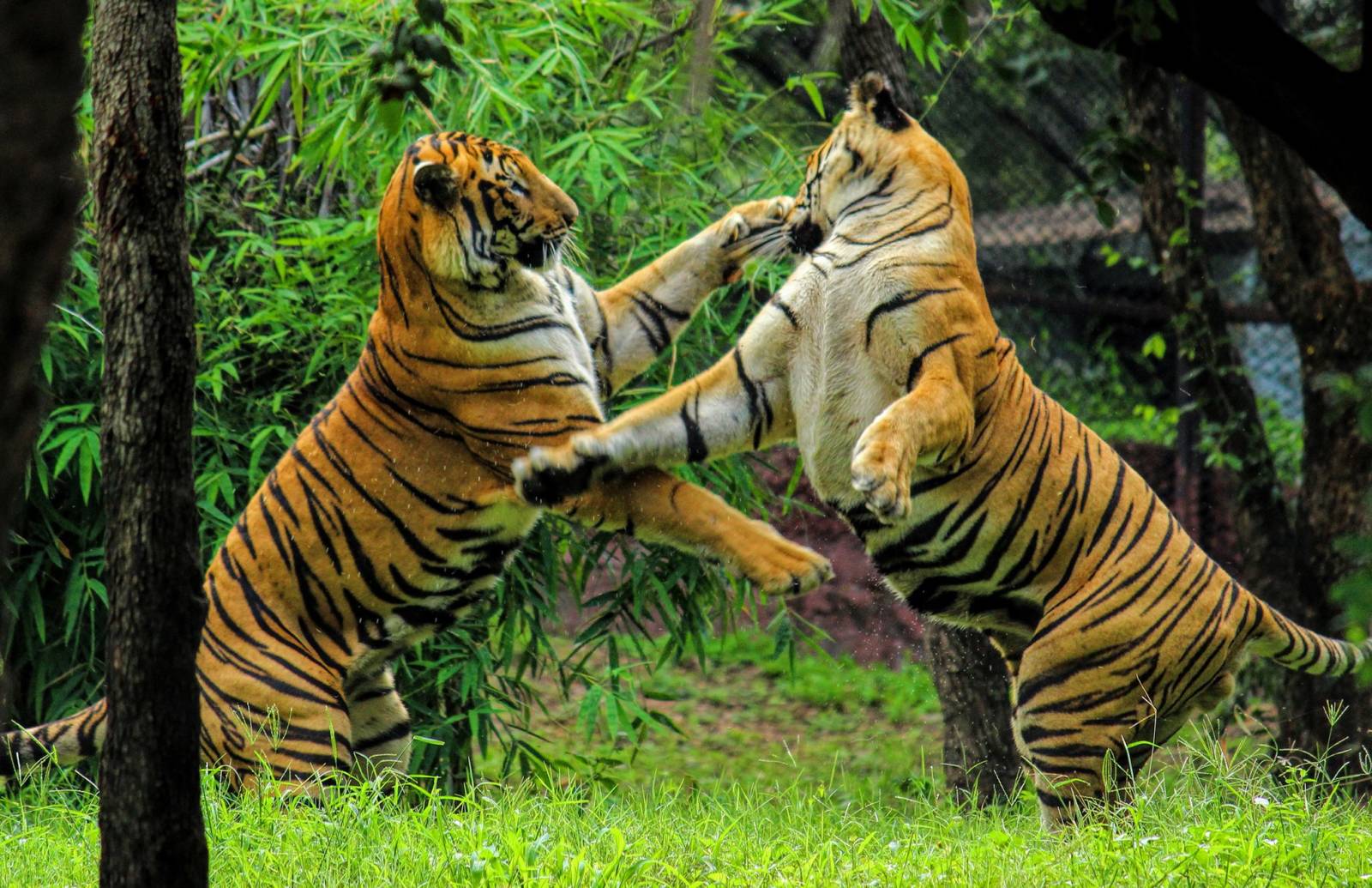
How I’d like to take on my thesis.

After many valiant efforts, the situation has come to remind me of childhood wrestling matches with my older brother. The harder I’d throw my tiny, indignant fists, the harder he’d laugh at me. Sometimes, I imagine my thesis doing the same. I sit down determined to blast out a full section, but instead find some trivial inconsistency in my figure formatting, and tumble into a coding wormhole trying to fix it. I reemerge hours later, much as my 6-year-old self did after every sibling tussle: frustrated, exhausted, and confused about how this has happened to me again. It feels like the hours have been stolen from me, along with my dreams of a completed Chapter 3. It’s easy to get lost in the project, which leaves me feeling like my hours of focused work are worthless.

Thesis to my tackling attempts: “nice try.”

Enter the Done List.

The McGraw Center teaches the “salami method” of to-do-list management: break each task into small, specific, salami-thin slices. Splitting items that may take many, many hours (“Write rough draft”) into those that take 30 minutes or less (“Write thesis statement,” “Fix axis on Figure 4”) makes progress seem more achievable.

This is great advice, but I’ve recently run into problems using the salami method on my thesis. One issue is that the number of slices I need is simply overwhelming. And then there’s the lunchmeat that flies in out of left field: new papers I come across, bugs in my code, figure formatting that ends up taking ages. Because I’m doing a lot of things for the first time, it’s hard to know how long it all will take – and easy to overlook tasks that end up being very time-consuming.

So, on a friend’s recommendation, I’ve started keeping a “Done List” – a catalogue of the things I’ve done, alongside the list of things I need to do. My Done List is the sworn enemy of data wormholes and literature vacuums. Instead of getting discouraged that I haven’t checked “finish discussion” off my to-do list yet, the Done List reminds me to recognize that I have downloaded three papers on phosphate limitation. One step towards understanding the literature. Check!

I now write a Done List and To-Do list in parallel, and I’ve found this approach useful for small and large projects alike. The two lists are important for different reasons: my to-do list keeps me looking ahead, while my Done List reminds me to appreciate my progress so far. Even when the steps are small, recognizing the “done” keeps me thinking positively, which helps motivate the next step, and the next. Maybe that’s not how to take down a world-class wrestler (or an older brother). But, fortunately, I don’t have to tackle anything; I just have to write a thesis. And I can do that, one little “done” at a time.

— Zoe Sims, Natural Sciences Correspondent
Categories
Independent Work

Celebrating Senior Theses: An interview with Aubree Andres ’17

In our spring series, Senior Theses: A Celebration, we take a moment in the interlude between thesis deadlines and graduation to appreciate the diverse, personal, and impactful work of seniors’ capstone research projects.

~~~~~~

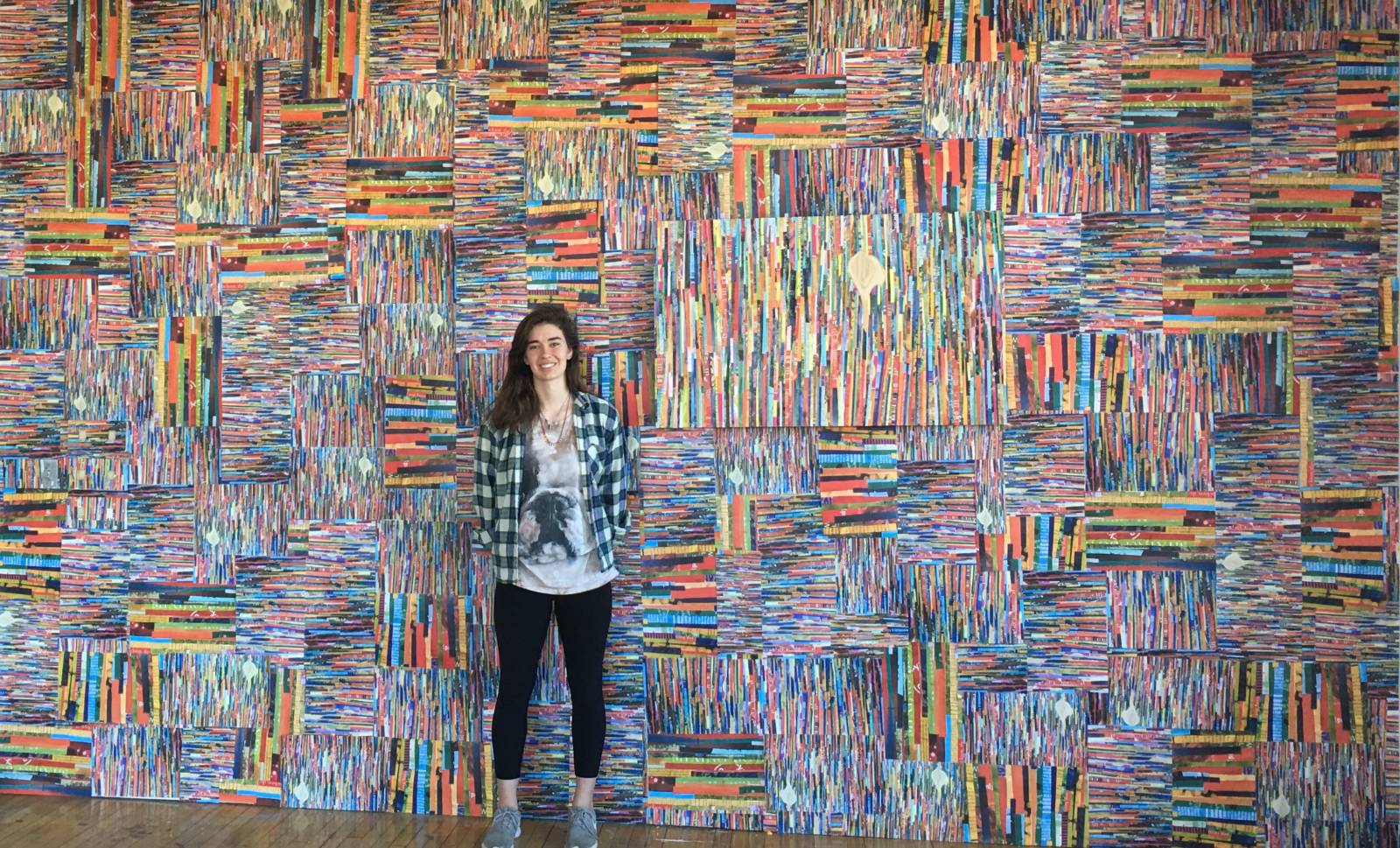
Aubree Andres ’17 is an Anthropology concentrator with a certificate in visual arts. Here, she shares the story behind her visual arts thesis, an installation that transformed a room in the Lewis Center into a kaleidoscope of color and collage. The installation is titled after Aubree’s favorite non-word: &Thunk.

Aubree, a senior from Cambridge, Massachusetts, stands with one of the completed walls in her thesis exhibition. The panels are a collage of strips she cut from fashion magazines, interweaving images and words. 

What is your thesis about?
The intersection between chaos and control, the complications with human memory and fragmented narrative, and giving the viewer a lot to get lost in.

Tell me about the space where you created your thesis.
I share a studio in Lewis with two other girls in the program. It’s facing Nassau Street, so we get tons of natural light. The heater’s broken, so it’s always really cold. But it’s just – it’s a mess, in the best way. The floors have been splattered with paint for years before you’ve been there. You know, each year, every studio is made to reflect the humans that are living and working there. It’s like moving into a dorm room, with the history of all the people who have lived there before you – except it’s a dorm room with no repercussions for throwing paint everywhere. You can tell it’s a space to get chaotic and messy.

What are the things you can’t thesis without?
Mod Podge [a collaging glue]. Scissors. Lots of magazines. I mostly used fashion magazines – Vogue, and a bunch of old Oprah magazines from my mom. I spent hours and hours in the studio, often with friends, flipping through magazines…putting the show together was very different from the normal kind of stress I feel at Princeton. Oh, and I listened to a lot of music. Music is the real MVP.

What’s the soundtrack of your thesis?
A lot of Hamilton, relaxing folky music, and long, random mixtapes. The three albums I listened to the most were Always this Late by Odesza, Malibu by Anderson Paak, and In Colour by Jamie xx.

“My mom is probably the most influential creative force in my life. She and I had done mosaics in the past – not on this scale or style – but I took a lot of my pieces home over winter break, and we laid down the papers and talked about it. That’s when a lot of the work started to come together.”

Did you have an Aha! moment in your artistic process?
The weekend I installed the project, my parents had come down to help out, and it was an exhausting two days. My “Aha! moment” came just after I’d installed both of my bigger walls in the space, and then brought my beanbags in and sat down. My mom has a picture of me passed out there in a beanbag chair. When I woke up there, in that space, I realized: wow – I’ve done it. I’ve created something that I could look at forever.

“When I woke up there, in that space, I realized: wow – I’ve done it. I’ve created something that I could look at forever.”

What’s one thing you would do differently if you were to start again from the beginning?
I was way too nervous at the beginning about what I was ultimately going to do. With a thesis and a whole installation it’s hard to see the endpoint from the very beginning, and I put way too much pressure on myself to perform – all with Mod Podge and paper, these most basic materials! I learned that not knowing where you’re going to end up is totally fine.

— Interview by Zoe Sims, Natural Sciences Correspondent
Categories
Independent Work

Effective Study Habits for Independent Work

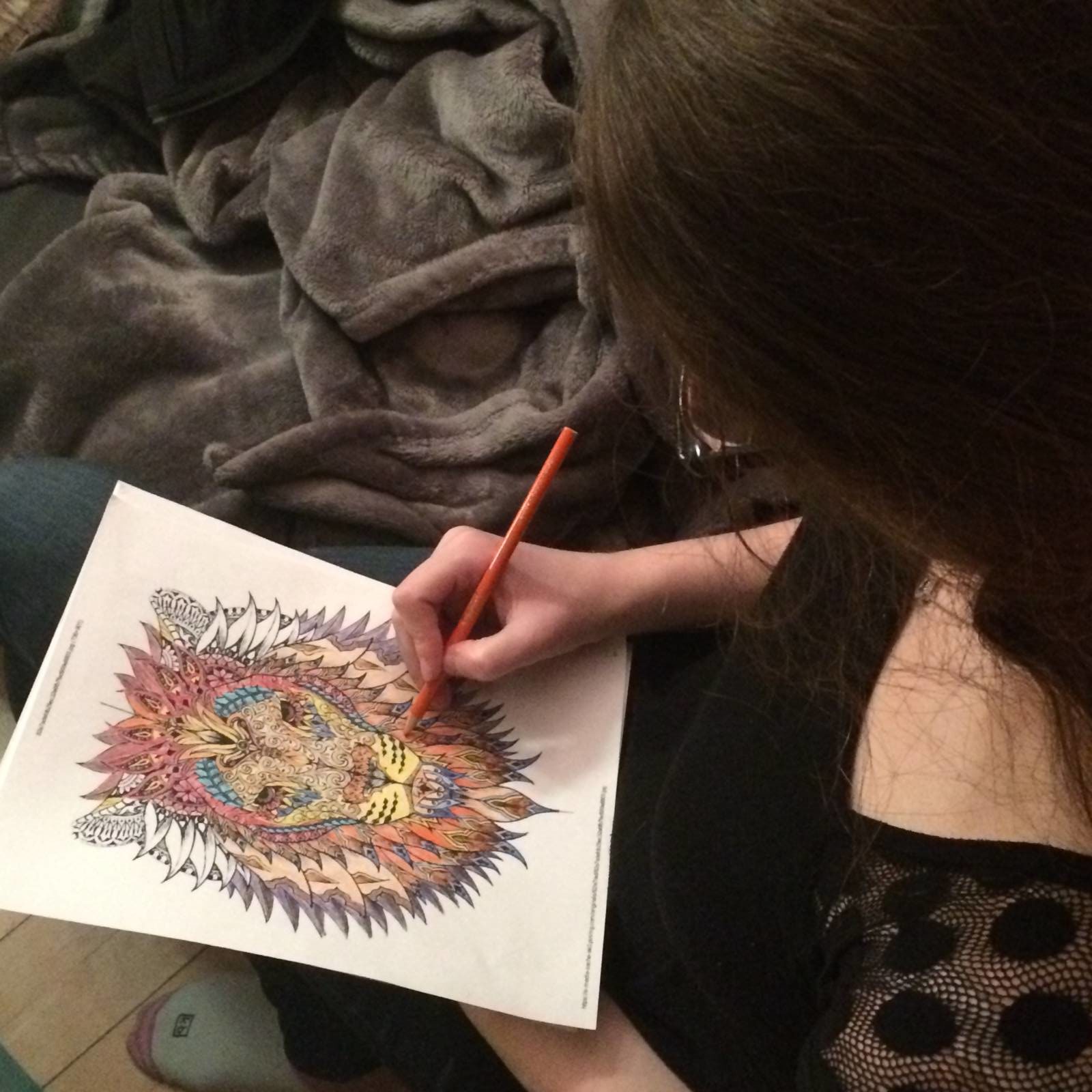
Taking a study break to color!

April has finally arrived, which means that the deadlines for theses and junior papers are quickly approaching (cue the dramatic music)! While teachers and advisers may be reminding you to pace yourselves and to still find time to relax, this post is for those who are grinding through their work and may even be (dare I say it) binge writing. Whether you fall into this category or not, brushing up on some effective work habits can be helpful in all parts of academic life. With that said, here are a few strategies that I have found make my writing sessions as efficient as possible:

Categories
Independent Work

Structuring Senior Year: Choosing Courses

The registrar will soon be releasing fall course offerings. Even as spring semester continues full speed ahead, many juniors are beginning to think about the coming year. Especially for A.B. seniors, who take only six classes, the questions of which to take, how many to take, and how to balance them with a thesis and post-graduation plans, all loom. Remembering how I, as a second semester junior, relied on advice from outgoing seniors, I decided to compile some of my own reflections on approaching coursework in senior year.

Three-three or four-two? For most A.B. students, senior year is the only time we take six courses, rather than eight or nine, to make more time for independent research. We may divide these courses in two ways: three each semester; or four in the first, two in the second. This decision may come down to a number of factors, including: your ability to plan ahead and pace your work, your spring extracurricular conflicts, and your research requirements (for some, scheduling lab work is an important consideration). Personally, I am so grateful for my decision to take four and then two. Especially since I have two theses — one for the Spanish and Portuguese concentration, and a thesis play for the theater certificate — I appreciate the lighter course load.

Final requirements? As you select final courses, narrowing down the choices can seem impossible. Before you make any decisions, first consult your departmental, certificate, and distribution requirements. Many departments have advising tools and calendars to help keep you on track. If you have any prerequisites left, check if these courses are only offered one semester. Senior fall, for instance, was my last opportunity to take ANT 300, a requirement for the Ethnography certificate. Having this in my schedule helped me limit my other choices.

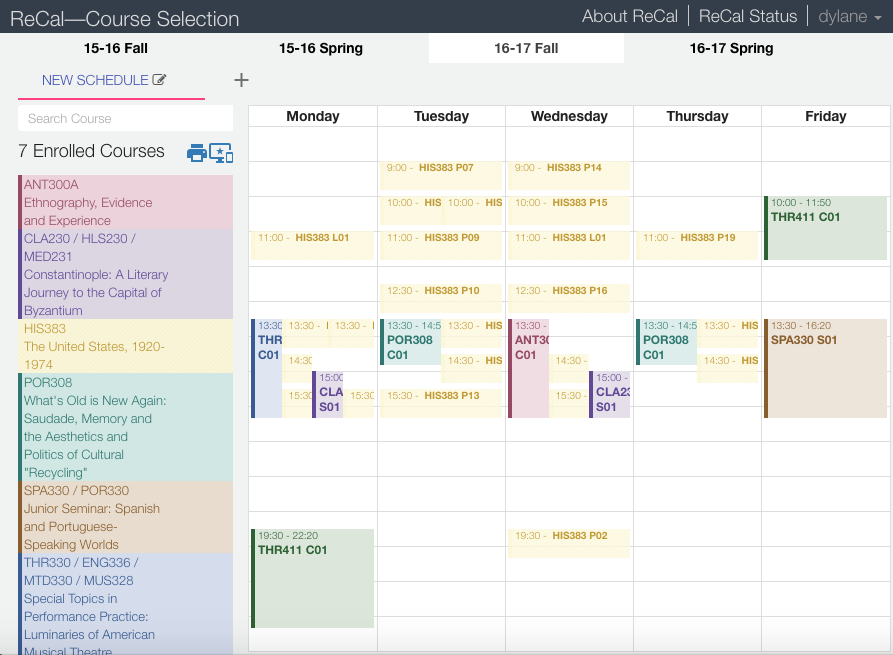
One tool that might help with course selection is recal.io, which allows you to develop a potential class schedule. Here is the schedule I developed last year at this time for my senior fall.
Categories
Conduct Research Independent Work

Water Whispering: Memoir of a Winter in the Lab

February 28. I’m sitting in the basement of Guyot Hall, grinding dried algae with a mortar and pestle.

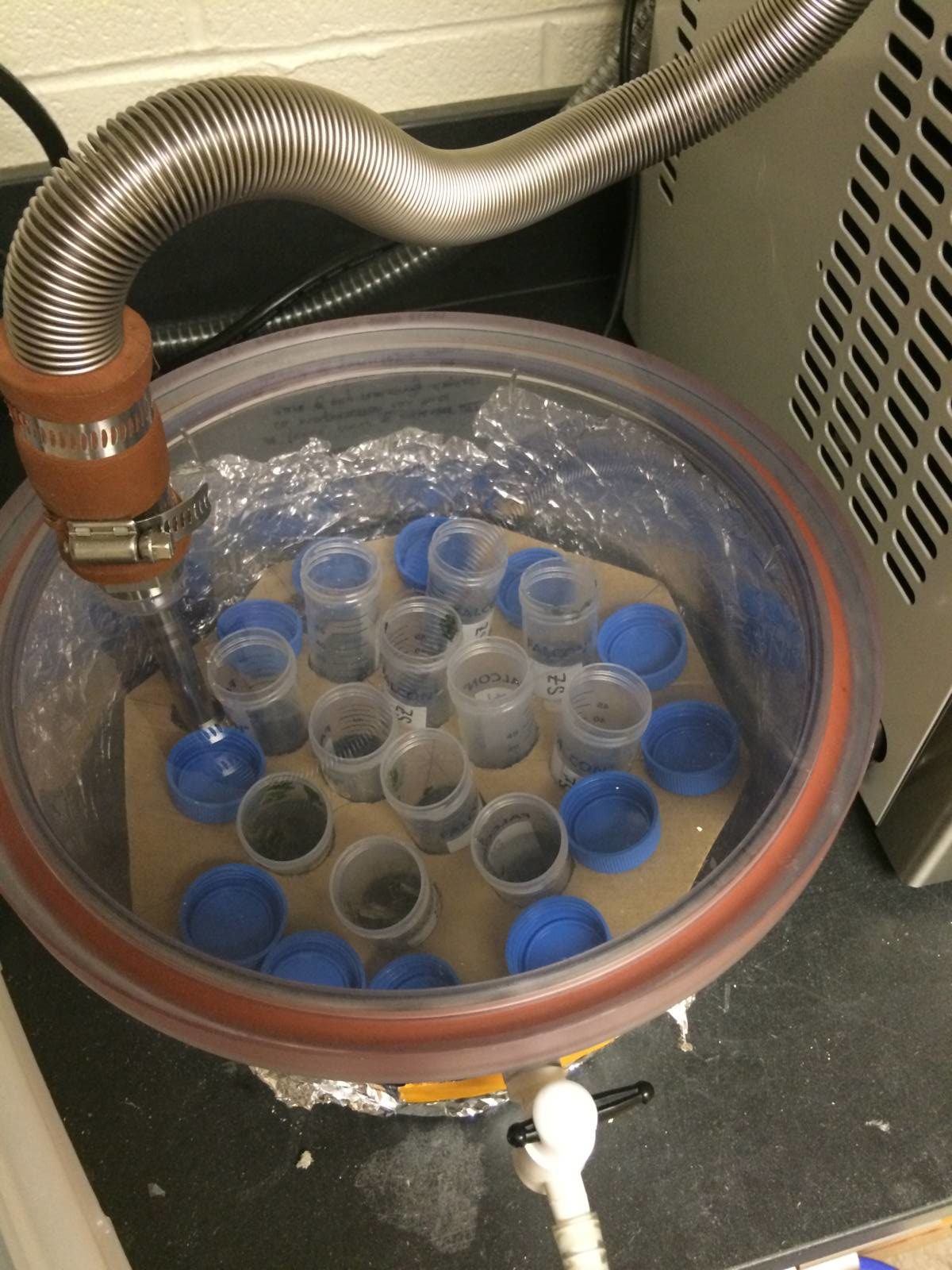
Vials of algae in the freeze-drier – the first stage of analysis.

At this stage, Caulerpa racemosa, the Green Grape Alga, no longer looks its name. In its natural habitat, Caulerpa’s short stalks bob in the water like clumps of balloons. Its round “leaves” are clustered around the stalks just like green grapes, if grapes were the size of pinheads. But by now I’ve freeze-dried these samples so they are shriveled and stiff, and once I’m done grinding them, the plants are reduced to a uniformly fine olive-green powder.

This is what science looks like for me this winter. It’s not simmering test tubes or even statistics: just the incremental alchemy of water samples and crusty Caulerpa into numbers with the potential to tell a reef’s story.

At a recent job interview, I was asked to talk about the lessons I’ve taken away from my research. One image that came to mind was that of my water samples: the hundred or so bottles that I filled in the ocean in Bermuda, carried back to Princeton in a cumbersome cooler, and spent much of this winter analyzing in the lab. Lined up in the freezer, the bottles are identical but for their labels. These bottles contain the most important data I have – and, for months, they’ve looked exactly like identical bottles of water.

But identical they are not. After many a long lab day, I have numbers to crunch – each bottle associated with nutrient concentrations and nitrogen isotope data that begin to tell the reef’s secrets.  These nutrient data represent the raw materials available to plants and animals on the reef. The isotope data help determine where those raw materials have come from, and what organisms are using them. In my thesis, I am studying how nutrient pollution coming from human sewage changes the geochemistry of Bermuda’s reefs, affecting reef organisms, like Caulerpa, that use those nutrients. This has the potential to shift the ecosystem’s balance: nutrient enrichment puts reef-building corals at a disadvantage, threatening the intricate, biodiverse communities – of anemones and angelfish and everything in between – that corals support.

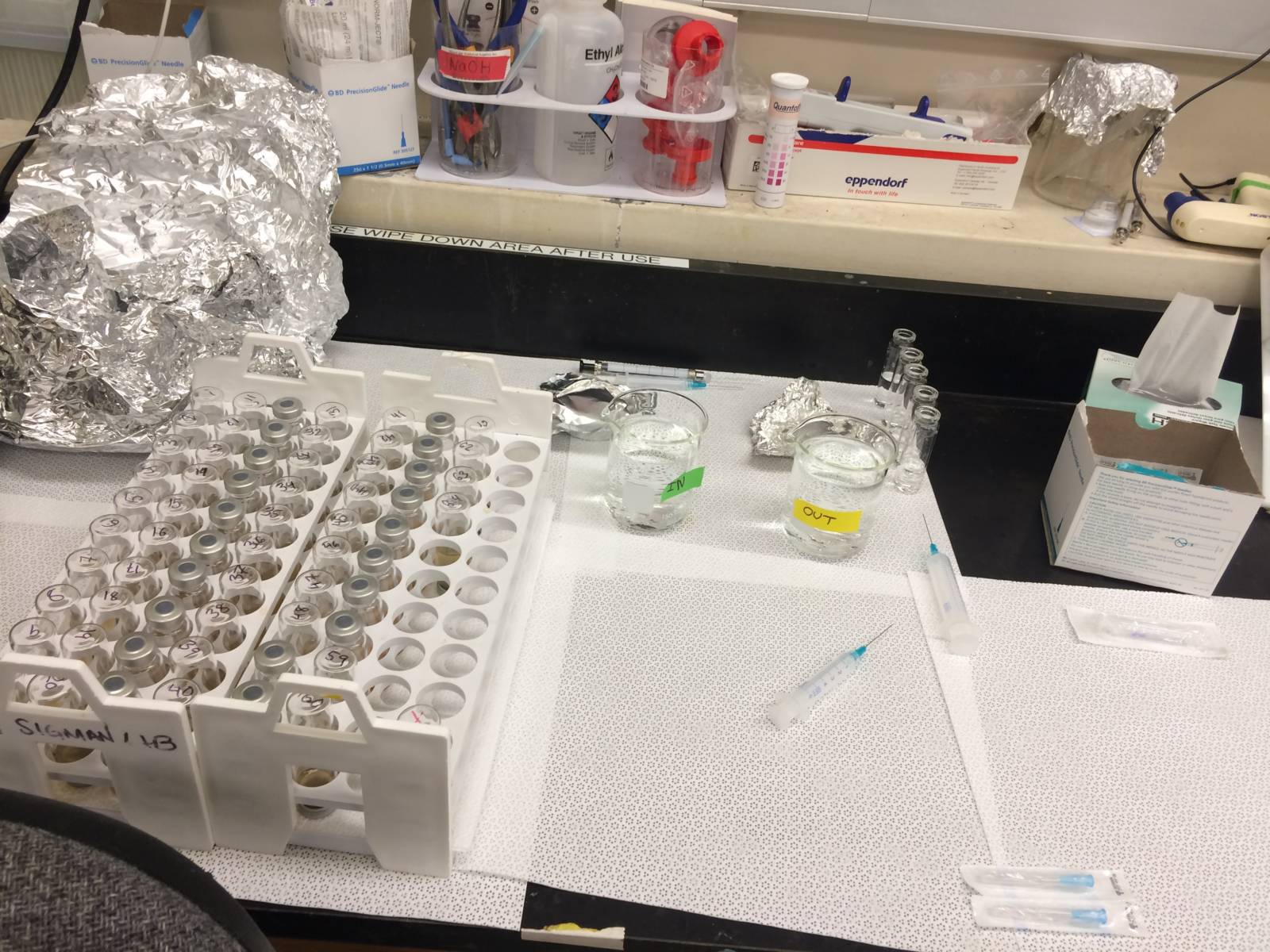
A set of water samples mid-way through vial injections for isotopic analysis.