Categories
Conduct Research

Inside the Neuroscience Lab: How Core Lab is Shaping My Research Journey

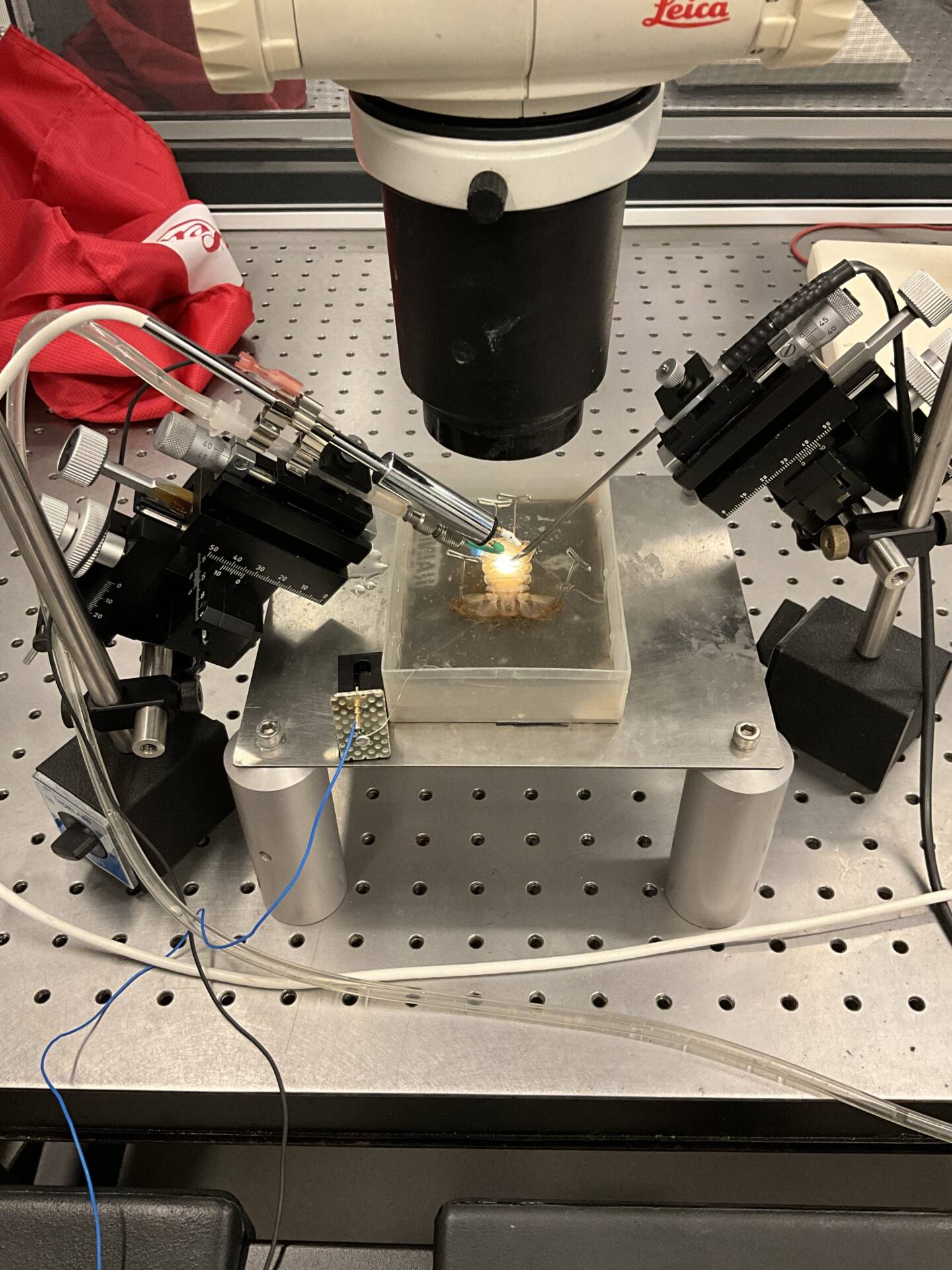
This picture depicts the setup of crayfish dissection with the microscope positioned on top of the dissection, light source attached to the headstage on the right, and electrode coming in from the left.
Extracellular recording of crayfish nerve

For most STEM majors at Princeton, one of the requirements is a course known informally as Core Lab. This class aims to equip students with laboratory skills required to succeed as a scientist in the field. It is usually composed of two 3-hour labs and one lecture per week. As a neuroscience major, I am currently taking NEU 350: Laboratory in Principles of Neuroscience, a class designed to introduce students to modern methods of analyzing neural activity—from the level of single neurons to large-scale networks underlying cognition. The course covers a range of techniques, including intracellular and extracellular recordings, optogenetics, EEG, and fMRI. After weeks of conducting designed experiments, it culminates in an independent research project where students design and conduct their own experiments based on knowledge and skills learned throughout the semester.

Categories
Conduct Research

Demystifying Big Data: An Introduction to Some Useful Data Operation Tools

A sample image of computer code that works with data
A sample image of computer code that works with data. Photo credit: Markus Spiske.

“Big data” and “data science” are some of the buzzwords of our era, perhaps second only to “machine learning” or “artificial intelligence.” In our globalized, Internet-ized society of plentiful information galore, data has become perhaps the most important commodity of all. Across all kinds of academic disciplines, working with large amounts of data has become a necessity: universities and corporations advertise positions for “data scientists,” and media outlets warn ominously of the privacy risks associated with the rise of “big data.”

This isn’t an article that discusses the broader, societal implications of “big data,” although I highly encourage all readers to learn more about this important topic. Instead, I’m here purely to provide you some (hopefully) broadly applicable tips to working with large amounts of data in any academic context.

In my own field of climate science, data is paramount: researchers work with gigantic databases and arrays containing millions of elements (e.g., how different climate variables, such as temperature or precipitation, change over both space and time). But data, and opportunities for working with data, are present in every field, from operations research to history. Below is an overview of some existing data operation tools that can hopefully assist you on your budding data science career!

Categories
Conduct Research Independent Work Present & Publish Findings

A Guide to Poster-Making

You’ve finished a research project and now you’re on to the final step: presenting your work! It’s time to share the incredible work you’ve done with the general public, and one of the best ways to do so is to create a poster conveying the significance and conclusions of your research. This will be an essential skill during your time at Princeton whether for a course or as a part of your junior and senior independent work. If this is your first time creating a poster presentation, check this blog out! ​​

A student presenting her junior work as a poster presentation.
Sara Akiba ‘26 with her poster presentation on “Foraminifera-bound δ13C as a Paleo CO2 Proxy: Methods Testing” for the Geosciences Junior Poster Presentations! If you want a poster as great as hers, continue reading below for some advice.
Categories
Conduct Research Independent Work Research Life Resources

A Quick Guide to Writing a Funding Proposal

A student typing on a computer.
This could be you working passionately on your funding proposal using the tips in this guide! Photo credit: Glenn Carstens-Peters.

After having discovered a potential funding opportunity, you might be reading the requirements for the application and find that you need to write a “research proposal” as a part of the application. This might be your first time writing a funding proposal. Here are a few tips to assist you in writing your funding proposal!

Categories
Conduct Research Get Started with Research Present & Publish Findings

Proven Tips on How to Read Scientific Literature

A printed article with yellow highlighting under a blue pen with the hands of the person reading and annotating.
A person reads and annotates an article printout. Photo Credit: Y.Arcurs/iStockphoto

In our undergraduate years, as we get involved with research and science, it can be incredibly overwhelming to read scientific literature. It’s easy to drown in hundreds of thousands of articles with fancy-sounding titles, pages and pages of complex writings, and dozens of figures that you have no idea what they mean. However, reading scientific literature is a necessary skill to have, and you must be able to understand what scientists know, and what they don’t. 

Therefore, I’ve created a list of tips and advice to tackle scientific literature as an undergraduate. Follow my advice, and you’re on your way to impress your supervisors with your knowledge, and create a nuanced understanding of where your research lies within the body of knowledge that scientists have been cultivating!

Categories
Conduct Research Research Life

A Hidden iGem at Princeton

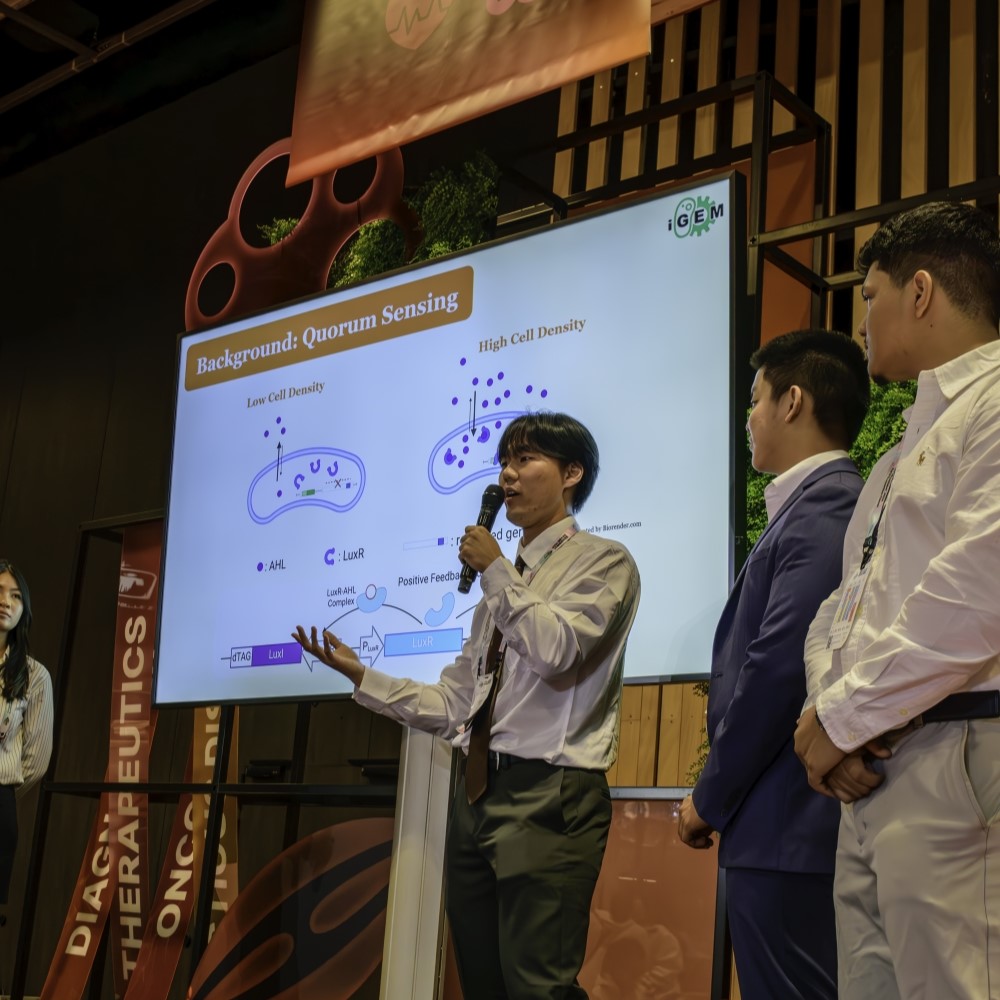
Dowon Seo '27 stands center frame holding a microphone, in front of a presentation screen describing quorum sensing. Besides him are members of the iGem team.
Dowon Seo ’27 presenting Research in Paris, France. Photo courtesy of Dowon Seo.

Princeton offers a wealth of opportunities to engage in undergraduate research. From smaller projects found in writing seminars to the ever-looming senior thesis, research is woven throughout our academic journeys. Still, outside of this mandatory exposure to research there are also unique opportunities to explore research as an undergraduate. One of the most interesting of these is the Princeton iGem team. I was able to sit down to speak with a member of this year’s team, Dowon Seo ‘27, after he returned from the annual iGem conference in Paris.

Categories
Conduct Research Research Life

Balancing Research and Academics: The Art of Course Planning

Screenshot of TigerJunction page with course planning template
A blank Tiger Junction page ready to be filled with the courses for next semester.

Planning your courses while doing research can feel like a juggling act—one that involves not just your academic requirements but also your research commitments and, of course, your own well-being. At a place like Princeton, where opportunities in labs and research projects abound, learning how to navigate and integrate everything into your schedule can make a huge difference. 

Categories
Conduct Research Plan Beyond Graduation

To Ph.D. or Not to Ph.D.: An Interview with Microbiology Ph.D. Candidate Ciara Sanders

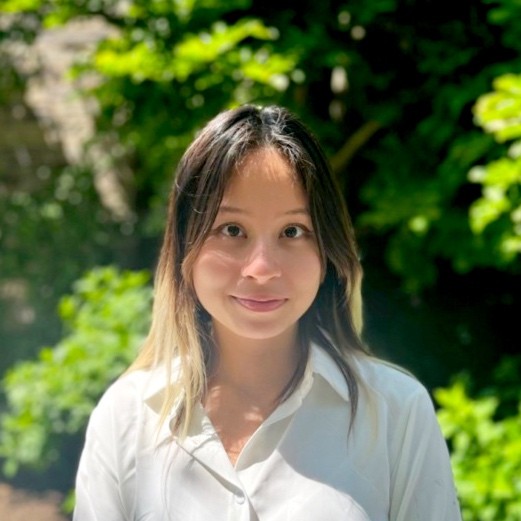
Showing the person I interviewed to add a face to the name and words

Headshot of Ciara Sanders, Ph.D. student. Photo credit: Ciara Sanders.

For this post, I decided to ask third-year Ph.D. student Ciara Sanders in Dr. Brooks Lab here at Princeton about her experience in molecular biology graduate school. She hails from California and is currently carrying out microbiology research for her Ph.D. For students considering molecular biology research/Ph.D. as a career, these questions may help answer any concerns you have, especially since medical school seems to be the popular option for molecular biology majors.  

Categories
Conduct Research Present & Publish Findings

Simplify Your Research Poster Printing: Using Princeton’s Makerspace Large Format Printer

Photo of three students wearing black suits and smiling at the camera. Machine learning research poster in the center.
Alexis Wu (author), Jenny Pang ‘24, and Jimmy Hoang ‘24 at the COS 484: Natural Language Processing Spring 2024 poster session.

The end of the semester is often accompanied by deadlines for semester-long projects and final papers (including the infamous Dean’s Date deadline, which past correspondent Ryan Champeau has amazing advice on!). For some classes, students may be asked to create an academic or research poster and present their work to their peers in a poster session. A couple of courses I have taken where I produced a final research paper were COS 484: Natural Language Processing and ASA 238: Asian-American Psyches

In ASA 238, the department provided funding so that all students in the class could have their poster printed through Princeton Print & Mail Services. However, this option typically is not free-of-charge to students. Moreover, since this process typically takes 4-5 business days after the proof is approved to be printed, course instructors may set conservatively early deadlines so that all students’ posters may be printed on time. With more deadlines in other classes, this can create additional stress.

The great news is, this stress can be avoided with a free, straightforward alternative: utilizing the Makerspace’s Large Format Printer. The Princeton University Library (PUL) Makerspace is a creative space on the A-level of the Lewis Science Library open to current students, faculty, and staff. If you’ve never used the space before, it might be daunting, but I hope this article will clarify the process and assuage any fears you may have!

Categories
Conduct Research PCUR News Present & Publish Findings Research Life

Harmonizing Research and A Cappella: How Music Fuels My Scientific Journey

Photo of the members of the Princeton Footnotes in the year 2024-2025, taken at Rocky courtyard
Photo of the Footnotes, Princeton’s fresh low-voice a cappella group founded in 1959

Imagine standing in front of a big audience, heart racing, ready to blend your voice with others and hit the notes of an intricate a cappella arrangement. Every beat, every breath, is crucial. Every time I stand on stage or under an arch with my a cappella group, the Princeton Footnotes, I think of how similar singing and music feels to what I do in the lab. You might be thinking that singing in an a cappella group and doing research are worlds apart. However, these two passions have formed a bond in ways that I never believed possible. In fact, the creativity, collaboration, and discipline I have channeled in being a part of the Footnotes have made me a better researcher—and vice versa.