A long-term project like a thesis is a marathon, not a sprint. This has been a difficult adjustment for me. In almost every other research project I’ve done at Princeton, I’ve chosen the last-minute sprint model, rather than a more organized long-term approach. Sprinting hasn’t worked well in the past, but it won’t work at all for a thesis. There’s simply too much involved in a thesis to cram it into the few weeks before the deadline.
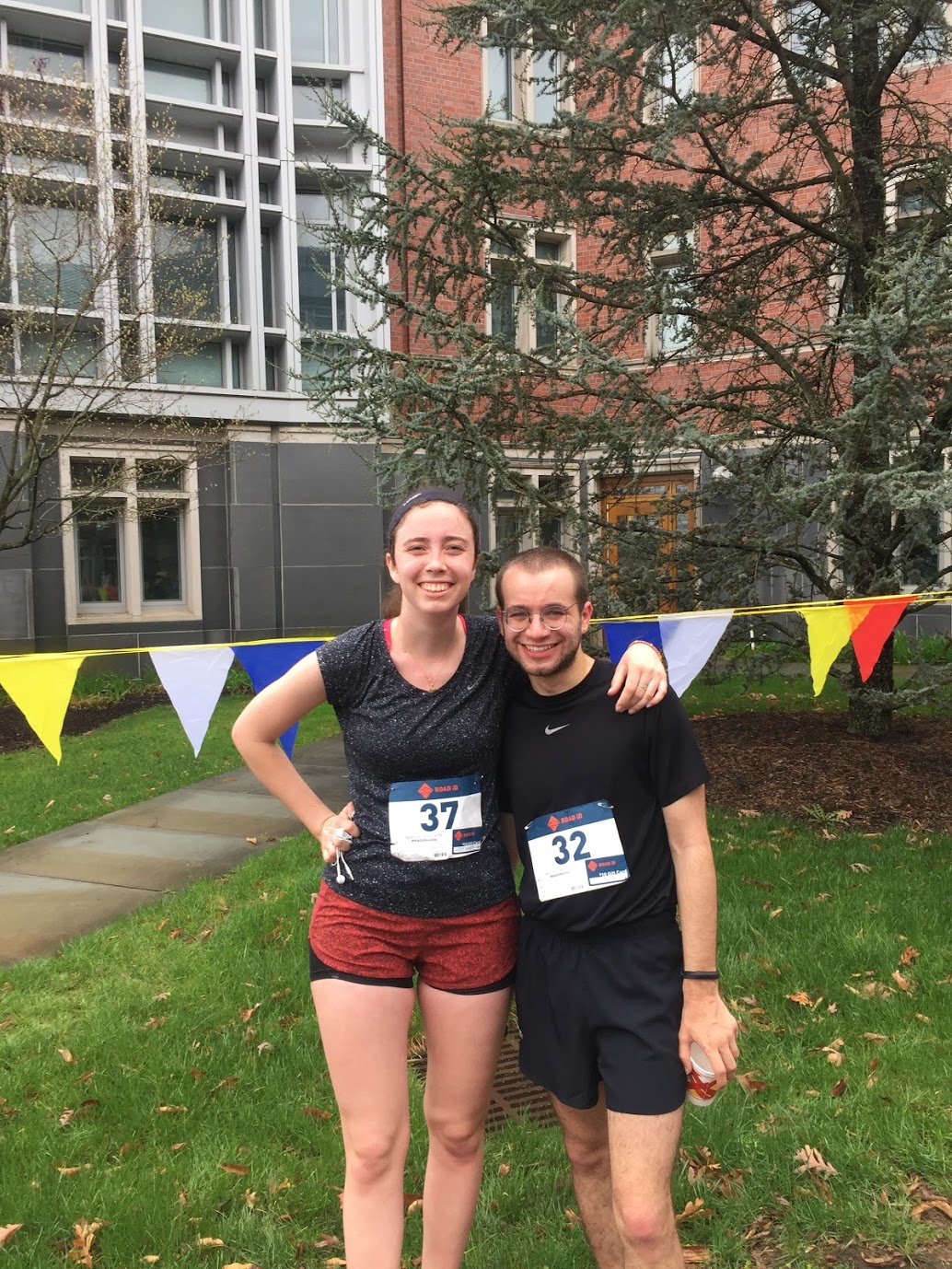
My thesis buddy and me cheesing at the finish line of a 5K last spring. It’s never too early to start training for the thesis marathon!
The marathon approach is new to me, so I looked up some tips for how to train for an actual marathon. I was surprised how many were relevant for a long-term project like a thesis or a final paper. I’ve collected my ten favorites here:
While students usually choose to seek research internships over the summer, some research opportunities are also available during the semester, such as working under a professor or graduate student to aid with their academic research. However, among these choices, it may often feel like there are especially limited research opportunities available for students pursuing majors in the humanities or social sciences. We often imagine research assistants as collecting and analyzing statistical data, examining Petri dishes in a lab, developing computer programs, and so forth, and so we may be more skeptical as to what kind of research non-STEM majors could possibly partake in.
To learn more about research opportunities during the semester in the humanities and social sciences, I interviewed Emily Sanchez ’22, who is currently working as a research assistant under Professor Rosina Lozano. Professor Lozano, an Associate Professor of History at Princeton, specializes in Latino history and the study of Latino cities in the U.S. As a research assistant, Emily has been examining 19th-century Spanish newspapers from the Southwest to understand more about the historical ties between ethnic Mexicans and indigenous communities in the region.
Here’s what Emily shared about her experience as a research assistant:
In the fall of my first year I wanted to join a neuroscience research lab. I was hoping to contribute to meaningful research, network with helpful mentors, and develop new skills and qualifications. In retrospect I should have waited to adjust to Princeton and my new course-load before even beginning to think about labs. I didn’t, though, and as I sent a flurry of emails to lab directors, I soon ran into a barrier: I found it incredibly difficult to be accepted into a lab.
In their response to my email, one lab director told me that they preferred students with significant experience in the programming language Matlab. Although I’d used Matlab before, my trial subscription had long expired. Using the free software links available through the Office of Information Technology (OIT) website, however, I was able to download and use Matlab once more. I soon realized that a laboratory setting wasn’t necessary for me to conduct my own research. In fact, I actually felt empowered by the ability to choose my own research topic.
Research does not end at simply conducting experiments or making a mind-blowing discovery in your academic field. It’s just as important—or perhaps even more so—to share your findings with others and to hear their thoughts on what you’ve discovered. Throughout your time at Princeton, you will come across multiple opportunities to present your research–whether it’s presenting at Princeton Research Day, drafting independent work proposals for advisors, showcasing your research from summer internships, or even just preparing presentations for class. Sharing your research is thus a common and necessary step in creating scholarly conversation, and can be a very rewarding and enlightening experience for you and for others. However, it can be challenging to find the most effective way to convey your knowledge and work to your audience.
This past April, I participated in the Mary W. George Freshman Research Conference, where I presented my paper “Racism in K-pop: A Reflection of South Korea’s Racialized Discourse of Beauty.” My paper was 16 pages long, and in the beginning, I had no idea how I would synthesize this into a 10-minute presentation. How do you condense a paper that long into just 10 minutes without losing the key points of your argument? Everything in my essay felt critical to my thesis, and yet I knew I couldn’t include every single point in my presentation.
Here are a few aspects that I focused on, which I think will be helpful in transforming your paper into a great presentation.
The infamous Senior Thesis is a source of stress and anxiety for many students. Although there are information sessions galore for juniors, I didn’t feel like I actually understood the process until I started it. This summer, I began my thesis research process by traveling to Norway to collect observational data on the country’s prison system.
I’ve known that I wanted to do science research since the age of sixteen, when I spent my first summer in a neuroscience lab. My time in the lab taught me many new skills and enabled me to immediately apply them to unsolved problems–what other summer job could be more interesting than that? Though my specific interests have shifted slightly (I’m now a chemical and biological engineer rather than a neuroscientist), I’ve devoted every summer since to benchwork of some sort.
Consequently, when I started to look for laboratory opportunities last year, I immediately gravitated towards biology research. I had loved the past three summers–why not experience another? In the winter, I applied to internships through Princeton’s International Internship Program (IIP), and I was lucky enough to receive an offer to study the mechanisms of Shigella (a bacterium that causes dysentery) infection at the Pasteur Institute in Paris, France. I accepted immediately, thrilled that I’d be spending my summer abroad–and on Princeton’s dime!
But as the year wore on, I started to consider what the added value of another summer of wet-lab research would be, especially since time constraints would limit my contribution. I felt like was narrowing in on my chosen field too early. Wouldn’t I be bored?
Last fall, in a cubicle on the B-floor of Firestone, you might have seen me scrolling through my unfinished JP. It would have looked unremarkable. I had been working on my JP in the same cubicle for weeks. Except this time, my JP was due to my department in two hours and I was realizing I had about 25 pages of footnotes to complete. I was panicking: crying and shaking while typing faster than I’ve ever typed before.
Luckily, I was able to complete the citations and submit my JP with three minutes to spare! But it took me the rest of the night to recover from the experience (and, to be honest, I still get a rush of anxiety every time I think about it). I promised myself I would never allow myself to end up in the same situation again.
A selfie I took just minutes after submitting my first JP last fall…
Whether it’s a final paper, a JP, or a thesis, here are some tools I’ve been using to help me beat the panic of independent work:
For this year’s Spring Seasonal Series, entitled Post-Princeton Life: The Experiences of PCUR Alumni, each correspondent has selected a PCUR alum to interview about what they have been up to. We hope that these interviews will provide helpful insight into the many different paths Princeton students take after graduation. Here, Saira shares her interview.
~~~~~
As part of the Spring Seasonal Series, I interviewed Stacey Huang ’16, who was an engineering correspondent in the electrical engineering department. Stacey is now pursuing a Ph.D. in electrical engineering at Stanford University. As an engineering student who is also interested in pursuing a graduate degree, I interviewed Stacey to find out more about her research experience.
For this year’s Spring Seasonal Series, entitled Post-Princeton Life: The Experiences of PCUR Alumni, each correspondent has selected a PCUR alum to interview about what they have been up to. We hope that these interviews will provide helpful insight into the many different paths Princeton students take after graduation. Here, Nanako shares her interview.
~~~~~
In my last post, I wrote about how to get the most out of your short-term research internship. In this post, I provide some more insight I got about how to get the most out of my summer internship— this time from a more credible source: a Princeton alumnus. I interviewed Bennett McIntosh ’16, who used to write for PCUR, about his Princeton research experience.
Here’s a bit about Bennett:
Bennett McIntosh ’16 studied chemistry at Princeton and is currently a freelance science writer.
Bennett McIntosh is a freelance science writer and reporter living in Boston, covering the intersections of scientific research, technological change, and social welfare. He is currently helping to relaunch Science for the People, a magazine of science and politics whose first iteration grew out of the 1960s anti-war movement. While studying chemistry at Princeton, he wrote opinion columns forthe Daily Princetonian, science stories for Innovation, and lousy jokes for the Princeton University Band.
As a sophomore, I’ve finally started to get better at navigating Princeton, and there are many perks that come with that. But at the same time, this is when things can start to feel monotonous. During the winter, I started to look for ways to rid myself of this feeling, and one of the ways that I thought of was to study abroad. This week, I decided to interview Leslie Chan, a junior in the molecular biology department, about her experience going abroad to Oxford University in her junior fall.
The Oxford-Princeton Biochemistry Exchange is a program where selected juniors from the molecular biology department exchange places with an Oxford student for a semester and do research in a laboratory setting — it’s distinctive in that the students don’t take classes at Oxford, but rather become full-time lab members at a Biochemistry laboratory at Oxford. You still get transfer credit though, so you get to graduate on time!