My most recent post focused on gearing up towards your senior year and finding a thesis adviser. I decided to continue this mini “preparing for your senior thesis” series by providing some tips on funding your research! The infamous senior thesis is such a daunting thing to think about as a junior because it is not always clear how early you should begin to plan for it and what steps you should take. At the beginning of the year, I attended an information session through the Woodrow Wilson School regarding thesis research funding. During that meeting, the speakers told students that they should start working on applications for funding as soon as possible if they wanted to receive money for their endeavors.
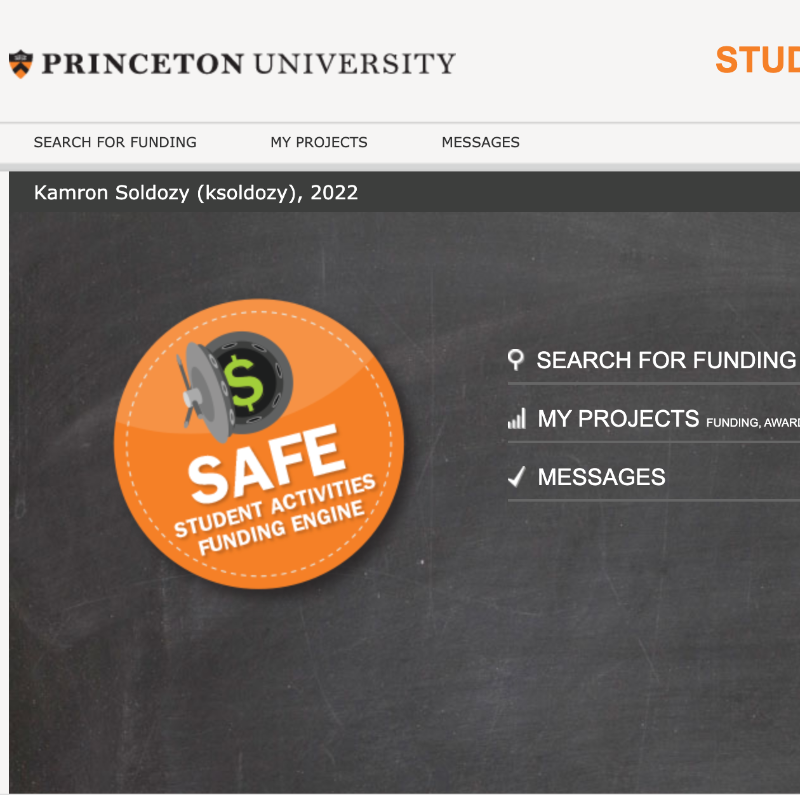
The Student Activities Funding Engine (“SAFE”) offers many opportunities to apply for funding!
As I began choosing my courses for next semester, I knew I had to take CBE core lab, as this is a requirement for the concentration during the spring semester of junior year. In addition, I was really excited about conducting independent work in a new bioengineering lab, which I am hoping will be the lab that I stay in for my senior thesis. With both 7 hours of core lab per week and an expectation of 20 hours of independent work per week, I know I will be spending a lot of time in the lab next semester, so I have started to prepare for that. If you are also taking core lab while doing independent work, or if you are enrolled in multiple lab-courses, such as chemistry, molecular biology and physics at the same time, you will likely need to plan ahead. In this post, I will offer tips on how to prepare for a lab-heavy semester:
Lab hours can quickly add up, especially if you are not organized with your time. Begin planning your schedule for a lab-heavy semester early in order to set your own expectations for you project.
So you’ve just finished your JP, a dean’s date assignment, or some other research project. Considering how fast things seem to move here, you might have already forgotten about it – that’s how I felt when I turned in my R3 my first year.
However, I ended up taking another look at my R3 to prepare my presentation last spring for the Mary W. George Research Conference – the biannual writing conference – (tips on doing that here). During that process, I recognized some significant changes and expansions I could make on my R3, but I didn’t think much of it at the time.
After presenting my R3, I was encouraged by my writing
seminar professor and some of my peers to expand my work and submit the
manuscript for a conference or for publication. After submitting to a
conference and to multiple research journals, here are some of my takeaways from
the publication process:
Presenting my R3 at the Mary W. George Research conference helped me polish my paper.
We spend a lot of time finding and deciding what internships and jobs to pursue over the summer. There are quite a few posts on this blog alone that help with that process, including this one. After exploring my options, I think I know what I’ll be doing this summer: staying on campus to do research in a neuroscience lab (an experience I’ll talk more about in a future post).
However,
knowing what I’ll be doing this summer isn’t all there is to finalizing my
summer plans. For one, I don’t know how my experience will actually be funded. Second,
I’m unsure where I’ll be staying for the duration of my research.
To better finalize my plans, I turned to SAFE, the Student Activities Funding Engine. SAFE is a website where students can apply for funding for internships and other activities. In addition to finding a relevant funding source for my summer plans, I came across many other interesting funding opportunities for students who have secured unpaid internships over the summer. I’ve gone ahead and summarized a few of them below.
The Student Activities Funding Engine Website (SAFE)
Taking notes with an eye toward synthesis (that is, making connections to previous material, readings, lectures, and so forth) can give you a head start on the writing process.
One of the challenges of college is assimilating large amounts of information from a variety of sources: lectures, course readings, independent work research, precept discussions, extracurricular programming—the list goes on and on. Compounding the challenge is the fact that what’s ultimately demanded of students is not mere recall, which can be accomplished through memorization. Rather, we’re charged with synthesizing disparate materials, pulling things together, making connections across genres of information. In this post, I reflect on some of the ways I try to do this.
It’s that time of year again: everyone is spending endless amounts of time browsing and discussing the available spring courses with their friends, advisers, and mentors. The buildup is for good reason: it’s important to put together a balanced, enjoyable course schedule (for tips on how to go about doing that, check out this post).
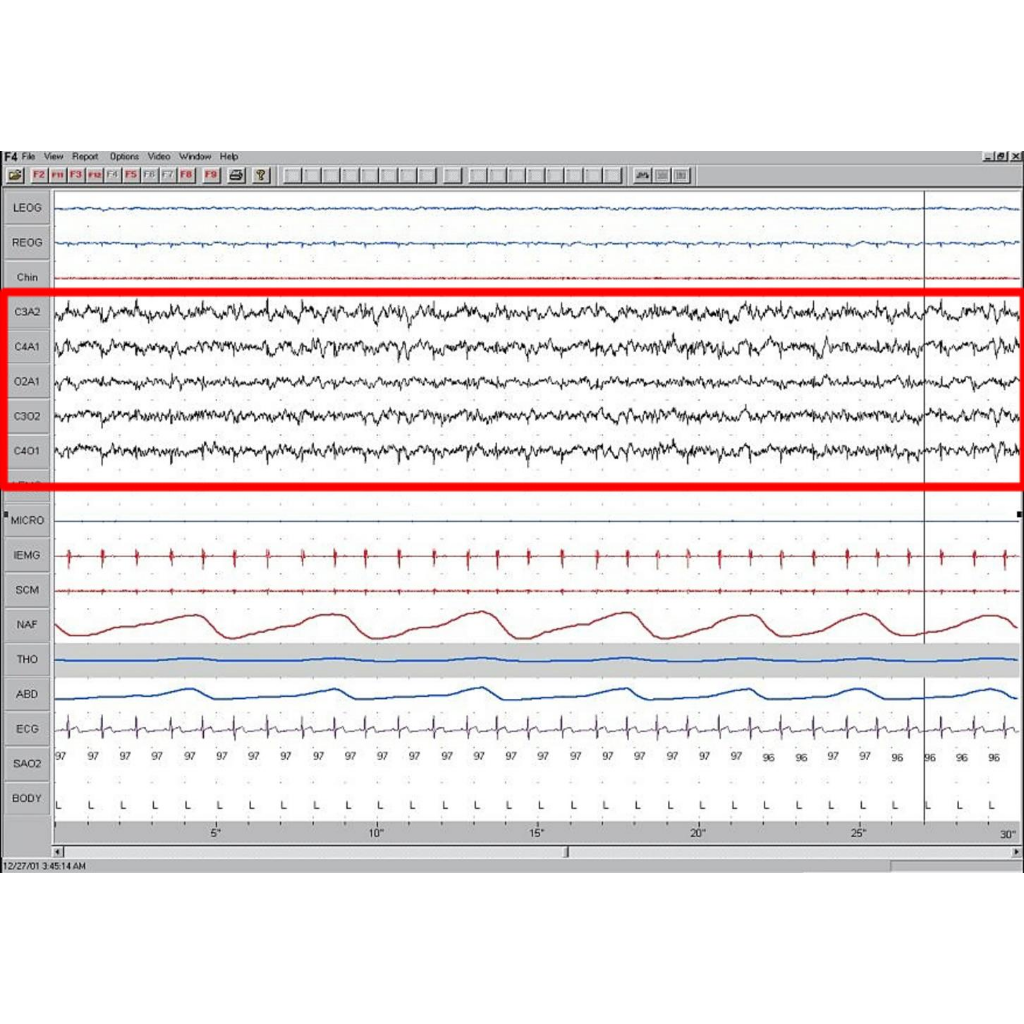
I’ve personally had my eye on NEU 350, the neuroscience major requirement known for teaching data analysis techniques and lab procedures. Thus far in my Princeton career, I’ve learned a lot about theoretical methods within the discipline, but I’ve yet to actually apply those methods myself and work with real data. I wanted to take the class to learn these skills and broaden my understanding of what actual work within the neurosciences looks like.
However, I noticed under the “Prerequisites and Restrictions” header of the course on the registrar website that sophomores need permission from the Instructor to take the course. I found this odd considering that many sophomores are enrolled in NEU 314, a class that is typically taken by neuro majors the semester before NEU 350. The need for instructor permission felt intimidating to say the least, and in this post, I’ll share a few steps I took to learn more about NEU 350 and whether or not I should take it this spring.
An example of the brain-wave data that gets analyzed in NEU 350
It’s been almost four years, and the generosity of Princeton faculty continues to surprise me. So many professors here are not just accessible to students, but deeply invested in supporting us in and outside of the classroom. It typically isn’t too hard to find at least one research mentor among our 950 full-time faculty.
Nevertheless, one institution’s faculty cannot possibly cover every sub-field or research topic. This has become especially apparent as I’ve moved towards the specificity required of a thesis project. In my case, no professor on campus studies Vilna, the Eastern European city at the center of my thesis.
A newsboy in Vilna in the early twentieth century. Without guidance from professors at other institutions, I probably wouldn’t have selected this fascinating city as my thesis topic!
Of course, there are ways around this. For one, there is probably a professor on campus whose area of expertise has something in common with your project. My thesis adviser does not work on Eastern Europe, for example, but she is an expert in writing urban histories. So even though Vilna is new to her, she has been invaluable in guiding my methodology and argumentation.
She has also encouraged me to reach out to faculty and graduate students in other departments and at other institutions who might be more familiar with Vilna itself. Connecting with these scholars has turned out to be one of the most valuable aspects of my thesis process thus far. I’ve compiled some tips for accessing the rich academic network beyond your particular department or university.
Last spring, I began the semester specifically planning to PDF my English class. I knew my schedule would be time-consuming, since in addition to English, I was also taking immunology, organic chemistry, intro to material science, and Portuguese. Because I intended to count all of my other courses as either CBE departmental electives or towards a Portuguese certificate, so I thought it would be wisest to PDF English.
However, half-way through the semester, I realized that I was doing relatively well with the English coursework, so I probably did not need to PDF the course. The course that was actually more time-consuming and difficult than I had expected was immunology. This caused me to rethink my process for choosing how to select a course to PDF. I started to look at the course load itself instead of just at the requirements I was satisfying, and in the end, I chose to PDF immunology. In this post, I will discuss in more detail some things I considered before making my decision and offer tips for selecting to PDF a class.
Opting to PDF a class can be really helpful during a stressful semester. Before making the decision, be sure to consider the different factors outlined on this post.
Colleges like Princeton love to brag about their high rates of student involvement in research: our admissions pamphlets are peppered with student testimonials about the accessibility of professors and the university’s commitment to undergraduate research. But although Princeton does provide incredible resources, doing research with professors doesn’t always feel accessible. Especially as a first-year or sophomore student, it can be challenging to find research opportunities outside of classes (except during the summer).
As a first-year student, I definitely felt this pressure in the fall semester. I knew I wanted to be a part of research on campus as soon as possible, but I worried that no professor would want to work with me. After all, I was less experienced than many older students, and as a CBE major, I knew that quantitative and technical skills were of paramount importance in my field. Though I was afraid of being ignored (or worse, rejected!) by professors, I decided to reach out anyway. I emailed my MOL214 professor (who runs a lab in CBE) hoping that he would help give me an introduction to the department. When I went to his office for a simple discussion, he ended up offering me a position, and I’ve been working in his lab ever since!
Lab readings can be less time consuming than simply opening up a science journal and reading through every abstract for papers relevant to your research!
When beginning a new lab project, whether it is a summer internship, independent work, or a senior thesis, your mentors will likely present you with academic papers relevant to your topic. This will help you begin to frame your experiments and the overarching goals of your research.
But once you understand enough background to begin, staying up to date with recent papers can be difficult, especially when you are balancing course work, extracurriculars, and other commitments in addition to planning and conducting experiments. In my experience, I found it difficult to sit down and do broad scholarly searches on a research topic as I first did when starting a new project. However, strategies such as using library resources and speaking with others in the department facilitated this process. In this post, I will give tips on how to stay current with laboratory news and advances, specifically with STEM research.