Categories
Independent Work Present & Publish Findings

The Gem of Cross-Disciplinary Thesis Advice

For better or worse, the university is internally cloistered as an academic institution. Walls literal and metaphorical separate the departments. This is perhaps most apparent to students on an administrative level; each department has its own academic guidelines, grading policies, and research expectations. Deeper differences, though, may present in modes and content of knowledge production. Disciplines often preclude interdisciplinarity. Divergent methodologies might be applied to the same subject matter to produce different results; within a department, the range of expertise might end up applying similar methods to wildly different subjects. 

I, for one, think that these disciplinary divisions often do more to stifle than to encourage intellectual growth or humanistic inquiry (on the problems and politics of the academic disciplines, see my interview with Daniela Gandorfer here). But, as things are, attempting to explain research across disciplines can be quite difficult– like speaking to someone in a different language without a translator. Seniors writing their theses are certainly familiar with this issue when trying to explain their work to people outside their department, or in some cases, anyone other than their adviser. When it comes to feedback on thesis work, then, it makes immediate sense to gravitate towards people with background in whatever you are writing about. They indeed might be able to give very pointed advice.

That said, there is still great value to turning towards those beyond the official borders of your discipline. A lack of familiarity with the subject matter can indeed be an asset– especially in terms of providing feedback on your writing and your writing/research process.

Categories
Present & Publish Findings

How to Write An Email To Someone You Don’t Know

“What? Why would I ever need to read an article about how to write an email?” This is what my first thought would’ve been if I ever saw an article like this. While many Princeton students probably understand the basics of how to write an email (type, then hit send), today, I wanted to go over tips to use when “cold emailing” someone.

Before coming to Princeton, the emails that I wrote were sent to my friends and high school teachers. I’d only ever emailed people that I already knew. However, throughout the years, I’ve learned that email is wonderful ⎯ and useful for research ⎯ because you can contact people who you don’t already know! Although learning how to write emails is something that’s not taught formally, I think it’s increasingly important to know what to do and what not to do when you’re trying to catch the attention of someone you’ve never met or talked to.

Categories
Conduct Research Plan Beyond Graduation Present & Publish Findings

Interdisciplinarity and the Political Imperative of Research: An Interview with Daniela Gandorfer, Part II

Specializing in legal thought and critical theory, Daniela Gandorfer is a graduate of the doctoral program in Princeton’s Department of Comparative Literature, a postdoctoral scholar at UC Santa Cruz, and co-director and head of research at the Logische Phantasie Lab (LoPh). LoPh, a research collective recently founded by Princeton alumni and current students, describes itself as a “comprehensive research agency that actively challenges injustices resulting from political, legal, economic, social, physical, and environmental entanglements by means of specific investigations.” I want to thank former PCUR correspondent Rafi Lehman, now the Development Coordinator at LoPh, for putting me in touch with the research collective’s team.

Over email and Zoom, I was able to talk to Daniela about the critical methods employed by LoPh, its relationship with the established academy, and the benefits and limits of an interdisciplinary research approach.

This interview has been edited for length and clarity. Below is part two of a two-part interview. You can read Part I here.

Daniela Gandorfer, co-director and head of research at LoPh.
Categories
Present & Publish Findings

Interview with Tiger Gao, host of Policy Punchline

This week I had the opportunity to interview Tiger Gao, currently a senior in the Economics Department at Princeton and the founder and host of Policy Punchline, a student-run podcast that focuses on conducting interviews with well-known public figures on current policy issues. I am a researcher for the podcast. In this interview, I had the chance to ask him about Policy Punchline and about entering the field of economic research and public policy in general.

The interview has been edited for length and clarity.
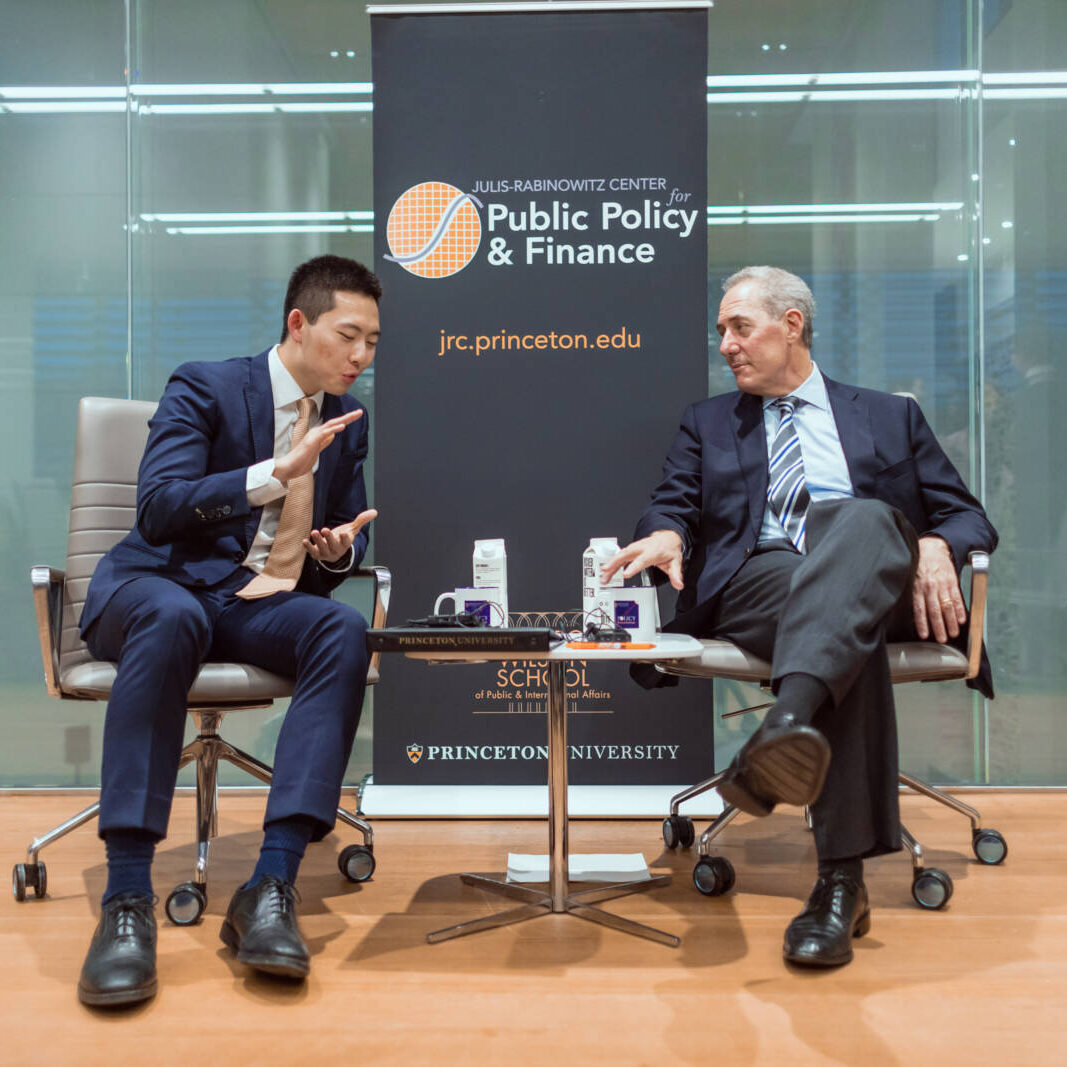
Tiger interviewing former US Trade Representative Michael Froman for Policy Punchline

M.B.: What inspired you to start Policy Punchline?

T.G.: At Policy Punchline, we interview people involved in policy. It’s fully student-run and nonpartisan. What we really care about is to promote long-form dialogues on urgent issues and frontier ideas, whether you are a postdoc who’s doing some interesting research or the NFL’s data chief discussing the response to the Covid-19 crisis.

As a freshman/sophomore at Princeton, I was kind of lost. I didn’t know what to do. I hadn’t gotten into any major clubs at Princeton, I didn’t feel like I’d fit in. I had run for class president and lost. But what I’ve always loved is to go to the guest lectures after class – and once the lecture ended, I would ask questions. I soon realized that hardly anyone talks to these fascinating people with such interesting ideas. And the idea of Policy Punchline was born.

So far, it has worked quite well: tomorrow we will drop our 99th interview and I personally have done more than 100 interviews.

M.B.: Quite the milestone.

T.G.: Yes, in the past two years our team has grown to more than 50 students. I’m incredibly proud of the team and its intellectual capacities and I expect great things going forward.

M.B.: You talked about students who are sometimes shy to talk to these guest lecturers – or even to their own professors, and I can relate to that. What would you like to tell them?

T.G.: My very first interview was with Dr. Christopher Marks, the Head of Emerging Markets for Mitsubishi Financial Group. I remember spending three hours with him in a studio in Wilson and I didn’t really know what was going on. I felt nervous. I had to re-record my questions. My question list was very naive but he was very supportive and patient. And he said two things to me afterward that I think are quite profound and which had a lasting impact on me. 

The first thing he said was, “Don’t be afraid to talk to people that are smarter or more experienced at something than you. You’re going to look stupid, but that’s fine. You ask the questions and you improve and that’s what matters.” 

And the second: “You have to feel happy about bad mistakes.” He’s not referring to a getting-a-bad-grade type of mistake, but mistakes that might even point to some fundamental flaws in you. And he said that you have to be happy with them. These two pieces of advice really gave me confidence and laid quite a powerful foundation for Policy Punchline. You are going to run into difficulties. A lot of the people we email don’t get back to us and some others might and subsequently ghost us. Some interviews don’t go well and you wish you had done better. But that’s fine! Just go for it. And when you do, you’ll realize that the people you end up interviewing actually want to talk to you.

M.B.: If anyone reading this was interested in joining Policy Punchline or interested in this type of work in general, how would they go about it?

T.G.: Just send me an email! The way you joined was so incredibly informal. Princeton is already a difficult enough place and I don’t ever want people to feel excluded. I know what it feels like to polish your CV and go through the cover letter and prepare for the interview for a club and then never hear back. We ask people to prepare a research portfolio and based on what they tell us, we decide on how and where they fit in the team. If it’s not a good fit or if they are not passionate about it, they’ll leave soon. But if this is what they’re passionate about, then there are no barriers to how far they can go and how much they can do.

For anyone, who is interested in joining Policy Punchline, Tiger can be reached at miaokuan@princeton.edu.

Joining a podcasting team can be an unconventional, but rewarding, way to try to explore a field, especially at an interview-focused podcast like Policy Punchline, where there are opportunities to engage in dialogue with experts, ask questions and learn further about a subject. As a result, they can be an incredibly rewarding experience for anyone – regardless of their prior level of knowledge. For anyone who is interested to go in-depth about the policy issues, I would recommend reaching out to Tiger about joining Policy Punchline. Every week you get to learn about the many issues that affect us – from reimagining capitalism to the energy sources of the future to the current elections – in different ways.

– Abhimanyu Banerjee, Social Sciences Correspondent

Categories
Present & Publish Findings

Attending a Virtual Conference: Reflections from the 2020 AIChE Student Conference

In the spring of 2019, I wrote a post highlighting my positive experience at the 2019 American Institute of Chemical Engineers (AIChE) Regional Conference. Specifically, I encouraged other students to attend conferences and seminars within their department even when they felt as if they were too busy to attend, as these events can strengthen your academic experience rather than interfere with it. 

Throughout the COVID-19 pandemic, in-person conferences and academic events have been replaced with virtual experiences that are now even more accessible to students, as you can attend without traveling far distances and at reduced or no costs. Although the virtual conference was undoubtedly different than the in-person one, I still felt the same, if not more, benefits from attendance. In this post, I will give advice on how to navigate a virtual conference, as I reflect on my takeaways from this experience. 

Screenshot of the virtual platform used for the 2020 AIChE Student Conference. This allowed attendees to navigate through different sessions.
Categories
Present & Publish Findings

Write Again! Stress-Reducing Tips for the Rewriting/Editing Process

Pre-pandemic Firestone: A writer’s paradise?

As a student studying history, my classes are essay heavy. Whether it’s a short, 5-page paper, or a longer 10-to-15-page paper, I write a lot. And surely, I’m not alone; as Princeton students, we are expected to write a lot, whether it be academically, extracurricularly, or professionally. With so much writing, it becomes easy to grow tired and forgo editing. After all, with an outline and ‘rough draft’ in hand, it’s easier to call it a day and pray for an A.

The rewriting process is perhaps the most underrated yet important step when it comes to essay writing. Rewriting is not just about catching misuse of the dastardly Oxford comma or misspellings of common words but finding out what fundamental aspects of the essay work and do not work. This is asking yourself the basic questions: Does the essay make sense? Does the structure create a naturally flowing, cohesive essay? Are my references in order? Is everything grammatically correct?

With a new semester coming up ahead, and those dreaded 5-page or 10-to-15-page papers coming along with it, I thought it was best to outline some of the strategies I use to rewrite my essays. These are strategies I took away from Writing Seminar (mine being WRI 146: Constructing the Past), some of my history classes (most notably HIS 281: Approaches to European History), and my own writing exercises to rewrite and edit my essays. This list is not exhaustive, not meant to be followed point-by-point nor used for every type of essay; in fact, I would take this list as blend of different strategies to mix-and-match. Nevertheless, here it is!

Categories
Conduct Research Independent Work Present & Publish Findings Research Life

An Interview with Haider Abbas ’17: How to Make an Impactful Senior Thesis

As senior thesis season approaches, Haider Abbas offers advice that will help you produce a thoughtful, successful, and influential thesis.

Haider Abbas ‘17 is a Princeton alumni who recently published his inspirational senior thesis which he created while in the Princeton School of Public and International Affairs. Many Princeton seniors are now beginning to dive deeper into their theses, therefore I think that hearing from Abbas would be very helpful. Thankfully, a few weeks ago, I was able to interview Abbas and he offered key insight into why he chose his thesis topic, how he was able to produce his thesis, and most significantly the impact that his thesis will have beyond his years at Princeton. I hope that you can learn from his experience and develop a thesis that you feel passionate about!

This interview has been edited for length and clarity.

Categories
Conduct Research Plan Beyond Graduation Present & Publish Findings

Interdisciplinarity and the Political Imperative of Research: An Interview with Daniela Gandorfer, Part I

Specializing in legal thought and critical theory, Daniela Gandorfer is a graduate of the doctoral program in Princeton’s Department of Comparative Literature, a postdoctoral scholar at UC Santa Cruz, and co-director and head of research at the Logische Phantasie Lab (LoPh). LoPh, a research collective recently founded by Princeton alumni and current students, describes itself as a “comprehensive research agency that actively challenges injustices resulting from political, legal, economic, social, physical, and environmental entanglements by means of specific investigations.” I want to thank former PCUR correspondent Rafi Lehman, now the Development Coordinator at LoPh, for putting me in touch with the research collective’s team.

Over email and Zoom, I was able to talk to Daniela about the critical methods employed by LoPh, its relationship with the established academy, and the benefits and limits of an interdisciplinary research approach.

This interview has been edited for length and clarity. Below is part one of a two-part interview.

Daniela Gandorfer, co-director and head of research at LoPh.
Categories
Conduct Research Present & Publish Findings

Reflecting on your first Midterm to Perform Better on the Final

For most of us undergraduates, midterms tend to be a stressful time, even more demanding than finals or Dean’s Date. This is because we go through midterms while classes and assignments continue as usual. In contrast, we have a week-long reading period at the end of the semester to focus on writing papers and preparing for finals. If you are a first yearstudent, you have the additional stress of going through  Princeton midterms for the first time and you might have realized that they can be quite different from exams in high school. Therefore, it is not unusual for first years to receive grades on midterms below their expectations.  When I was a first year, I learned how I could use my midterm grades as guideposts to help me identify which courses I most needed to adjust to and improve my final grade.  It is important to note that midterms scores will not always fully correlate with finals and that there are plenty of opportunities after midterms to adjust strategies and improve performance. Here are some of the strategies I have found helpful when looking to bounce back from a midterm.

Categories
Independent Work Present & Publish Findings

Lost and Confused? Create a Map!

It’s said that a picture tells a thousand words; a map, however, can tell you a million.

To me, maps are not just tools for navigation. They have a variety of uses, enabling their creators to visualize a vast array of data efficiently and quickly. From questionable election forecasts to the location of monuments in a city, anything of your choosing can be mappable. Maps, in my experience, can be one of the most powerful tools in your research toolbox. Thus, I want to show you how you can use maps in your research, and the power they hold!