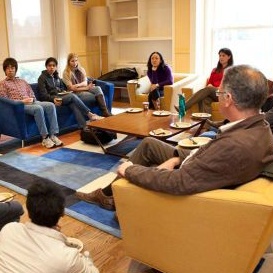
A Senior Thesis boot camp held in Rocky Dining Hall over spring break, 2016. The author participated in a similar boot camp, organized by Mathey College, during Intercession 2020.
Working on my thesis over intercession, I found myself thinking about language. As anyone who has studied a foreign language likely knows, there are few substitutes for immersion. If we really want to learn a new tongue, be it French or German or Turkish or Spanish, we should spend as much time and mental energy as possible thinking about it. In this post, I suggest that there’s a transferrable lesson for thesis writers here.
As I began choosing my courses for next semester, I knew I had to take CBE core lab, as this is a requirement for the concentration during the spring semester of junior year. In addition, I was really excited about conducting independent work in a new bioengineering lab, which I am hoping will be the lab that I stay in for my senior thesis. With both 7 hours of core lab per week and an expectation of 20 hours of independent work per week, I know I will be spending a lot of time in the lab next semester, so I have started to prepare for that. If you are also taking core lab while doing independent work, or if you are enrolled in multiple lab-courses, such as chemistry, molecular biology and physics at the same time, you will likely need to plan ahead. In this post, I will offer tips on how to prepare for a lab-heavy semester:
Lab hours can quickly add up, especially if you are not organized with your time. Begin planning your schedule for a lab-heavy semester early in order to set your own expectations for you project.
During finals season, it’s even harder than usual to make time for independent work. So this reading period, I decided to ask a senior, computer science major Sam Arnesen, about the state of his thesis and his plans for spring semester. For his senior thesis, Sam is developing artificial intelligence software that can solve text-based computer games.
Sam, hard at work on his thesis.
What is your thesis about? My thesis is on text-based games–games like Zork where at every step of the game, you’re given a text description of the scene you’re in and you have to enter some text about what the next move is, like “pick up sword” or “open door.” You can imagine that we often teach computers to play games, but there are a few unique challenges associated with text-based games. Part of it is that it is partially observed: you can see what’s around you, but you can’t see the entire state of the game. The other thing is that it’s very difficult to parse the text and translate it into something meaningful, especially when it comes to actions. There’s stuff out there on various methods to do text-based games and be able to play simple versions of them, but they have a couple issues. First, most of the games are quite simple, and more importantly, the kinds of strategies that it would learn translate very poorly between games unless the games are extremely similar, which is bad because you would expect that certain skills (like having a key and a locked door, or remembering orientations) would be understood. The whole reason why we care about text-based games isn’t because it means anything to play the game, but because we want to be able to learn something about language through these games. So it’s bad if the agents are specific to one particular game, because it suggests that they’re learning idiosyncrasies of the game instead of actual language skills.
I’m specifically working on ways to have more transfer of learning between different kinds of text-based games. I am working on building an agent that’s able to parse walk-throughs of games. A walk-through happens in any kind of game, it’s a set of instructions that tell you what you should do at every step. That’s a non-trivial task: you have to parse that text, translate a paragraph into an action, figure out whether the action you took was the correct action, and be able to use the strategies you learn through parsing the walk-through to learn some general strategy.
The second time I met with my independent Junior Paper adviser this semester, I was nervous. I had decided following our first meeting that I wanted this JP to be the continuation of research I had, at that point, started nearly two years before (that project on the 1848 revolutions that keeps popping up in my posts), and I was apprehensive to present ideas that I felt might be stale; at the time, I struggled to think of ways to expand the project to something more mature than what I had begun as a first year student. Plus, I was feeling reluctant to be finishing up a project I had been working on for most of my college career.
My adviser and I discussed some of these concerns of mine, and right before I left, he smiled and said, “Alec, have fun with it.” He repeated this phrase at many of our weekly meetings, especially if I came feeling overwhelmed by often self-imposed worries. It was usually paired with a reassuring statement: “You know more than you think you know.” I knew more than I think I knew, and I was going to have fun.
Me “having fun” with my research, back in the summer of 2018!
It can be difficult to find the perfect place to write. When I leave my afternoon classes, I often find myself standing on the sidewalk, unsure of where to go next. There are so many study spaces on this campus, but some days nothing feels right. (For some ideas, check out Nanako’s post about finding the perfect space for you)
The space where I work matters. And frustratingly, what I
need in a study space is in constant flux, depending both on my mood and the
type of work I need to get done: energetic spaces for sleepy mornings, quiet
spaces for more focused work, and so on. Over my few years at Princeton, I’ve learned
how different study spaces affect me: campus cafes are energizing, but
distracting; Firestone carrels are productive, but isolating; and my dorm room puts
me to sleep within fifteen minutes—no matter the time of day.
With larger projects like a thesis or final paper, though,
it can be even harder to find the right space to write. In my experience,
larger projects require more focus and endurance, making it hard to be
productive in a loud, busy space. On the other hand, the prospect of extended hours
in library isolation is almost always unappealing to me.
As I have written on this blog before, you unfortunately may not find all the material you need for a research project in Princeton’s own library system. Borrow Direct and Interlibrary Loan may help bring items from elsewhere to Princeton, but often with primary historical sources, you may find that you need to travel to an archive to view them. This is especially the case if the source you need is only available in its original form (and thus may be difficult for a peer institution to duplicate or send directly to Princeton), or if you are unsure of precisely what sources are available, and need to browse a collection in full.
I found myself in this position just a few weeks before fall break. As I explained here, I had just expanded my JP topic to consider a broad range of American antislavery responses to the Paris June Days rebellion of 1848. My adviser suggested I look through the manuscript collections of a number of prominent activists of the time. Many of them— such as Wendell Phillips, William Lloyd Garrison, and Theodore Parker— worked out of Boston, and, as I discovered, a number of institutions there now hold their papers. I soon realized I would have to make a trip over fall break if I wanted to view all of these collections.
It’s been almost four years, and the generosity of Princeton faculty continues to surprise me. So many professors here are not just accessible to students, but deeply invested in supporting us in and outside of the classroom. It typically isn’t too hard to find at least one research mentor among our 950 full-time faculty.
Nevertheless, one institution’s faculty cannot possibly cover every sub-field or research topic. This has become especially apparent as I’ve moved towards the specificity required of a thesis project. In my case, no professor on campus studies Vilna, the Eastern European city at the center of my thesis.
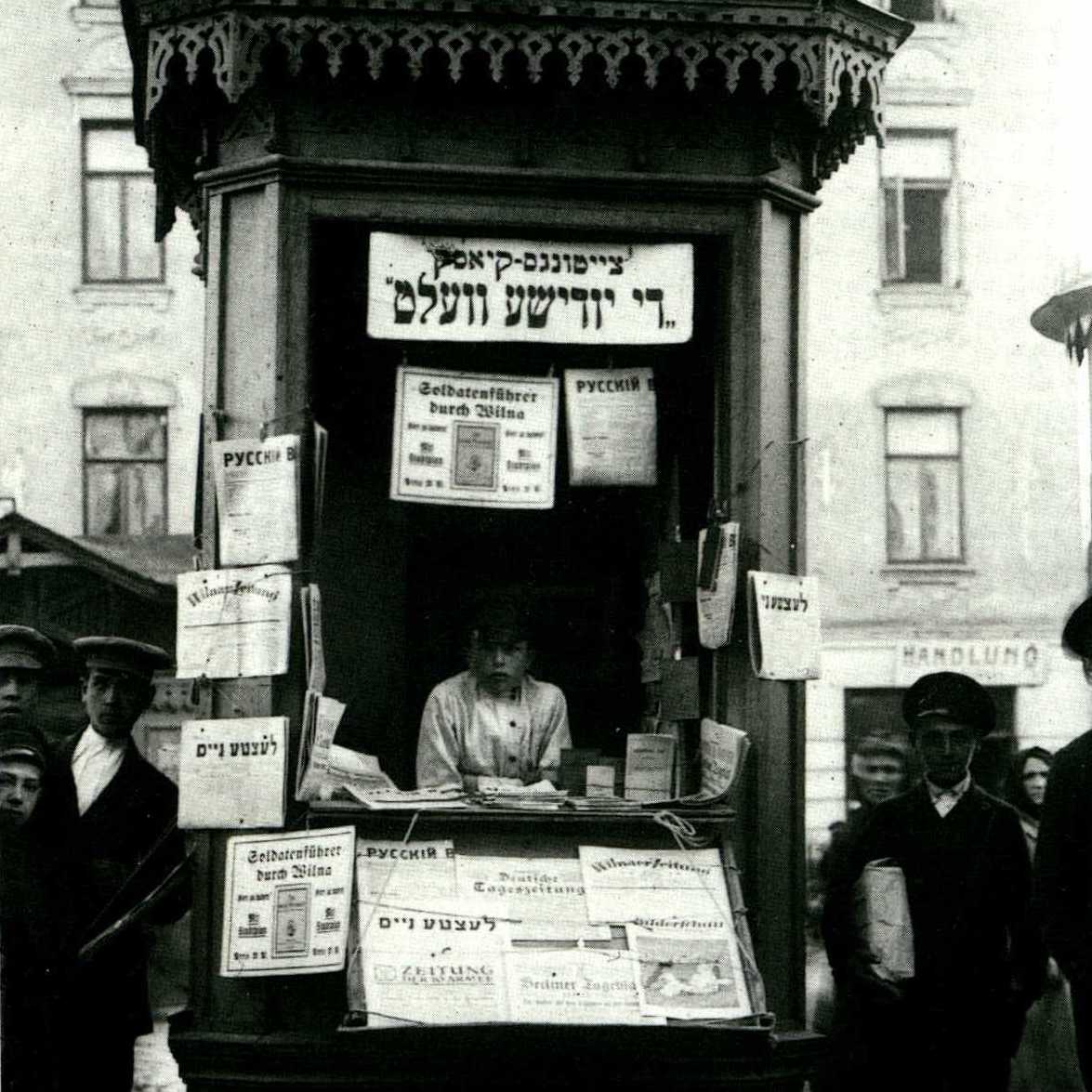
A newsboy in Vilna in the early twentieth century. Without guidance from professors at other institutions, I probably wouldn’t have selected this fascinating city as my thesis topic!
Of course, there are ways around this. For one, there is probably a professor on campus whose area of expertise has something in common with your project. My thesis adviser does not work on Eastern Europe, for example, but she is an expert in writing urban histories. So even though Vilna is new to her, she has been invaluable in guiding my methodology and argumentation.
She has also encouraged me to reach out to faculty and graduate students in other departments and at other institutions who might be more familiar with Vilna itself. Connecting with these scholars has turned out to be one of the most valuable aspects of my thesis process thus far. I’ve compiled some tips for accessing the rich academic network beyond your particular department or university.
Choosing a topic for independent work can be a challenging task. It can be difficult to narrow down the seemingly infinite research topics to one that you find compelling (see my post here with tips on how to do that), and on top of that, you have to juggle your research with coursework that may be unrelated. It isn’t always easy to switch gears between, say, literary criticism and your STL. That said, your coursework need not be totally separate from your independent work, and need not even parallel your independent work at the exact time you are conducting it. With courses for the spring semester just released, I want to suggest ways that you can structure your selections to complement (and even supplement!) your own research. This way, next semester, your own independent work may not actually be so “independent” after all.
While advising and formal research mentorship have been highly rewarding at Princeton, I have found more informal discussions with friends and classmates here to be invaluable in the development of my own ideas.
A professor recently offered this advice in class: if writing a paper isn’t going well—if you’re feeling the notorious “writer’s block,” for instance—then try writing a letter instead. In his view, this needn’t be a real letter to an actual person. The main point is to try to explain what you hope to achieve in a different way to a different audience.
Though I’d never tried letter writing of this sort before, I immediately appreciated my professor’s advice because of how it connects to a practice I’ve implemented in my own life for quite a while. That strategy is to “talk it out”—to take a break from a task that’s frustrating me and talk through the problem with a friend. This is the first reason that I think talking about research is helpful for each of us: it helps us clarify our aims and work through challenges.
As a sophomore planning on declaring in neuroscience, I’ve been wondering a lot about the types of research projects neuroscience majors do for their independent work and senior thesis. To get a better feel for these projects, I’ve been reaching out to neuroscience faculty, sometimes via cold emails – a task made easier with the help of this post. However, I recently wanted to reach out to one of my current neuroscience professors in particular, both to hear more about his undergraduates’ research projects and to develop a better relationship with him.
Building positive relationships with your professors is important and rewarding. It’s easy to regard getting to know professors as a purely professional opportunity: that is, for the purposes of soliciting a recommendation or finding a lab position. However, this process is rewarding in other equally important ways: for example, I enjoy when professors explain the trajectory of their own careers, since it has helped me clarify my own academic and extracurricular interests. Often times my meetings with professors have developed into personally meaningful friendships that I hope will extend beyond my time at Princeton.
A Coffee Chat at Prospect House
Although most of us would agree its important to build relationships with professors, it can be more difficult to know how to accomplish that. How do you approach a professor? Where and when do you meet? And what do you actually say to them? All of these questions ran through my head as I wondered how I would go about meeting the neuroscience professor I mentioned above. Meeting professors can be nerve-wracking – that’s why I’ve put together the eight tips I used that streamlined the process.