A blank Tiger Junction page ready to be filled with the courses for next semester.
Planning your courses while doing research can feel like a juggling act—one that involves not just your academic requirements but also your research commitments and, of course, your own well-being. At a place like Princeton, where opportunities in labs and research projects abound, learning how to navigate and integrate everything into your schedule can make a huge difference.
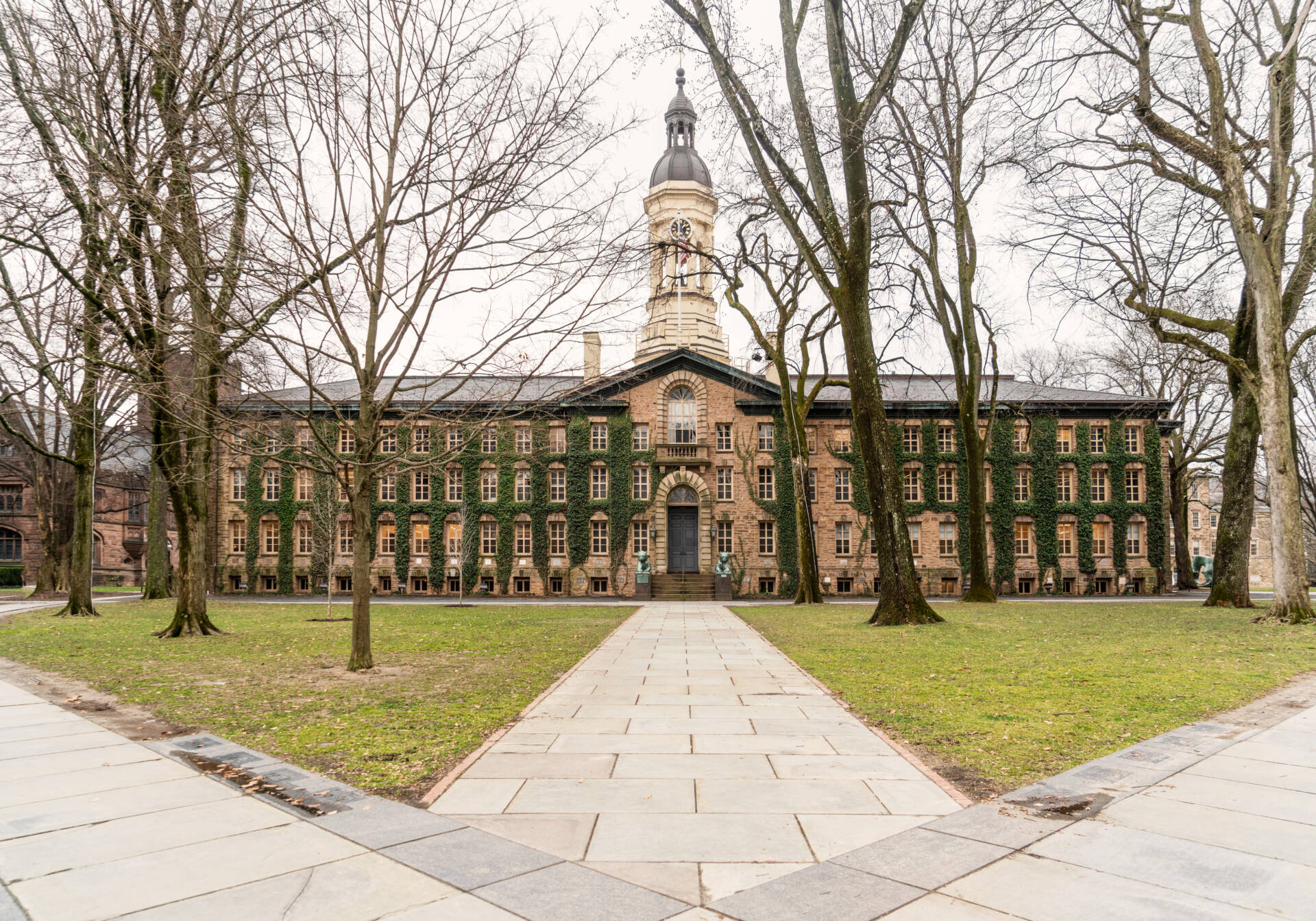
Nassau Hall on Princeton’s campus. Photo Credit: Adriana De Cervantes.
I think that November is a critical month for the fall semester. Many students feel more pressure to do better for the rest of the semester as midterm grades come in. Students in labs start to have their lab work amp up at this point in the semester, especially newbie researchers who just joined a lab in September. That ‘just getting to know the lab’ phase is over; the sun is setting at an outrageous time; the weather is getting colder; and the professors seem to make less sense. Holidays feel like they’re right around the corner, so the end of the semester feels so close yet so far. In short, November and the first half of December is a weird limbo phase that, at its best, is a transition/preparation period and, at its worst, purgatory. With this pressure in mind, it becomes important to recognize how to balance research work and studies and mental health and social life and…and…and the list goes on.
A quiet corner of a library where you might find a new way to approach your project.
We all have those moments when we doubt where we’re headed, even when the path we’re on is one we chose with so much excitement. Maybe it’s that feeling of disconnect, where you can’t quite see why you’re doing what you’re doing—even if it’s the thing you used to call your dream. And when it comes to research, that slump can feel even more intense.
On and off campus, Princeton offers many opportunities to build up one’s own library. (Leather-bound editions not guaranteed.) Photo credit: Iñaki del Olmo.
Reading is a fundamental part of one’s time at Princeton. Whether for sciences or the humanities, a great deal of coursework and independent research consists in careful and active reading. Reading for pleasure by oneself or as part of reading groups is also a common pastime, or at least a shared aspiration, of many students on campus. Moreover, Labyrinth Books’ and the University’s decision to cease coursebook sales has sparked a mix of dissatisfaction, outrage, and inventive solutions. With the end of textbook resales paired with personal interest for especially thought-provoking class readings, it is not uncommon for students to keep (at least some of) their coursebooks. It is quite natural, then, that over the course of one’s four years at Princeton, undergraduates tend to amass a good number of books and start to build up their own personal library. Thus, beyond our formidable library system and Labyrinth, it is good to know where and how to get books, even if such scholarly scavenging will not supply all of one’s textbook needs. Besides, building up one’s store of knowledge (and thought-provoking entertainment) is a worthwhile pursuit in itself.
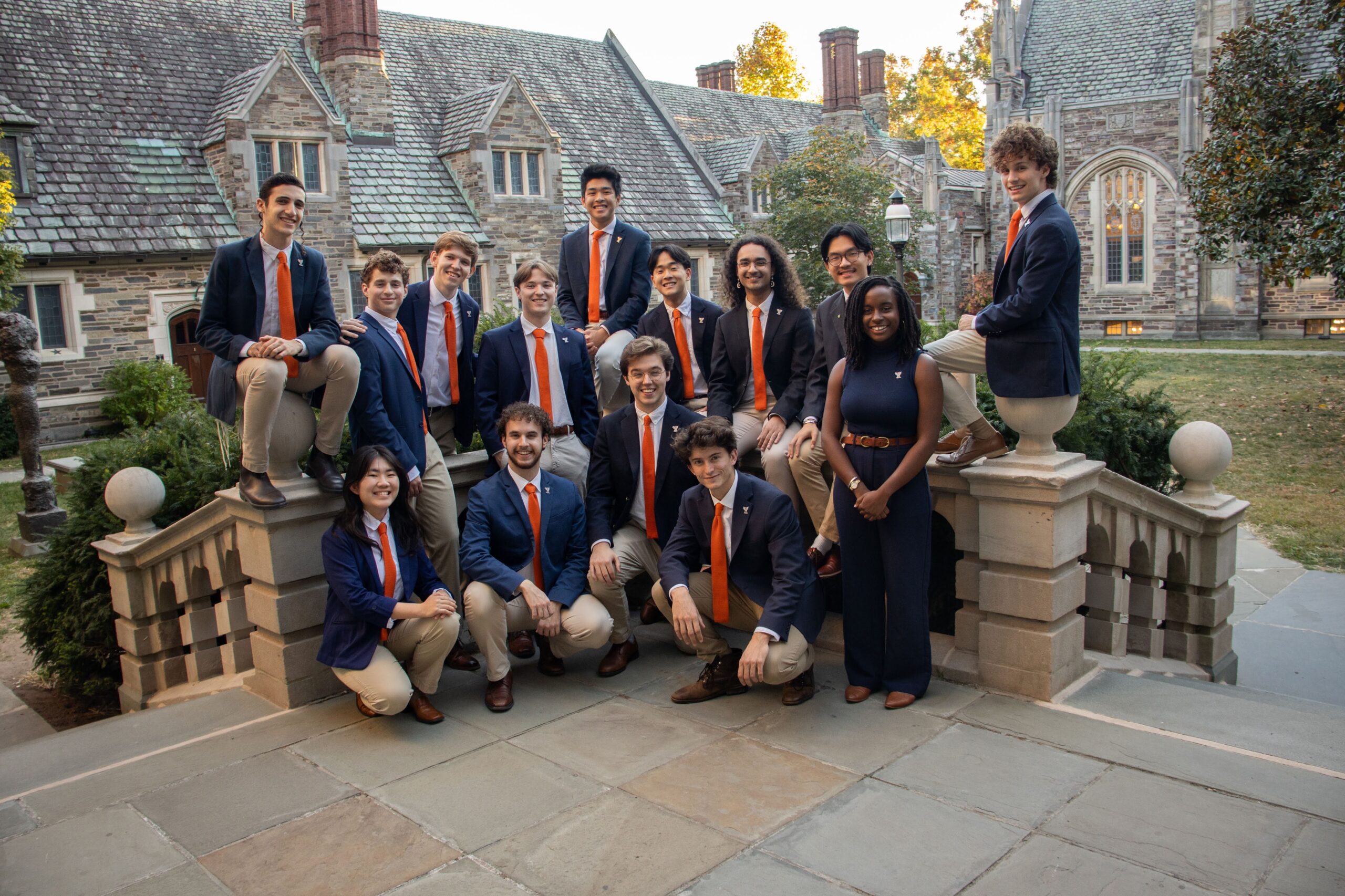
Photo of the Footnotes, Princeton’s fresh low-voice a cappella group founded in 1959
Imagine standing in front of a big audience, heart racing, ready to blend your voice with others and hit the notes of an intricate a cappella arrangement. Every beat, every breath, is crucial. Every time I stand on stage or under an arch with my a cappella group, the Princeton Footnotes, I think of how similar singing and music feels to what I do in the lab. You might be thinking that singing in an a cappella group and doing research are worlds apart. However, these two passions have formed a bond in ways that I never believed possible. In fact, the creativity, collaboration, and discipline I have channeled in being a part of the Footnotes have made me a better researcher—and vice versa.
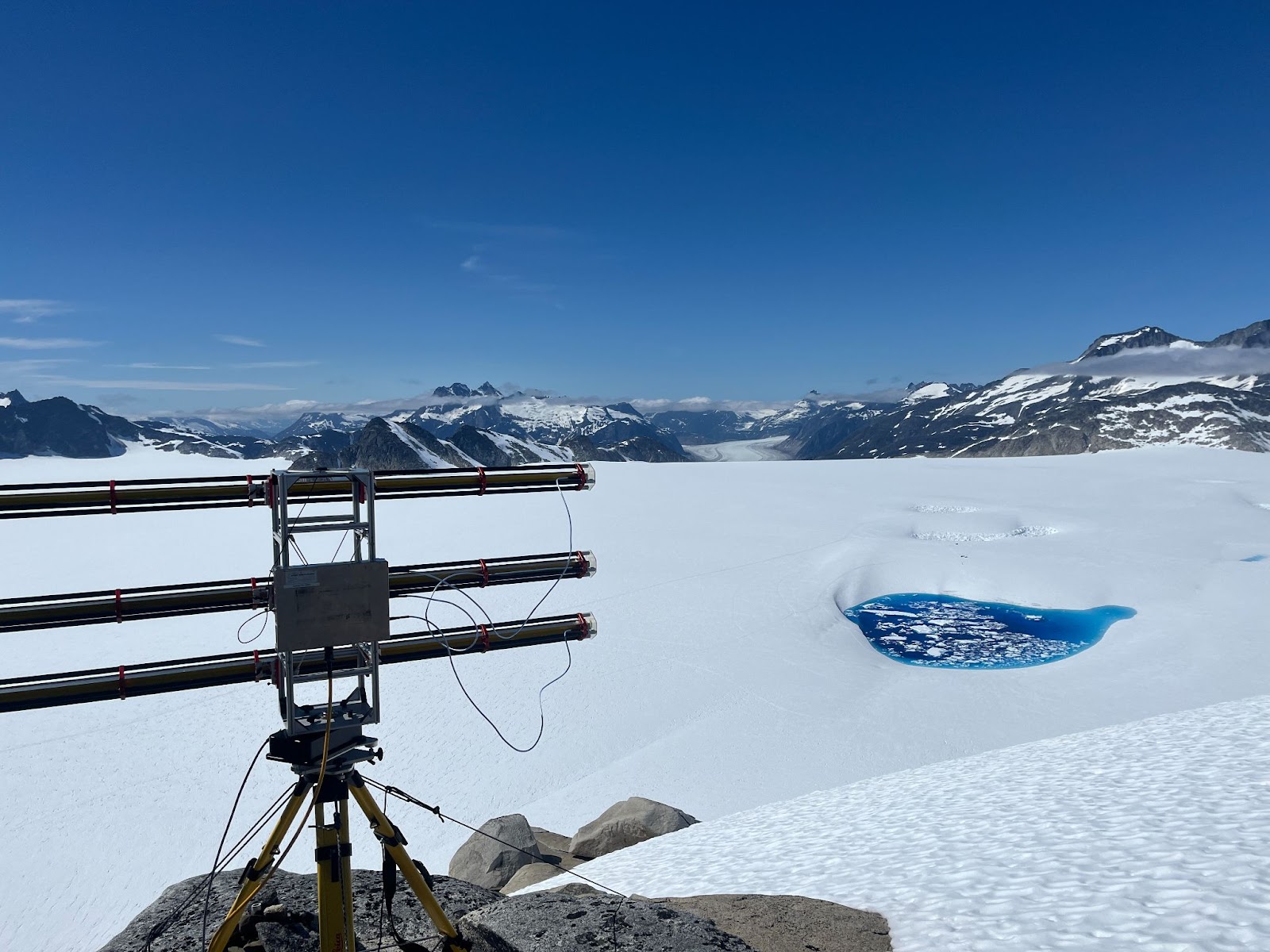
A Terrestrial Radar Interferometry (TRI) station overlooking Echo Glacier — a field site used by NASA as an analog environment to the moon Europa.Photo credit: Advik Eswaran.
Students across a variety of disciplines (or fields, if you will) have the opportunity to perform fieldwork at Princeton. In contrast to lab work—which involves performing experiments or analyses within a controlled on-campus environment—fieldwork takes place, well, in the field. Researchers venture out into the wide, wild world in pursuit of somehow collecting useful data from the vast webs of chaos that surround them. In my home department of the Geosciences, fieldwork is the norm: students go out to geological field camps or embark on oceanographic cruises to gather data about the raw Earth that surrounds us. However, fieldwork is truly possible in any discipline.
This past summer, I conducted my own fieldwork as part of the Juneau Icefield Research Program (JIRP). For two months, I lived and conducted glaciology research with about 40 other students, staff, and faculty on the glaciers of the Juneau Icefield—an interconnected system of over 140 glaciers spanning 1500 square miles across southern Alaska and northern Canada. It was one of the most incredible—and intellectually rewarding—experiences of my life. Here, I’ll share some stories from my time on the Icefield, contextualizing them within some broader lessons I learned about how field research operates.
Spotlighting the experiences of the 2023 IIP Virtual Poster Winners
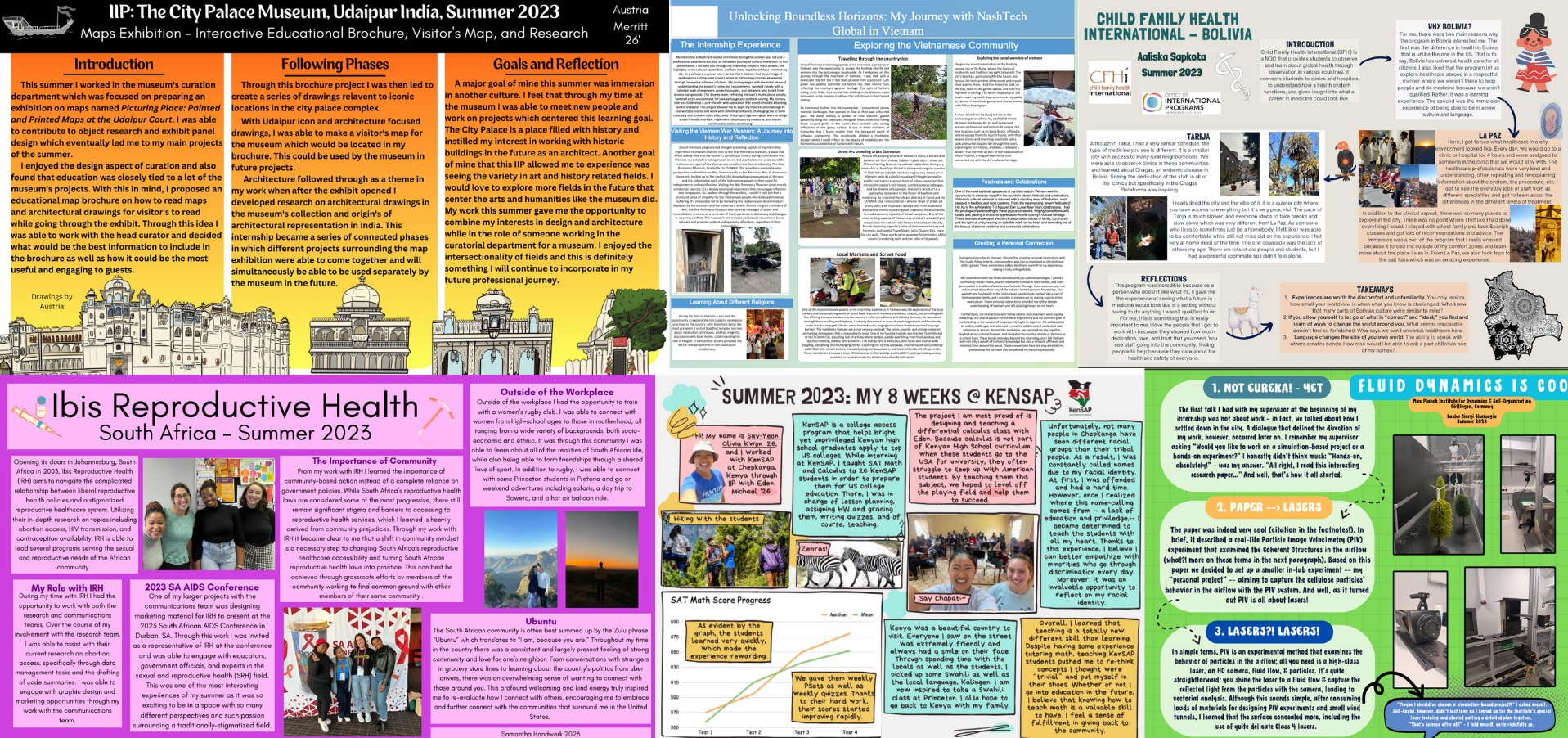
Several of the winning virtual posters from the 2023 IIP Program
Applications are currently open for the 2025 Summer International Internship Program (IIP)! This incredible program connects 1st, 2nd, and 3rd year students with an international institution for ~8 weeks to pursue a project that allows them to explore different careers, cultures, and workplace environments. Many of these projects empower students to take on various research endeavors, learn new research skills, and apply their research findings to make an impact on global communities. Here are several spotlights of Princeton students who shared their internship experiences and were winners of the 2023 IIP Virtual Posters. You can also view all of the poster reflections.
“What’s your priority this semester?” my friend asked after our first meal together post-summer break. My instinct was to say classes, internships, research—after all, we’re at school, preparing for life after college. The pressure to secure a job or get accepted into graduate school looms large. What could be more important than staying focused on the future? But none of those answers felt right. I paused for a moment before saying, “being happy.”
Jeremy Kiil is an alum from the Class of 2024 who majored in Electrical and Computer Engineering. He now works as a power engineer at Qualcomm in Raleigh, NC. While at Princeton, he was a member of Princeton Racing Electric, a worship leader in Princeton Christian Fellowship, and Vice President of Colonial Club.
At Princeton, I’ve formed close friendships with students across all years and departments, witnessing their challenges, hard work, and achievements, from difficult courses to their independent work and senior theses. When my friends often name-drop courses from their departments and share exciting insights from their day, I realize I haven’t taken many of those classes myself. This realization sparked a desire to generate deeper conversations about their academic interests, even if I don’t fully grasp all the technical details and concepts of their field.
One of these conversations was with Jeremy Kiil ‘24 about his experience in ‘Car Lab’ (formally, ECE 302: Robotics and Autonomous Systems Lab), a required course for all ECE juniors. To my surprise, our conversation wasn’t focused on the nitty-gritty details about hardware components. Instead, Jeremy shared insights applicable to all students. I found his advice on making consistent progress, staying resilient, and taking care of oneself as wonderful reminders for everyone. Inspired by our conversation, I wanted to document and share it with a broader audience.
A few weeks ago, while I was volunteering with the Trenton Youth Orchestra, a student asked me, “Do you think you have a lot of discipline?” I honestly didn’t know how to respond. Discipline hasn’t been something I’ve spent time thinking about as a college student. While the concept of discipline had been hammered into my brain by soccer coaches and band directors before college, I found myself thinking about what discipline really means here.