Demystifying the “Black Box” Part I: Holy Moly I Have to Write a Thesis

This is it. After an R3, two JPs, and the countless research papers in between, I’m expected to craft the 15,000 to 20,000-word magnum opus of my Princeton career. And I have to say, I still don’t really know how it’s all going to go down.

There’s something I like to call the “black box” of every Princeton student’s research career. You’re given a massive independent research project to undertake, then some wizardry happens in Firestone, a lab, or studio, and voilà everything is complete! This second “magical” step is the black box: no one from the outside can see what goes into the project’s actual assembly. We only see stress as a side effect of this mystical process, and then a final product. Throughout the year, I hope to demystify this black box by revealing my own thesis-writing process: the highs, lows, brainstorming, writing, and of course, the research.


The “black box” metaphor is actually computing jargon for a system only understood in terms of inputs and outputs, with its inner workings remaining mysterious. To paraphrase one of my favorite movies Se7en, “What’s in the [thesis] box?” We’ll find out together!
So what does writing my thesis look like in its initial stages? Right now I’m still brainstorming and narrowing down my thesis topic, which will be about how Public Service Announcements (PSAs) subvert the capitalist practices within traditional commercial advertising, using some French theory as a lens (shout out to the Department of French and Italian!). Fortunately and unfortunately that’s a broad topic with nearly infinite directions, so I’m working on figuring out more specific direction.

I’m beginning this process by looking at my JPs, which also dealt with my thesis topic, but used a small number of specific examples. Both papers were divided into sections where I argued different points, and while re-reading them, I’m treating each section as if it were its own paper related to my thesis. I’m asking myself questions like: Assuming I had ten more pages to write for each section, which other theories could I incorporate to corroborate the arguments I was making? How can I specifically incorporate the topic of capitalism? How would different theorists critique my arguments, and how can this inform a strong rebuttal?

Continue reading Demystifying the “Black Box” Part I: Holy Moly I Have to Write a Thesis

The Conference that Will Prepare You for Your Final Paper in Writing Seminar

Writing seminar is a demanding and rigorous rite of passage at Princeton. The packed schedule, along with the constant writing and peer editing, makes it seem like you’re taking two courses instead of one.

The Mary W. George Freshman Research Conference is a great resource for current and future writing seminar students.

But for all you first years, I promise (as a *hopefully wiser* sophomore) that there’s a lot that you can get out of this one course that Princeton requires all first years to take. Although writing seminar is a trying class, it really is the basis of writing for all your future classes at Princeton. (I know, I know, I sound like your writing seminar professor. I’m sorry!)

I still remember the dread I felt when I first heard about the R3, or revised essay #3. For the R1 and R2, the argument was, to a certain degree, provided by the professor. The R3 asked me to develop “an original argument,” and the possibilities for the research topic seemed endless. I had no idea where to start. How was I going to write this?

Continue reading The Conference that Will Prepare You for Your Final Paper in Writing Seminar

Developing Open Spaces on Campus: Spatial Analysis of Princeton Land Use

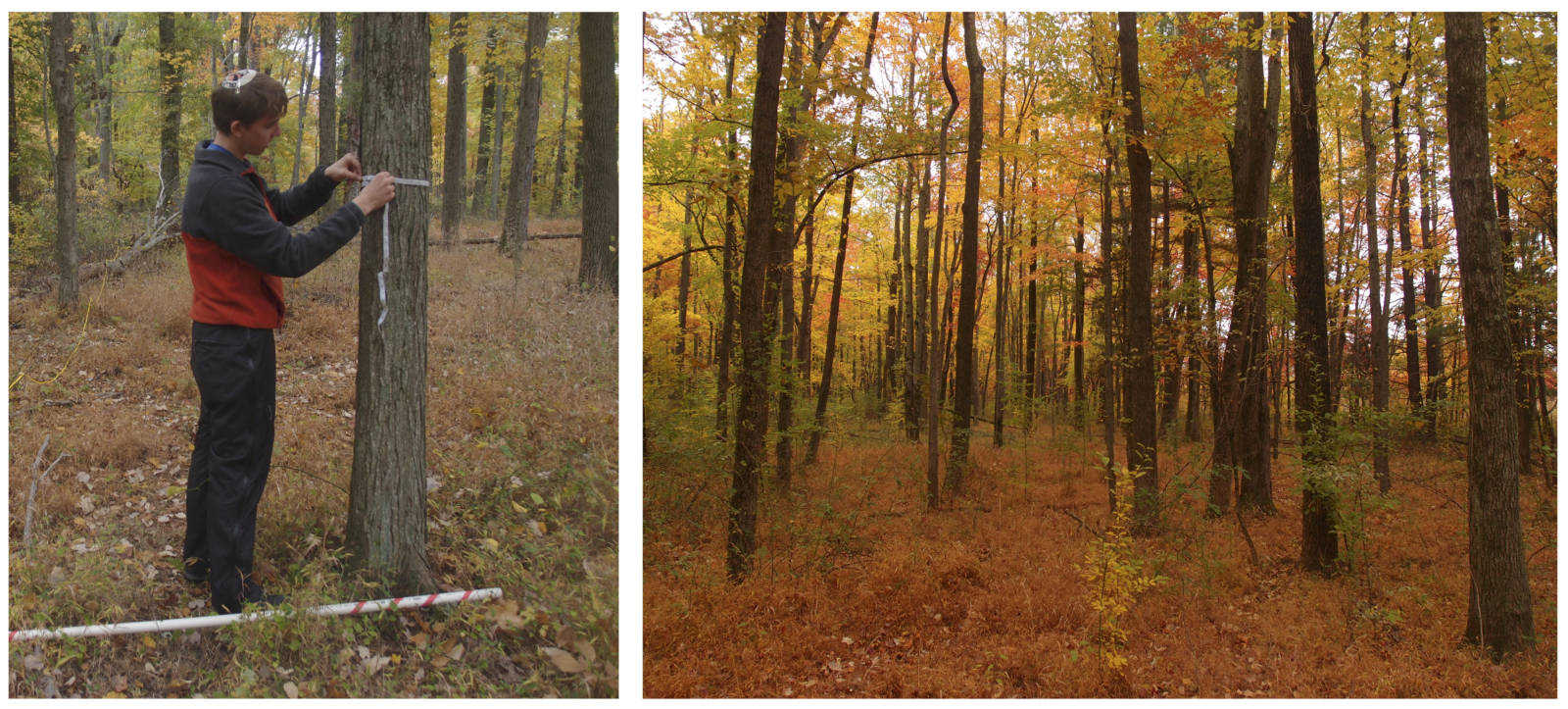
Last year, Princeton announced a plan to expand the University by 2026, adding another residential college and building new athletic facilities on the south side of Lake Carnegie. In what ways will this latest expansion transform our campus, and how does that change fit with the university’s historic land use? These are the questions that my twin brother, GEO senior Benjy Getraer, set out to answer last year in a class project for GEO 90 “Analyzing Ecological Integrity: An Assessment of Princeton’s Natural Areas.”

Research often involves a spatial dimension–you want to find out not only what is happening but also where. This is an important component in many disciplines: political scientists want to know how voting results breakdown by precinct or change over time; linguists may want to understand how dialects vary regionally; climate scientists want to know how much different parts of the globe are warming

To address these types of large-scale research objectives or answer smaller questions such as Benjy’s, you can use Geographic Information System (GIS) software to display, edit, and analyze geospatial data. Spatial analysis provides a unique way to study data and add diversity to figures and data visualization. In this post I will introduce basic concepts of geospatial data and one application of GIS analysis by walking through Benjy’s project, mapping land use change on Princeton’s campus.

Benjy Getraer ’19 analyzed historical imagery of Princeton’s campus to track land use change over the past 75+ years. The first step was to align the original overhead photography by geo-referencing the raster images.

Continue reading Developing Open Spaces on Campus: Spatial Analysis of Princeton Land Use

How to Study in College

After enjoying a summer of traveling, volunteering, camping, interning, hanging out with friends or whatever other shenanigans you might have been up to, it can be difficult to get back into the Princeton mindset.

Even though we are already a month in to the semester, I am still trying to remember how to do school! If you’re anything like me, you’re still working to rebuild your study habits.  As we all begin to prepare for midterms (eek!), here are some study tips and tactics tailored to your learning style.

Continue reading How to Study in College

Starting New Research: How to Learn What You Don’t Know

“I don’t know what I don’t know.”

That is what I was thinking when my summer internship mentor asked me if I had any questions. Having only taken MOL214 and CBE245, I was uncertain about what research at a bioenginnering lab on campus would be like. After attending a lab meeting the first day of my internship, I was overwhelmed by all of the new information I was receiving and thought I would never understand metabolic engineering. By the end of my internship, however, I was working independently and designing my own experiments.

When beginning a new research project, particularly in a new field, getting up to speed can be challenging. But if you approach the project efficiently, you will find that this task is not as daunting as it sounds. These are a few strategies that helped me when I entered my summer internship.

Understanding complex mechanisms was challenging, but these strategies helped me along the way.

Continue reading Starting New Research: How to Learn What You Don’t Know

How to Write a Precept Response

Having a pen in hand (and using it with some frequency) will set you up for active reading.

The precept response is a veritable Princeton institution, right there alongside Reunions, long nights in the library, and overly-friendly sidewalk squirrels. Somehow, I didn’t encounter this special form of assignment—where, as the name suggests, you “respond” to that week’s readings—until my sophomore year, but now I feel as though these responses set the rhythm of my academic week. On Mondays I’m responding to readings for a seminar on mythology. Wednesdays, for a history of science course. And Fridays, for a junior colloquium in Religion. Yes, friends, I cannot escape the precept response, and if you’ve read this far, I suspect you cannot either. As a celebration of our shared weekly assignment,  I’d like to offer some tidbits of accumulated wisdom for completing the precept response. Continue reading How to Write a Precept Response

How to Pick a JP Topic in a Research Seminar You Know Nothing About

Robertson Hall, home of the Woodrow Wilson School

As a concentrator in the Woodrow Wilson School, I have finally reached the much-discussed junior year, a year full of research seminars, task forces, and not one, but two JPs. Before the semester started, I was given a list of 8 to 10 research seminars and asked to rank my preferences. I’m interested in researching race and discrimination, but the limited selection meant that none of my options exactly matched up to this. Now I’m in a seminar about Maternal and Child Health in the U.S., and I have to face the nerve-wracking question: how do I pick a JP topic in a subject I’m totally unfamiliar with? For me, the first step started with a simple attitude change.

Continue reading How to Pick a JP Topic in a Research Seminar You Know Nothing About

Collaborating with Graduate Students

Sometimes graduate students are the older siblings you didn’t know you had.

In my Orange Key tours, I always emphasize how exciting it is to be an undergraduate student at Princeton. Unlike many other leading research institutions, Princeton maintains a strong focus on undergraduate teaching. This results in an unusual dynamic between undergraduates and graduate students on campus. In general, the two populations are pretty segregated. Aside from the preceptor-student relationship (and, of course, the ReMatch relationship), I haven’t encountered a whole lot of avenues for collaboration between undergraduates and graduate students in our research projects.

Map of Northeastern Native tribes (ca. 1710), the subjects of my JP research

Continue reading Collaborating with Graduate Students

Active Engagement and Mentorship on the Juneau Icefield

For over 70 years the Juneau Icefield Research Program (JIRP) has run an eight-week field research expedition on the glaciers spanning Juneau, Alaska and Atlin, British Columbia. JIRP is the longest continuous glacial monitoring program in North America. But what truly sets the program apart is its commitment to active student participation and mentorship: all of the summer research is carried out by students, ranging from high schoolers to Ph.D. candidates, and mentored by field staff and faculty from around the world.

Active participation and mentorship are vital aspects of all student research. In my experience, I learn way more from engaging with research in the real world than from reading, listening to lectures, or completing recipe-type lab exercises. So, when I got the opportunity to join JIRP this summer, I jumped at the chance.

Research in action! The author drilling an ice core (credit Alex Burkhart) and identifying alpine vegetation (credit Hannah Mode) with fellow ‘JIRPers’ on the Juneau Icefield.

Continue reading Active Engagement and Mentorship on the Juneau Icefield

Flexibility of Research: What to Do When You Feel like You’ve Hit a Dead End

Research can be a truly thrilling experience–interesting data, new findings, surprising collections. However, research can also be incredibly frustrating, namely when you feel like your work isn’t going anywhere.

If you’ve ever been really excited about a topic, done a load of research, and still found that you aren’t making forward progress, this post is for you. I’m talking about hitting tough obstacles in your research–walls you can’t seem to get over–reaching what seems like a dead end.

I’ve been there before (oh more times than I would like to admit), and what I’ve found is that normally, this frustrating lack of a solution is not an indicator that your research is ‘wrong’ or isn’t worthwhile. In fact, it might actually mean that there is another question buried in your topic that needs to be addressed primarily. Continue reading Flexibility of Research: What to Do When You Feel like You’ve Hit a Dead End