Students who are interested in research – especially junior- and senior-year students preparing for independent work – are often encouraged to master the use of a fully-featured statistical software like Stata or R in order to help with their statistical analysis. For example, in the Economics program at Princeton, Stata is often the software of choice for classes like ECO 202 (Statistics and Data Analysis for Economics) or ECO 302/312 (Econometrics). Similarly, other departments (for example, for the Undergraduate Certificate Program in Statistics and Machine Learning) offer SML 201 (Introduction to Data Science) or ORF 245 (Fundamentals of Engineering Statistics) to prepare students in the use of R. Usually, students end up developing a preference for one or the other even if they eventually grow proficient in both. While our coursework (rightly!) emphasizes the statistical methods, we, as students, are often left to navigate the intricacies of the statistical tools on our own. This post is a primer of some of the core packages in R that are used for advanced statistical analysis. As you begin to search for tools in R that can help you with your analysis, I hope you will find this information useful.
Tag: summer research
When most people think of summer, they think of warmer weather and longer days filled with newfound time to relax, travel, or to try something new. However, for many Princeton students, one summer topic that might be a source of both excitement and stress is summer internships. The summer can be the ideal time to pursue opportunities related to your interests in a more hands-on way, and summer internships provide (potentially paid) opportunities to do so. Many internships also provide avenues for Princetonians to do extensive and meaningful research, which, given the pace and workload of a typical Princeton semester, may be difficult to find time for during the academic year between classes and other extracurricular commitments.
The internship search process may be overwhelming, especially for freshmen and sophomores, who are still learning about the abundance of opportunities that Princeton has to offer. This post focuses on setting yourself up for a successful internship search by outlining popular programs, resources, and deadlines to ensure that you are able to find experiences that will enrich your (summer)time at Princeton. This list is not exhaustive and focuses on internships that include aspects of research, some combined with community service and professional development.

Whether you are thinking about applying to summer programs or graduate school, you most likely will need to ask for letters of recommendation for the application. Last year, I applied to various summer programs, but I didn’t start thinking about letters of recommendation until January, although most of my deadlines were in mid-February. Having only a month to ask for letters of recommendation was barely enough time, so this year, I am beginning to think about asking for letters of recommendation much earlier. Recommenders usually appreciate not being rushed, so don’t wait too long if you are also thinking about asking for letters of recommendation – one month is the minimum time. Here are some additional tips that are good to keep in mind when thinking about asking for letters of recommendation.

In the summer of 2021, I participated in a virtual global seminar in Cyprus entitled Conflict, Borders, Multilingualism, Translation. I was particularly drawn to the idea of learning about Cyprus’ history and culture through the lens of multilingualism and translation. Personally, language has always played a key role in my understanding of identity and culture. Three languages are spoken in my home (Filipino, English, and Chinese Hokkien), and growing up in this way has made me very conscious of language-culture influences, code-switching, and nuances in connotation.

Applying to this global seminar was a spontaneous decision; I major in MAE and am more used to spending my summers doing research and technology. However, when I read about this seminar in an email, I knew that it aligned with my personal interests in the social sciences. Because of the great time I had during the seminar, I am writing to motivate people to take advantage of the breadth of courses offered by Princeton and try studying something totally spontaneous and new!
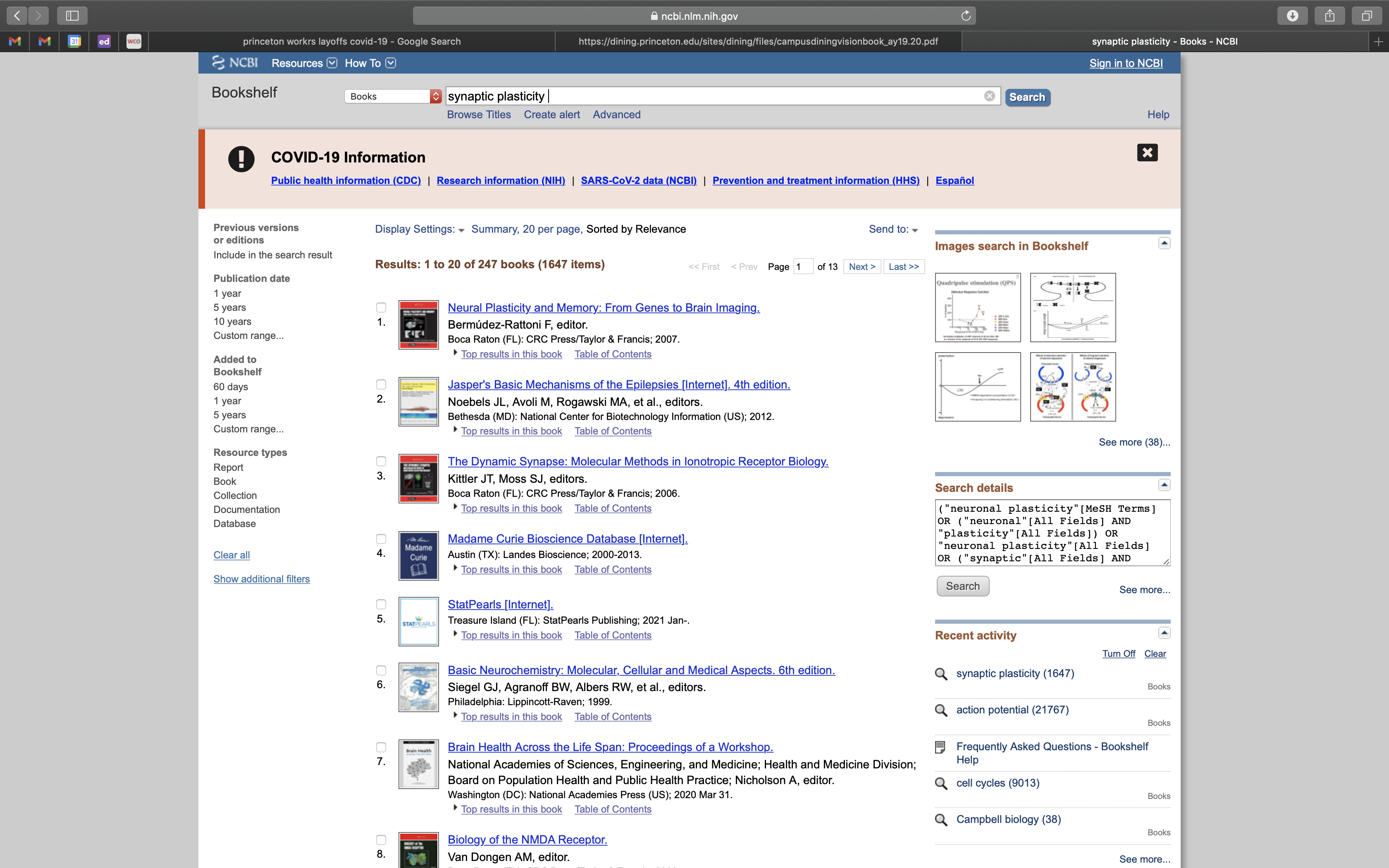
Have you ever come across something in class that you wish you could get a better Have you ever been wondering more about how proteins are made in the body? Or have you ever been looking for a specific type of lab experiment protocol for your independent work? If yes, then look no further than the National Center for Biotechnology Information (NCBI) website! It contains dozens of resources, some of which I have found to be very handy in my own research and school experiences. The site is tailored for students in the life-sciences field, but there is a lot of breadth in the resources available—you’ll be able to find useful tools regardless of whether you’re a MOL or CHM major, or if you’re interests lie in researching chemically synthesis mental health, or neurodegenerative diseases.

A very useful tool on the NCBI website is Bookshelf. There is a search bar at the top of the website where you can input some topic, book title, or field name, and the program will return a variety of different reference materials relating to the query, including full scientific textbooks, book chapters, studies. On the side, there are often figures and graphs that may relate to your search.
As I mentioned in my last post, this summer, I assisted in research by Dr. Kalhor at the Princeton’s Center for Policy Research on Energy and the Environment (C-PREE) in examining the effect of anomalous weather on economic activity as part of an internship funded by the High Meadows Environmental Institute (HMEI) at Princeton University. While my previous post focused on my insights in preparing for internships to maximize your experience, in this post, I want to focus on one of the technical challenges that I faced during the internship: (a) handling big data; and (b) one of the powerful tools that we have as students at Princeton students to handle large amounts of data – Princeton’s large computing clusters.
Have you ever wondered about your family history?
Besides the DNA kits offered by Ancestry and 23andMe, there are more concrete ways of piecing together the different tales that aunts and uncles spin at family reunions. Thankfully, as Princeton students, we are given access to a powerful database to locate, explore, and utilize different genealogical records to the benefit of both our personal and academic research: the Ancestry library. I had earlier discovered this resource through the class HIS 388: Unrest and Renewal in Urban America, whose instructor is Alison Isenberg, who was just featured in PCUR!
You might be asking: What kind of records does Ancestry keep? The records are multitudinous. From census records to wills to obituaries to yearbook photos, Ancestry keeps records from many different places, different times, and different people. The bulk of these records are government documents, often created, collected, and stored by bureaucrats for the purpose of institutional record-keeping and tracking individuals. According to Ancestry, these records are collected from different archives of information across the world, where they are then digitized, made machine-readable, and uploaded to their public database.
So, what does this all mean? What can we do with these documents? Let me show you.
As I mentioned in a previous post, this last summer, I assisted in the research by Dr. Elmira Kalhor at the Center for Policy Research on Energy and the Environment (C-PREE) in examining the effect of anomalous weather on economic activity, as part of an internship funded by the High Meadows Environmental Institute (HMEI) at Princeton University. Under Dr. Kalhor’s guidance, it became a fulfilling experience as I had the opportunity to formulate a model of how business activity is affected by extreme weather and thus apply many of the economic tools and theories that I learned to a practical space.

Now that it has been about three weeks since I gave my final presentation of my work to HMEI, I wanted to take the opportunity to reflect on my time there. While the internship was very enjoyable, it also presented me with many challenges – technical ones related to the statistical analysis and the research itself and practical/logistical issues in terms of having a valuable and fulfilling internship. In this post, I hope to discuss some of the more practical issues and guidelines that you could use to help maximize the efficiency of your internship experience, especially if you are working on a research-intensive project.
As I near the end of my first two years at Princeton, I thought that it would be useful to reflect on my time here so far, and how I prepared (or often did not prepare) myself to take advantage of research and internship opportunities. As I mentioned in my last post, one of the most useful parts of my internship search this year was talking with the preceptor of one of my classes, as I had the chance to learn from the experience of an older student. Here, I thought I might try and put my own advice into practice by flipping it around: while I cannot claim to have anywhere near the same experience of our graduate counterparts, I thought that my experience might still be useful to current and future first-year students. These are some of the pieces of advice from my time here.
Due to the Covid-19 pandemic, a lot of in-person internships and research positions for students have been transitioned to remote opportunities. Last summer after my first year of college, I opted to take online classes over the summer because in-person opportunities were not a possibility. For this upcoming summer, I was hoping to gain laboratory experience in person, but my internship was also transitioned online. With only one summer left before I apply to graduate school, this left me with a looming question: will I have enough in-person research experience before I apply to graduate school?
Although this question bothered me for a while, I realized that I was approaching this issue from the wrong perspective. I feel as though many students are probably dealing with similar issues now that many summer opportunities have been canceled or moved online due to the pandemic. In this article, I am going to walk through the reasoning behind why you should not worry too much about lacking in-person research experience and also include some additional opportunities you should be on the lookout for.