Categories
Conduct Research Independent Work

Macs, Tablets, Photoshop and More: Exploring the Digital Learning Lab

Have you ever wanted to learn Photoshop or make a 3D model? Maybe you’re trying to edit a video or record a podcast?

This year, I have become a frequent visitor to the Digital Learning Lab (DLL), an interdisciplinary, digital creative space located in Lewis Library. I first visited the DLL in the fall in order to borrow a drawing tablet to make a digital illustration for an issue of Nassau Weekly. Since my first introduction to the DLL, I have continued to learn more about all that is offered there, and I had to share!

Categories
Conduct Research Independent Work

Professorship and Mentorship: An Interview with Molecular Biology Professor Zemer Gitai

This winter, for our seasonal series entitled “Professorship and Mentorship,” PCURs interview a professor from their home department. In these interviews, professors shed light on the role that mentorship has played in their academic trajectory, including their previous experiences as undergraduate and graduate students as well as their current involvement with mentorship as independent work advisers for current Princeton undergraduates. Here, Nanako shares her interview.

~~~~~

As one can see from the many PCUR posts on Junior Papers

Professor Gitai wants students to be open minded about doing independent work. 

and Senior Theses, independent work is a huge part of the junior and senior experience here at Princeton. However, everyone has different views on why this process is important, and different departments have different requirements. For this Winter Seasonal Series, I decided to interview Professor Gitai, who I met when I took MOL214: Introduction to Molecular and Cellular Biology in the fall of my first year at Princeton. Read on to learn more about the thesis writing process for concentrators in molecular biology, and how to make sure you get the most out of this process!


Categories
Conduct Research Independent Work

Get to Know your Department Before Concentration Declaration

The spring semester is in full swing, and, for sophomores, concentration declaration is quickly approaching. Obviously, choosing a major is a big decision which will dictate what discipline you study in most of your courses and possibly direct your professional career. However, your department will also define your academic experience as an upperclass student in other ways; each department has different requirements for independent work, different research opportunities for undergraduates, and a different type of community. I found that considering all of these variables helped me to choose my major, but doing so may necessitate a bit of investigating.

So if you are a sophomore about to choose your concentration, what can you do over the next couple months to get to know the department(s) you are interested in?

Here are some tips to get you started, with examples from my beloved home Department of Geosciences:

Members of the geosciences department on a field trip to Iceland in 2016. Undergraduates planned and led this trip which brought together graduate students, post-docs, professors, and administrators. The close-knit community and emphasis on undergraduates are two of the main reasons I declared GEO. Before you declare your major, I encourage you to do some research into the departments you are interested in and find out more about their communities and what kind of opportunities are open to undergraduates.
Categories
Conduct Research

A Research Reflection: Discovering Historical Documents in Rare Books

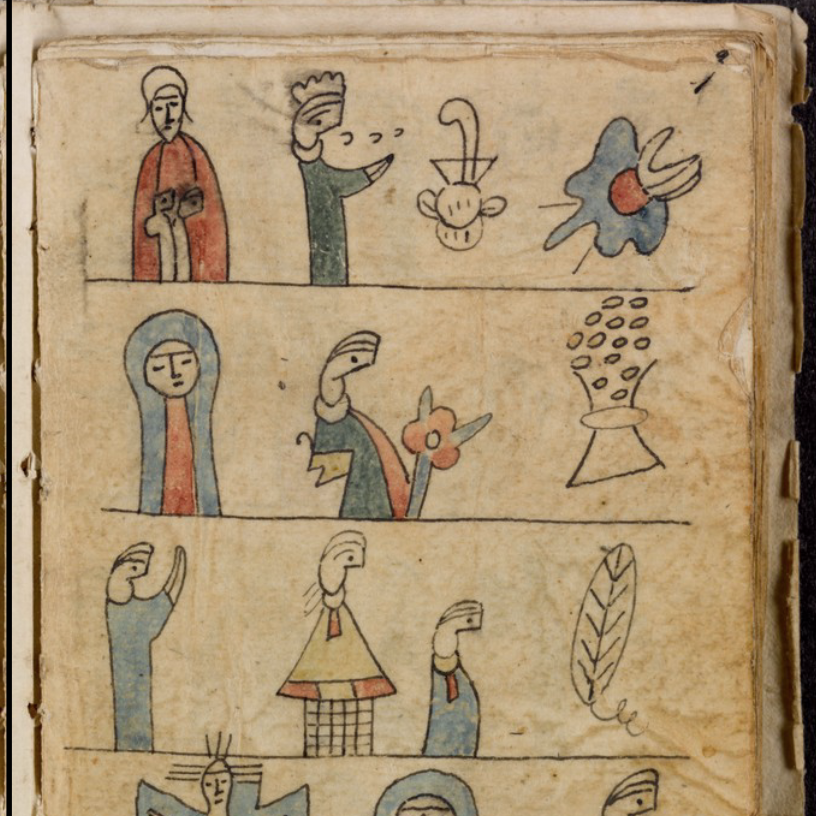
A sample page of the “Catecismo pictórico Otomí,” a rare surviving example of the sort of materials used by Spanish missionaries to attempt to convert Native American populations. A wonderfully digitized version of the catechism can be accessed via the library website.

This semester, I’m taking REL 357/HIS 310: Religion in Colonial America and the New Nation with Professor Seth Perry. Even though we’re only in the fourth week of the semester, we’ve been thinking about the final project for the class already, since it consists of independent research on a primary source from Firestone Library’s Rare Books and Special Collections Division, pertaining to the history of American religion. In this post, I’ll be sharing some of my reflections thus far on this project, which I hope will be of use to anyone engaging in primary source research—especially those feeling overwhelmed by the sheer volume of materials available to work with!

Categories
Conduct Research

How to Prepare for an Internship

As Princeton students begin to finalize internship plans, excitement and anticipation begin to take over, and we start to think about how to make the most out of our experience. Whether you are preparing for a summer internship or a one-day princeternship in the spring, you will learn the most if you begin preparing ahead of time. In this post, I will give a few tips on how to best prepare for an internship.

Students finalizing internship positions are eager to begin learning, and prior preparation can make a difference in that experience.
Categories
Conduct Research Independent Work Research Life

Trust the Qualitative: An interview with Sheila Pontis about Field Research

When we think of academic research, we often think of libraries or labs. We might imagine flipping through books, reading articles, or running lab experiments, but there is a branch of research that looks much different than this. In fact, it looks like the real world.

This branch is field research. Researchers from various fields apply this method of research, but in this post, I’ll be focusing on field research in design. Design is a big field with a wild range of applications. Design spans from information design (think infographics, instructions, maps) all the way to User Interface design (think apps and websites), but what’s at the root of design is a need to communicate effectively with people and facilitate understanding. The goal in design is to create systems that are effective–ones that work for their users. Accordingly, when designers conduct field research, they go out in the world and record qualitative data on people’s needs and experiences: What information are they searching for? What do they want out of a product? What parts of the current product are helpful? Which are frustrating and confusing?

In this interview, Sheila Pontis, a lecturer in the Keller Center, talks about her work and encourages designers and student researchers to embrace field research and trust qualitative data.


Categories
Conduct Research Independent Work

How to Survive Major Declaration Season

As spring semester gradually picks up the pace, there are many things to think about depending on your class year. As a senior, you might be thinking about your thesis deadline that is quickly approaching. Juniors might be focused on their Junior Papers. First-year students are preoccupied with mastering a new semester they’ve never experienced. Sophomores have a whole different challenge to tackle: major declaration (check out related posts here and here).

Categories
Conduct Research Independent Work Present & Publish Findings

The Writing Center as an Independent Work Resource

If you’re caught up on some of my previous posts, you’ll remember that I wrote my fall Junior Paper about shackling pregnant inmates in New York women’s prisons after the 2009 anti-shackling bill. I recently submitted my Junior Paper at the beginning of January, and it’s safe to say that it was a wild ride. To name a few challenges: I had to completely change my topic, I navigated tough interviews, and I spent a LOT of time editing my essay. Although I wrote a post about how to work efficiently during winter break, I pretty much ignored all of my own advice and ended up working on my JP each night, making my winter break anything but carefree and relaxing. However, I came back to school with a paper I was proud of.

The Writing Center is an incredible resource to utilize for independent work

But the challenges did not stop there. This JP was my first encounter with a substantial piece of independent work, and it included a whole lot of revisions after I had completed my first full draft. After reading through the paper, I scheduled a phone conference with my professor that left me with a plethora of edits to make in a very short amount of time. I made the changes, going through the paper with a fine-toothed comb, and the day after I got back to Princeton, I went to my first-ever appointment at the Writing Center.

Categories
Conduct Research

Reflections on Sophomore Fall: The Guilt of Not Constantly Working

As Princeton students, we generally like hectic schedules. As much as we complain about impossible p-sets, extensive readings, and multiple extracurriculars, we often feel as if we need to constantly be busy. Thus, we fill up every minute of our schedules because a packed schedule makes us feel as if we are pushing ourselves to constantly operate at full potential.

I intended to pack my schedule like this last semester by joining the bioengineering lab where I researched the metabolic pathways of yeast cells over the summer. (You can read more about my experience by looking at some of my previous posts).  It seemed logical for me to continue working in the lab during my sophomore year, as this would provide me with both experience and extra preparation for junior independent work and eventually my senior thesis. But because of scheduling problems and sophomore funding issues, I was not able to continue working during the fall.

As students, we tend to fill up our schedules so that we are constantly working on something.
Categories
Conduct Research Present & Publish Findings

Asking Your Professors for Feedback

After late hours on the B-floor and that last-minute citation dash, you never want to see that Dean’s Date paper again. I know the feeling. Over the past few years, I’ve developed the terrible habit of sending in my papers before reading them over – in a short-sighted attempt to avoid confronting my mistakes. But sometimes, as I’ve learned, the final draft can offer the most important learning opportunities.

It can be hard to revisit your final work. Sometimes I even avoid my Dean’s Date Firestone carrel for a few weeks after Dean’s Date.

In my experience, very few professors share feedback on final papers beyond the letter grade. And there is something satisfyingly simple about the “grading machine” – send a paper in one end and receive a letter grade on the other. However, this process obscures some of the more personal and pedagogical elements of an instructor’s grading.

Professors dedicate a significant chunk of their time each semester to reviewing and grading students’ work. They’re expert readers, writers, and researchers – you don’t want to miss this opportunity to receive their feedback. Each professor’s approach to feedback is different, but I can almost guarantee that they’ll have something insightful to say about your final project.