Turning a research paper into a visual presentation is difficult; there are pitfalls, and navigating the path to a brief, informative presentation takes time and practice. As a TA for GEO/WRI 201: Methods in Data Analysis & Scientific Writing this past fall, I saw how this process works from an instructor’s standpoint. I’ve presented my own research before, but helping others present theirs taught me a bit more about the process. Here are some tips I learned that may help you with your next research presentation:
More is more
In general, your presentation will always benefit from more practice, more feedback, and more revision. By practicing in front of friends, you can get comfortable with presenting your work while receiving feedback. It is hard to know how to revise your presentation if you never practice. If you are presenting to a general audience, getting feedback from someone outside of your discipline is crucial. Terms and ideas that seem intuitive to you may be completely foreign to someone else, and your well-crafted presentation could fall flat.
Less is more
Limit the scope of your presentation, the number of slides, and the text on each slide. In my experience, text works well for organizing slides, orienting the audience to key terms, and annotating important figures–not for explaining complex ideas. Having fewer slides is usually better as well. In general, about one slide per minute of presentation is an appropriate budget. Too many slides is usually a sign that your topic is too broad.
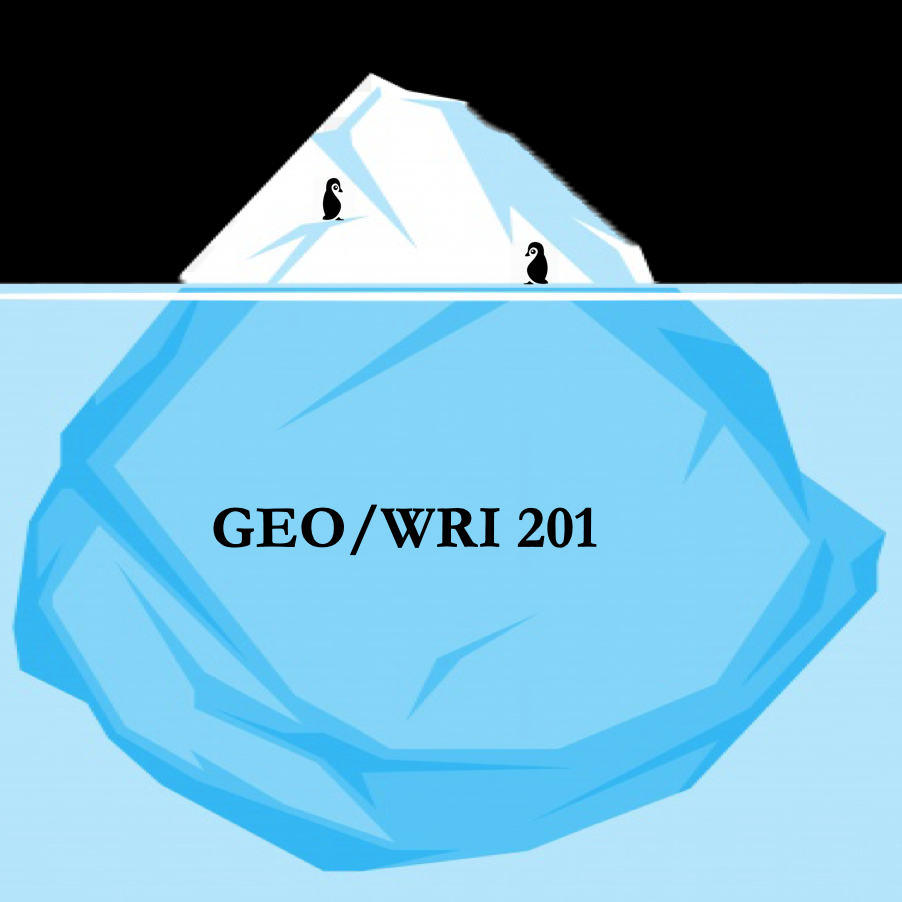
GEO/WRI 201 teacher Amanda Irwin Wilkins introduced me to the iceberg analogy: like the iceberg, the vast majority of research stays ‘beneath the water’; only a select portion is visible to audiences. Achieving this balance is not easy. It can be frustrating to present only a fraction of your work and difficult to identify which aspects belong above water. But in the end, you want to be presenting with the happy penguins on top of the ice, not flailing in the water.
Our friend, the humble bookshelf. I find that browsing shelves sparks my curiosity, causing me to pick up books that I might not even find in a standard keyword search.
Books are, in many ways, at the center of the college experience—particularly for my fellow students of the humanities and social sciences. At Princeton in particular, books are both the subject of many conversations and the object of much loathing (“Can you believe Professor X assigned us a whole book on top of next week’s reading?”). So, inspired by my own recent work with books in preparation for reading period and finals, I thought I’d use my post this week to discuss some ways to digest and analyze these valuable sources of information.
We’re done with half the academic year and you’ve probably started to think about what you’re going to do this upcoming summer. Many of you have probably taken advantage of two of the largest summer internship programs sponsored by Princeton: Princeton Internships in Civic Service (PICS) and International Internship Program (IIP). Some of you may be lucky enough to have gotten a positive response. However, some of you, like me as a first year, were probably told that your application “unfortunately did not work out this year.”
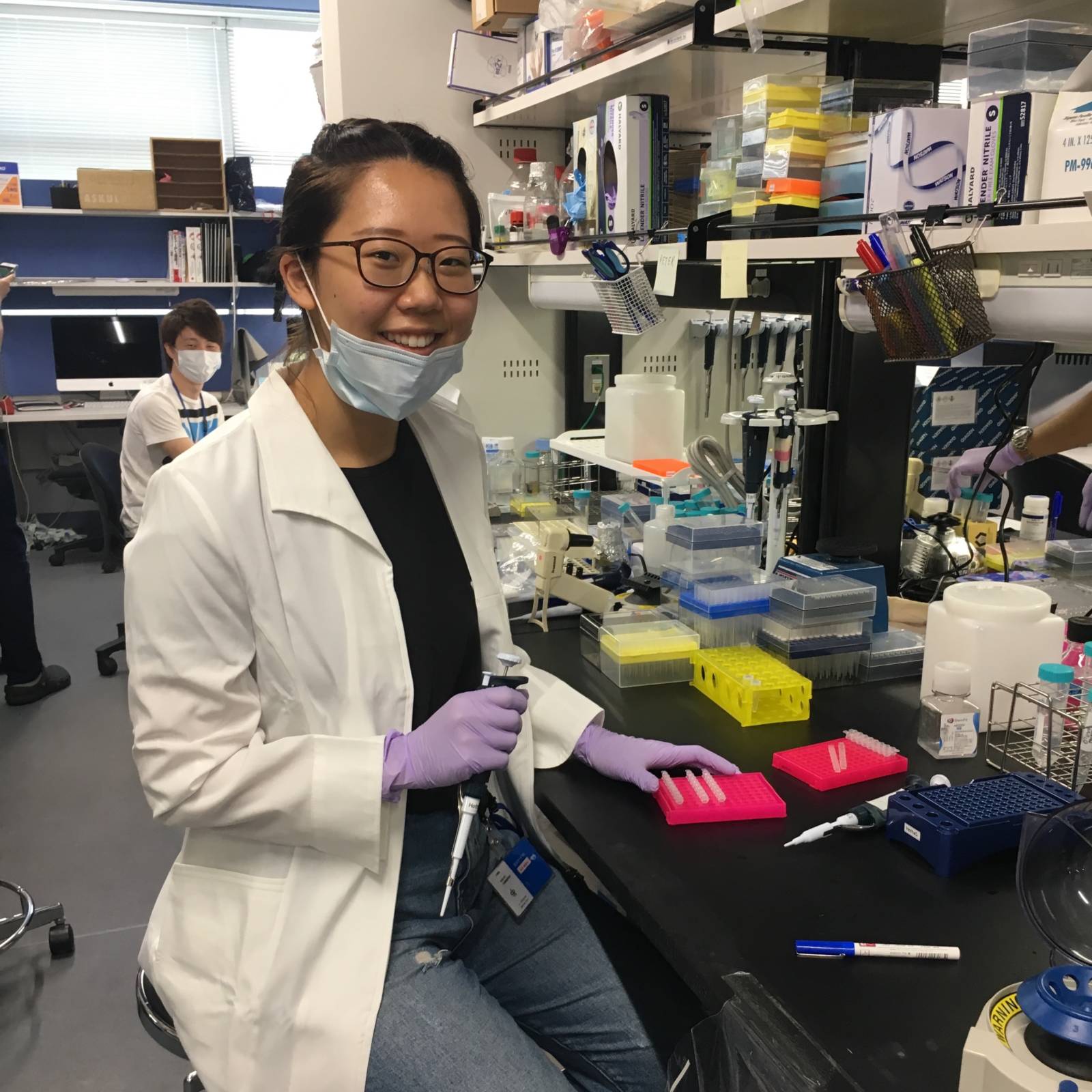
One of the locations I interned at was the Center for iPS Cell Research and Application at Kyoto University in Kyoto, Japan.
But have no fear! While I was rejected from both PICS and IIP as a first year, I still managed to participate in two great internships (one eight weeks and the other four weeks) that led to a spectacular summer — in this post, I’d like to share how. (For another great post about Princeton summer opportunities, look at this post by fellow correspondent Raya!)
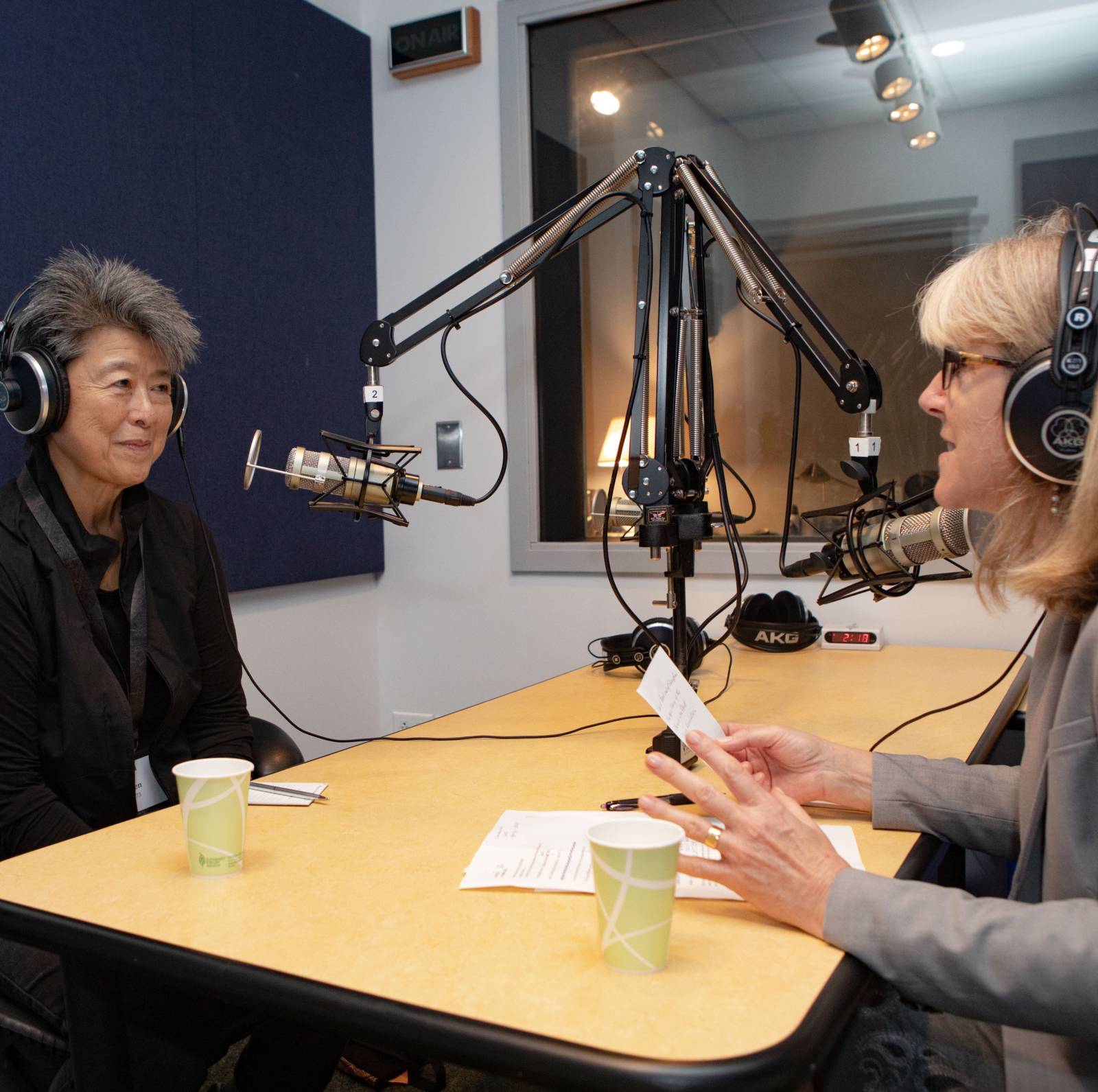
You might not have a fancy podcast studio such as this at your disposal, but don’t let that hold you back from conducting an interview! All you really need is a willing interviewee, a phone (to record), and a flexible list of thoughtful questions.
When we think of research, we tend to picture someone sitting in the library surrounded by stacks of books. While it’s true that books (and textual materials accessed via the web) remain incredibly important to the research process, not everything research-worthy comes in book form. Indeed, for certain types of research, such as ethnography, journalism, and oral history, going out into the broader world outside the library doors is essential. This was the case for me recently as I worked on a podcast for a History of Science class; an interview with a molecular biology professor about their work on the Human Genome Project was central to my endeavor. So, in light of this recent experience and in the spirit of diversifying the types of sources we use as researchers, I will share in this post some thoughts on how to incorporate an interview into a class project or research paper.
Every department offers wonderful opportunities. For instance, departments offer seminars, special lectures, opportunities for internships or grants, study abroad programs, amongst other things. But to take advantage of these opportunities, it is important to know your department well. As a sophomore, one of the biggest challenges for me this year has been familiarizing myself with my own department, chemical and biological engineering (CBE).
In this post, I will provide some tips on how to get to know your department by describing how I engaged with CBE.
If you are caught up on my latest posts, you will remember that I have had some ups and downs in my research process for my Junior Paper. I think it is safe to assume that most students experience difficulties with their JPs. However, the difficulties differ from student to student.
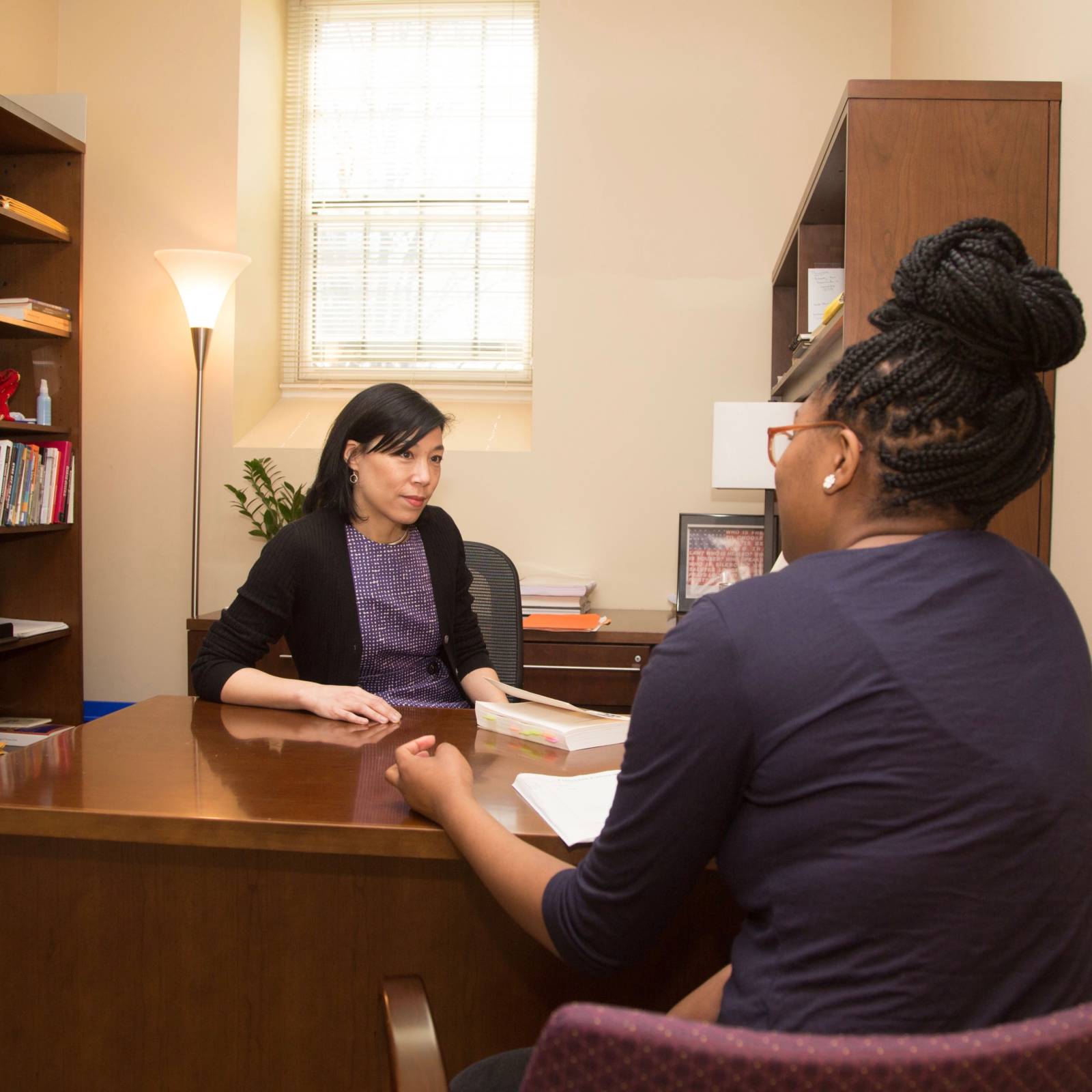
Interviewing experts is a great source of information, but sometimes it can be challenging!
In the Woodrow Wilson School, you choose–or, sometimes, it is chosen for you if you are enrolled in a seminar that specifically focuses on quantitative or qualitative research–whether you would like to do a quantitative or qualitative analysis of your JP topic. While most of the quantitative students are focusing on coding and analyzing existing datasets, the qualitative researchers analyze literature, conduct interviews, and gather information on their own. My biggest challenge so far has been the interviews.
If you were to take a tour of Princeton’s campus, your tour guide would point out various things that are unique to Princeton’s campus. For example, we have the third largest university chapel in the world, and Frist Campus Center used to be Einstein’s laboratory. But, something that is incredibly special about Princeton’s campus–and I feel we don’t talk enough about –is the fact that Princeton has an amazing art museum directly on campus.
The Princeton University Art Museum (PUAM), whose collections hold works by artists ranging from Cézanne to Basquiat, is a great spot for tourists and community members to visit. However, it is arguably an even greater spot for students.
This week I share a little bit about my experiences at the art museum and interview Juliana Ochs Dweck, the Andrew W. Mellon Curator of Academic Engagement, to talk about the different ways the PUAM can serve as a resource for research and studies at Princeton. After all, as Dweck notes about the university museum, “the whole point is to be a teaching museum.”
I hope I’m not the only one that feels like their Thanksgiving break went by far too quickly. For this post, I wanted to reflect on my Thanksgiving break — on what went well and what didn’t go so well — so that I can make the most of the upcoming winter break. Hopefully, this reflection will be useful for any of you who also felt extremely stressed that Sunday right after break.
Let’s start with the good. Like many of you, I went home to visit family and had a great time spending time with them and doing things like simply hanging out on the couch and reading. I also was *finally* able to catch up on sleep, so I felt physically rejuvenated. In short, break started off great.
After Winter Break, it’s straight into reading period and finals
Winter break: a month (hopefully) full of rest and relaxation. The weeks after winter break: minimal hours of sleep and high levels of stress for pretty much all Princeton students. When the time comes, it is non-stop work until finals are over. If you are anything like me, it is easy to trick yourself into feeling like there is no work to be done over winter break. You get lulled into this false sense of reality, one in which your papers and exams aren’t due for another month. So, you binge-watch a Netflix show (or a few) and sleep in. However, this makes you susceptible to getting hit, hard, by the work waiting for you when you get back to campus. This is something I was afraid of during my first year here, so I did everything I could to overcompensate for this possibility. I ended up working throughout the entire break, not really giving myself any time to relax, which was not ideal, and I saw others who didn’t work at all, which also was not ideal. By junior year, after many trials and errors, I’ve figured out some tips that work for me to achieve a happy medium between rest and productivity over winter break.
Every year, the Andlinger Center for Energy and the Environment organizes a conference where students, faculty, and industry professionals discuss research and innovations related to clean energy and other environmental solutions. The event features keynote speakers, faculty panels, poster presentations, amongst other sessions to introduce and highlight the work of different professionals. The purpose of this event is to educate students and professionals on new advances in energy technologyand to encourage even further research.
This year, I attended my first annual meeting, where I learned more about the clean energy research at Princeton and in New Jersey. In this article, I will reflect on some of the highlights from the event.
Phil Murphy’s Keynote Address
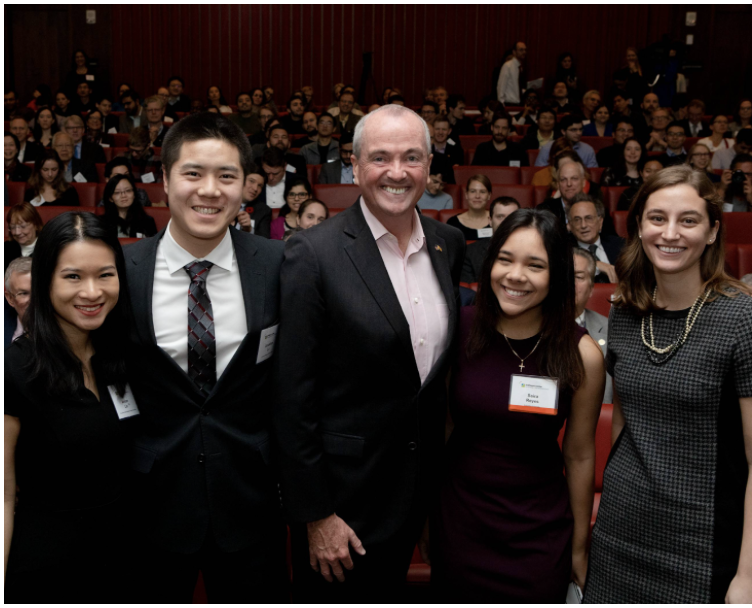
Along with fellow students from New Jersey, I met with Phil Murphy as he spoke about our role in energy and environmental research in the state.
This year, the keynote speaker was Phil Murphy, the Governor of New Jersey. In his speech, Murphy addressed challenges in clean energy reforms, and suggested that innovation is essential to create environmental advances. He encouraged people to work together, because at these conferences, individuals can share ideas. Others can then step in and say “we can help.”
At the address, I sat next to fellow students from New Jersey, the CEO of Public Service Enterprise Group (PSEG), Ralph Izzo, and the Dean of the School of Engineering and Applied Sciences, Emily Carter. Seeing individuals from different backgrounds coming together around a common goal reminded me of the importance of collaboration in research. While one lab cannot solve all of the energy problems in the state, the efforts of multiple people can. As institutional researchers, we are responsible for driving innovation and developing new technologies in our fields, thus it is important for us to collaborate in the lab and across the academic sector.
Faculty and Industry Panels
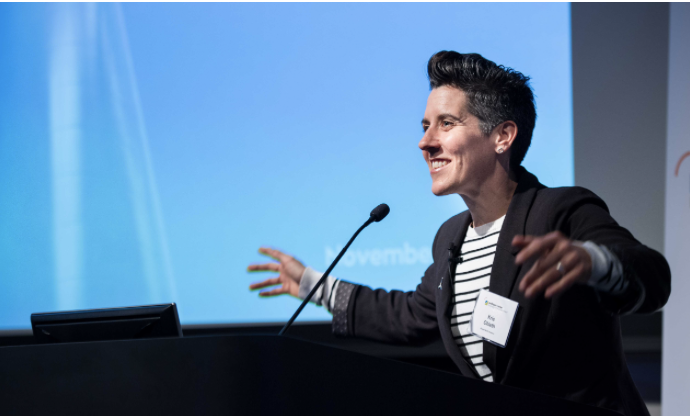
Kris Ohleth from Orsted speaks about current work on wind energy developments in New Jersey.
Amongst the discussions, faculty in various departments spoke about their research. Representatives from other universities and companies such as Orsted and ExxonMobil were also present to speak about energy visions and advances at their companies. The topics discussed ranged from ocean wind turbines to innovative approaches to produce biofuels and even new technologies for clean transportation. These panels were useful to observe where we stand in energy research and where we plan to go.
Poster Presentations
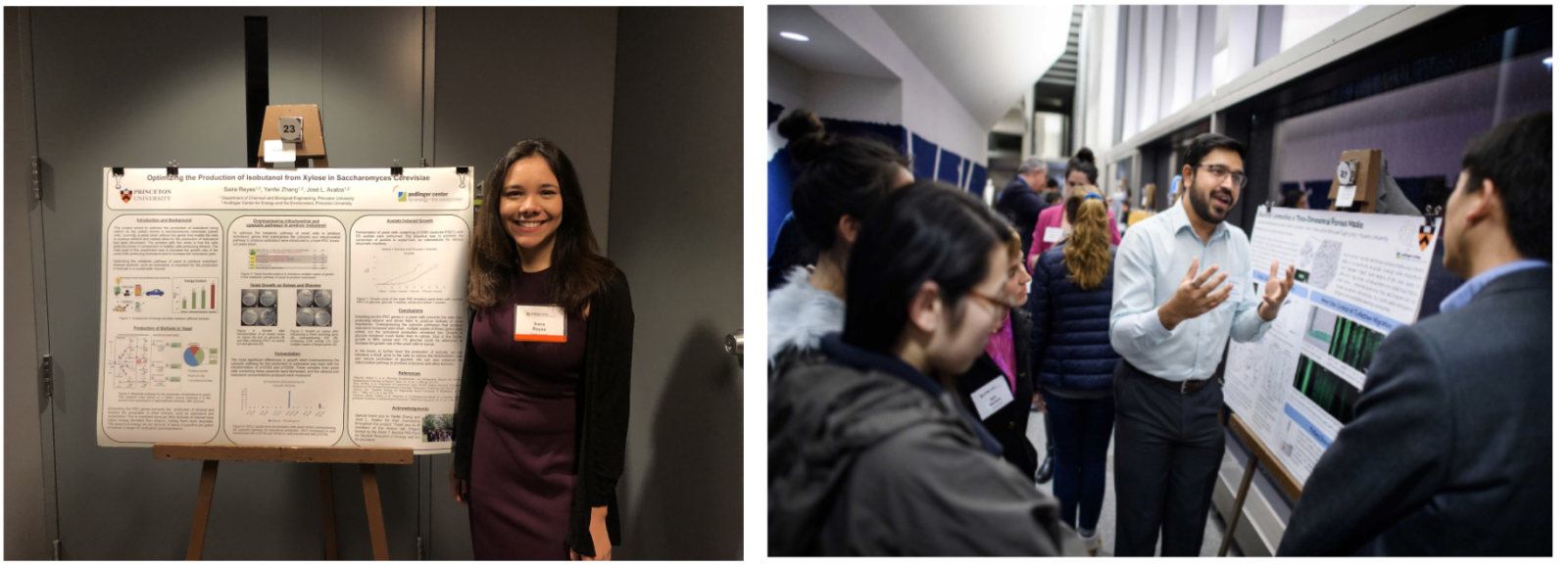
The event concluded with poster presentations where undergraduates, graduate students, and postdocs presented their research.
Undergraduate students, graduate students, and postdocs from different engineering and natural science departments presented their research in a symposium-style poster session. I presented on the research I did during my summer internship with the Andlinger Center.
Throughout the event, I spoke with some of the presenters situated around me. I heardfrom a postdoc in the mechanical engineering department, Guang, about research in fluid dynamics to harvest energy. I also heard from a senior in the chemistry department, Gabriella, about electrochemistry reactions related to energy. In addition to learning about interesting research, I learned that Guang had been a TA for MAE305, a course which I am currently taking, and Gabriella had taken multiple courses in the Portuguese department, where I am interested in getting a certificate.
As I heard this, I thought back to what Phil Murphy had mentioned. The purpose of academic conferences is to connect people and encourage collaborations. Not only are we researchers, we are also students that continue learning from others.
—
The Andlinger Center Annual Meeting is designed to further conversation on research and innovation. Regardless of your academic background, these issues impact the community as a whole, and it is important to learn about the future of energy and environmental concerns.
If you could not attend (or even if you did), I hope that my reflections serve to inform you about some of the conference highlights and I encourage you to attend events at the Andlinger Center throughout the year. In addition, learning through collaboration in research is not limited to the science field. You can also look for similar events and opportunities to learn through collaborative research in other departments by visiting the Office of Undergraduate Research event calendar.