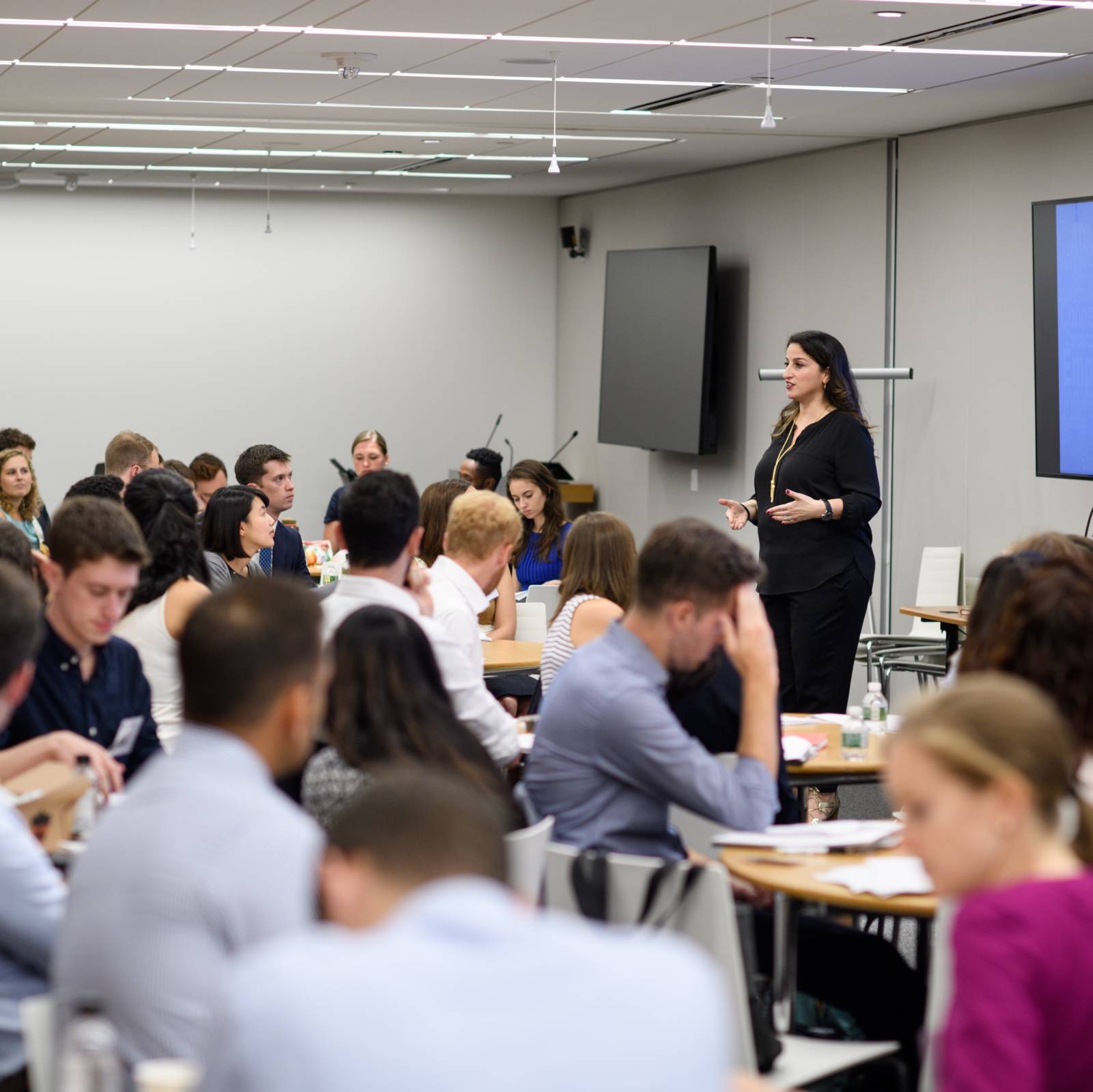
Taking notes with an eye toward synthesis (that is, making connections to previous material, readings, lectures, and so forth) can give you a head start on the writing process.
One of the challenges of college is assimilating large amounts of information from a variety of sources: lectures, course readings, independent work research, precept discussions, extracurricular programming—the list goes on and on. Compounding the challenge is the fact that what’s ultimately demanded of students is not mere recall, which can be accomplished through memorization. Rather, we’re charged with synthesizing disparate materials, pulling things together, making connections across genres of information. In this post, I reflect on some of the ways I try to do this.
Since coming to Princeton, I’ve become involved in diverse publishing and editing opportunities. One of the first undergraduate publications I joined was PURJ, the Princeton Undergraduate Research Journal. As a member of the Peer Review Board for PURJ, I learned more about the peer review process in academic research publications and had the opportunity to review manuscript pieces spanning incredibly diverse disciplines from the undergraduate body. In contrast to some other more specialized journals I’m involved in, such as Unfound, Princeton’s Journal of Asian American Studies, PURJ is a truly multidisciplinary publication that showcases work from the humanities, social sciences, natural sciences, engineering, and arts.
To learn more about the perks of being involved in a research journal, I interviewed Jasper Lee ’21, the current Co-Editor in Chief of PURJ. A molecular biology major, he first joined PURJ as a member of the Peer Review Board and then took on the role of Managing Editor of Peer Review. Here’s what Jasper shared about his experience with PURJ:
While advising and formal research mentorship have been highly rewarding at Princeton, I have found more informal discussions with friends and classmates here to be invaluable in the development of my own ideas.
A professor recently offered this advice in class: if writing a paper isn’t going well—if you’re feeling the notorious “writer’s block,” for instance—then try writing a letter instead. In his view, this needn’t be a real letter to an actual person. The main point is to try to explain what you hope to achieve in a different way to a different audience.
Though I’d never tried letter writing of this sort before, I immediately appreciated my professor’s advice because of how it connects to a practice I’ve implemented in my own life for quite a while. That strategy is to “talk it out”—to take a break from a task that’s frustrating me and talk through the problem with a friend. This is the first reason that I think talking about research is helpful for each of us: it helps us clarify our aims and work through challenges.
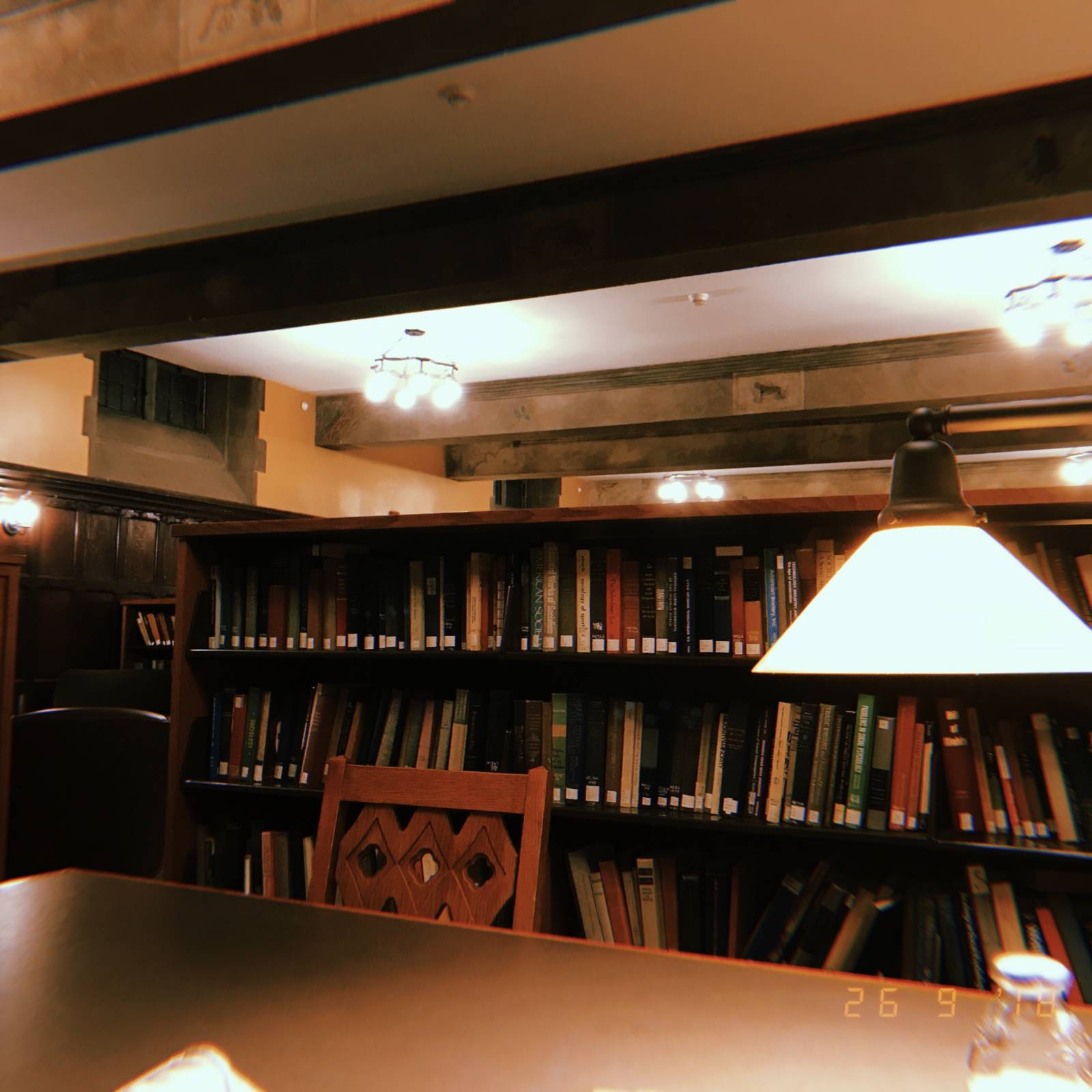
The Rocky-Mathey library, where I wrote most of my papers last spring.
It’s always recommended to balance your course workload appropriately with a good number of paper classes and problem set (p-set) classes. While it’s definitely not ideal, sometimes you just end up taking multiple classes with a demanding reading and writing workload–which means you can also end up with four or five final papers. Some students may actually prefer having only papers and no exams, and vice versa. Exams are a one-and-done deal, whereas final papers allow an indefinite amount of time and access to endless resources–but this can be stressful in its own way. Sometimes, you never know when you’re truly done with a paper, and it can be difficult to allocate time effectively when you’re juggling multiple written assignments.
Being a prospective English major, I tend to pile my coursework with a lot of reading and writing-heavy classes. Last spring, I took four humanities/social science classes and had four papers due for Dean’s Date. Needless to say, in the beginning I felt overwhelmed by the thought of having to write and polish several papers in what felt like not nearly enough time. As a general rule of thumb, I’ve learned that time management is especially crucial when having to complete multiple Dean’s Date assignments, and that planning ahead on your papers can make your life so much easier.
Aside from time management, here are some tips so that you can avoid feeling a sense of impending doom by the time Dean’s Date rolls around:
As a sophomore planning on declaring in neuroscience, I’ve been wondering a lot about the types of research projects neuroscience majors do for their independent work and senior thesis. To get a better feel for these projects, I’ve been reaching out to neuroscience faculty, sometimes via cold emails – a task made easier with the help of this post. However, I recently wanted to reach out to one of my current neuroscience professors in particular, both to hear more about his undergraduates’ research projects and to develop a better relationship with him.
Building positive relationships with your professors is important and rewarding. It’s easy to regard getting to know professors as a purely professional opportunity: that is, for the purposes of soliciting a recommendation or finding a lab position. However, this process is rewarding in other equally important ways: for example, I enjoy when professors explain the trajectory of their own careers, since it has helped me clarify my own academic and extracurricular interests. Often times my meetings with professors have developed into personally meaningful friendships that I hope will extend beyond my time at Princeton.
A Coffee Chat at Prospect House
Although most of us would agree its important to build relationships with professors, it can be more difficult to know how to accomplish that. How do you approach a professor? Where and when do you meet? And what do you actually say to them? All of these questions ran through my head as I wondered how I would go about meeting the neuroscience professor I mentioned above. Meeting professors can be nerve-wracking – that’s why I’ve put together the eight tips I used that streamlined the process.
A long-term project like a thesis is a marathon, not a sprint. This has been a difficult adjustment for me. In almost every other research project I’ve done at Princeton, I’ve chosen the last-minute sprint model, rather than a more organized long-term approach. Sprinting hasn’t worked well in the past, but it won’t work at all for a thesis. There’s simply too much involved in a thesis to cram it into the few weeks before the deadline.
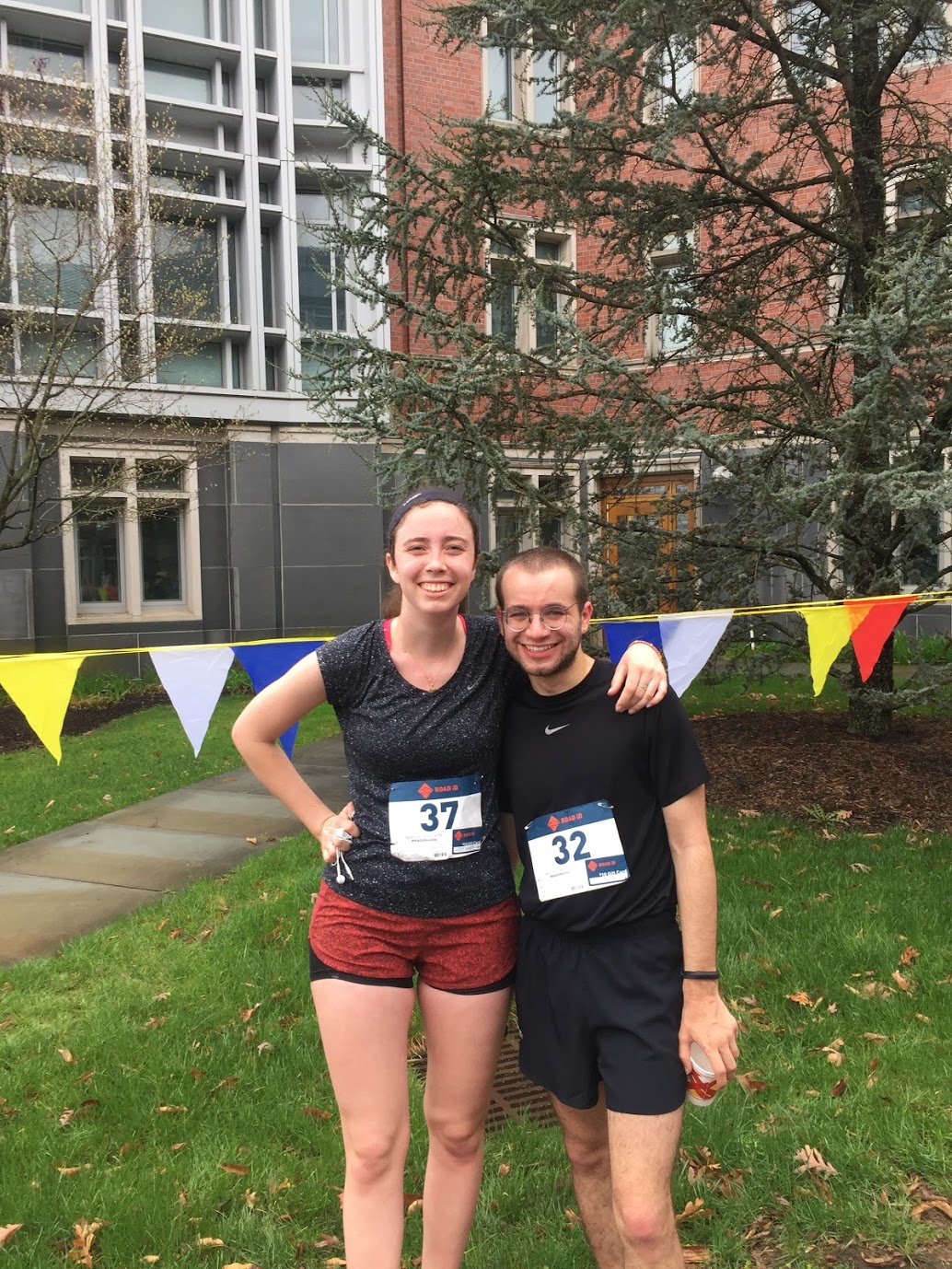
My thesis buddy and me cheesing at the finish line of a 5K last spring. It’s never too early to start training for the thesis marathon!
The marathon approach is new to me, so I looked up some tips for how to train for an actual marathon. I was surprised how many were relevant for a long-term project like a thesis or a final paper. I’ve collected my ten favorites here:
First-years, you’ve just survived everyone’s favorite time of year: your first Writing Seminar deadline. Over the course of the past few weeks, you’ve learned the difference between motive and thesis, discussed strategies for analyzing data, written a draft of your first essay, and finally, turned in your first piece of graded work: your R1!
The process of going from an ungraded draft to a graded revision may have seemed intimidating. In part, this is because most first-years have little to no experience with serious revision of essays. In high school, when standards were lower, I, like many others, got away with handing in first drafts most of the time. When I did make the time to revise, my “revision” consisted mainly of adding a few fancy words to my essay and tightening up my conclusion. So when I got to my Writing Seminar and was essentially told to rewrite my entire essay, I panicked.
Did I have to completely start over? Was all my D1 work wasted? As I had no experience with the revision process, I struggled to even begin the process of writing my R1. So if you felt the same way after handing in your R1, read on: I promise that your next two revisions will be made much easier (and dare I say, pleasant?) with the help of a few key strategies.
As I have written for the PCUR blog before, choosing a topic for an open-ended research project can be challenging. Even once you have narrowed your search and settled on an idea you would like to pursue, you may find that other scholars have already written about it. There is indeed a finite number of possible research subjects (even if it seems, as I suggested in my earlier post, that there is infinite possibility), and as undergraduates many of us have yet to find our research niche. This by no means should discourage you! Just because there is existing literature does not disqualify you from making your own contribution. Of course, we are told this in our first-year writing seminars, where we discuss the different “scholarly moves” one can make (“piggybacking” on another scholar’s work, “picking a fight” with a scholar, and many others, as helpfully delineated in this paper).
In this post, however, I do not merely want to rehash what these “moves” are, but rather suggest how one goes about making any intervention, especially in determining what kind of intervention one wants to make. The following are some methods I have found useful in my research:
Last spring, my JP adviser passed on a piece of wisdom from his graduate adviser: for a research project, you should spend one third of your time reading, one third of your time writing, and one third of your time editing.
This was new to me. Historically, I’d spent 80% of my time reading, 19% of my time writing, and 1% (at best) of my time editing. I had always told myself that it didn’t make sense to start writing until I’d read everything and figured out what I wanted to say. Also, reading almost always felt easier and safer than writing. Instead of constructing my own ideas, I could sit back and receive other people’s finished products.
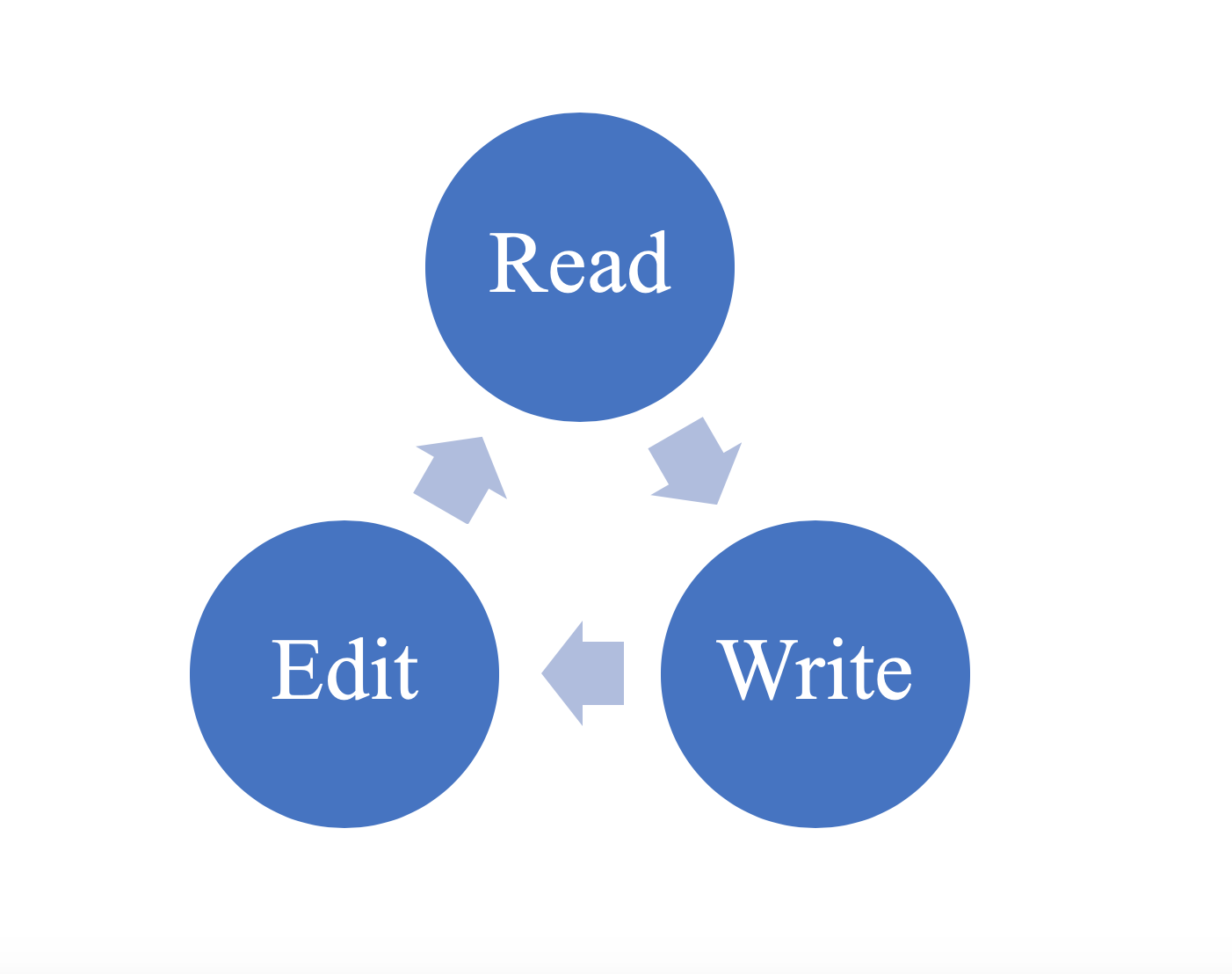
The research cycle: read, write, edit.
The problem was: I never ran out of things to read. Most of the time, I would only start writing once the deadline was in sight and I had no more time to waste. Rarely would I have enough time to edit my work.
For my thesis, though, I’m trying to follow my JP adviser’s system, spending equal amounts of time reading, writing, and editing. It took me until this week to realize that I need to treat these three elements as parts of a cycle, rather than macro chronological steps. In other words, I realized that I shouldn’t spend the first half of my fall semester just reading, the next few months writing, and the next few months editing. I need to be doing all three simultaneously. My reading, writing, and editing should be working in tandem with each other.
Attending workshops and events outside of class can give you a better perspective on your coursework. Think of academic enrichment events as learning experiences rather than as something that takes time away from classes and homework assignments.
It is easy to get caught up in everything going on on campus. Between classes, extracurriculars, and other activities, it feels as if there is no time for anything outside of Princeton. However, in a post at the end of last year, I mentioned the importance of attending outside academic conferences and other enrichment opportunities as a way to strengthen your academic experience. After a great learning opportunity at the American Institute of Chemical Engineers (AIChE) conference in April, I made it a goal for myself to attend more of these events this year. Thus, when I received an email from the Princeton University Mentorship Program (PUMP!) about attending the DISCOVER Summit in Philadelphia on September 13th, I immediately accepted. In this post, I will further expand on how the summit affirmed the importance of looking beyond the “orange bubble”.