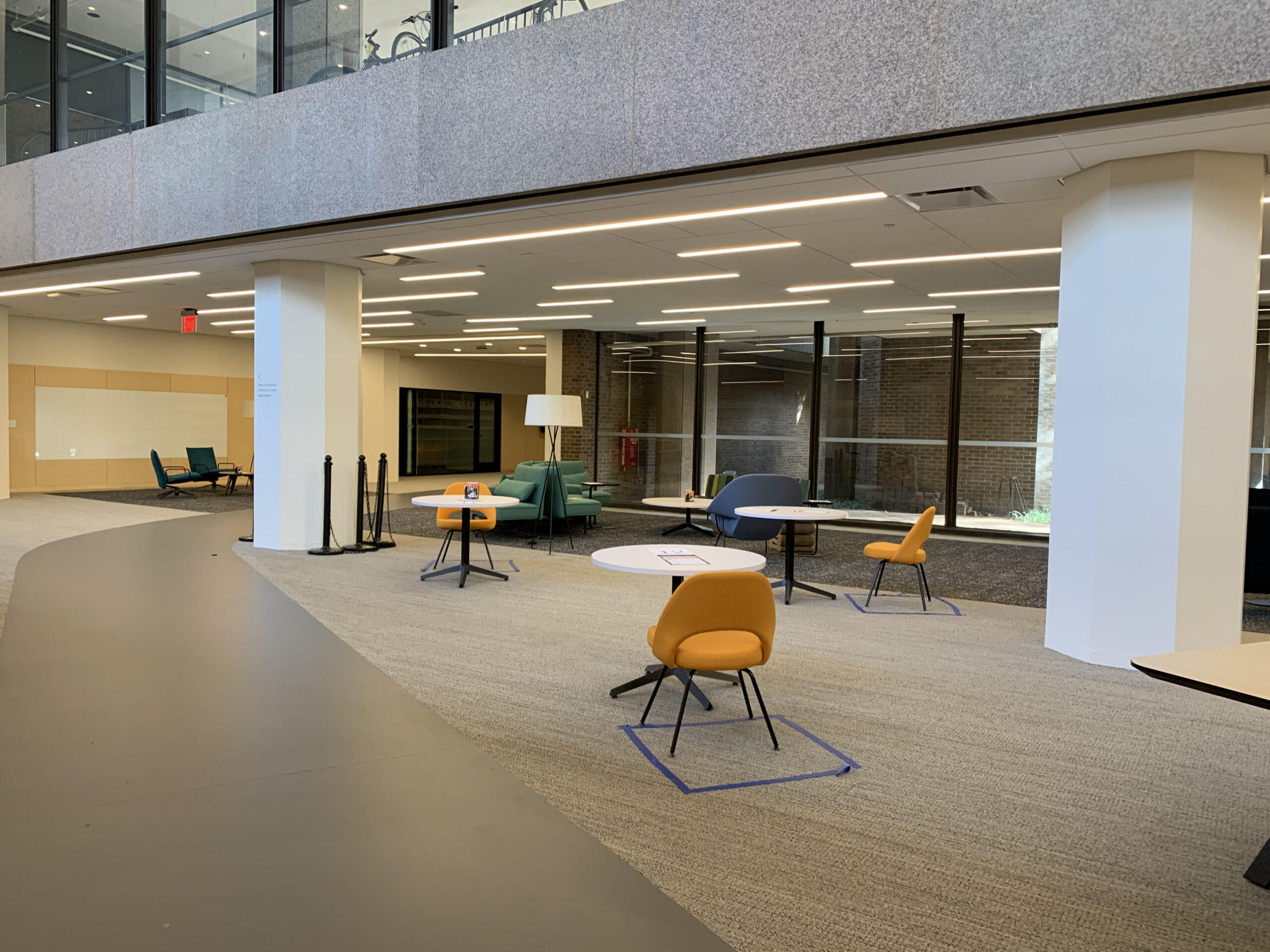
A view of the North Study section of the new Engineering Library underneath Fine Hall.
Last school year, during my first year at Princeton, I rarely ventured out to study in the libraries, instead preferring to stay in the comfort of my dorm room. However, after spending the fall semester at home, I realized just how much I missed the Princeton libraries, and I regretted not taking advantage of this amazing resource more often while on campus.
Going into spring semester, I challenged myself to explore the many incredible study spaces on campus that I had never been to. I was partly inspired by this post on the best study spaces on campus, and I wanted to provide an update on how studying on campus during a pandemic is like. A lot of the logistics around studying in the libraries have changed due to new Covid-19 regulations. So, in this article, I am going to lay out the changes to the Princeton library system and provide an update on some of the best new study spaces on campus.
For better or worse, the university is internally cloistered as an academic institution. Walls literal and metaphorical separate the departments. This is perhaps most apparent to students on an administrative level; each department has its own academic guidelines, grading policies, and research expectations. Deeper differences, though, may present in modes and content of knowledge production. Disciplines often preclude interdisciplinarity. Divergent methodologies might be applied to the same subject matter to produce different results; within a department, the range of expertise might end up applying similar methods to wildly different subjects.
I, for one, think that these disciplinary divisions often do more to stifle than to encourage intellectual growth or humanistic inquiry (on the problems and politics of the academic disciplines, see my interview with Daniela Gandorfer here). But, as things are, attempting to explain research across disciplines can be quite difficult– like speaking to someone in a different language without a translator. Seniors writing their theses are certainly familiar with this issue when trying to explain their work to people outside their department, or in some cases, anyone other than their adviser. When it comes to feedback on thesis work, then, it makes immediate sense to gravitate towards people with background in whatever you are writing about. They indeed might be able to give very pointed advice.
That said, there is still great value to turning towards those beyond the official borders of your discipline. A lack of familiarity with the subject matter can indeed be an asset– especially in terms of providing feedback on your writing and your writing/research process.
Most people’s New Years Resolutions, I imagine, are not about improving their knowledge of statistics. But I would argue that a little bit of knowledge about statistics is both useful and interesting. As it turns out, our brains are constantly doing statistics – in reality, our conscious selves are the only ones out of the loop! Learning and using statistics can help with interpreting data, making formal conclusions about data, and understanding the limitations and qualifications of those conclusions.
In my last post, I explained a project in my PSY/NEU 338 course that lent itself well to statistical analysis. I walked through the process of collecting the data, using a Google Spreadsheet for computing statistics, and making sense of what a ‘p-value’ is. In this post, however, I walk through how I went about visualizing these results. Interpretation of data is often not complete before getting a chance to see it. Plus, images are much more conducive than a wall of text when it comes to sharing results with other people.
In PSY/NEU 338, From Animal Learning to Changing People’s Minds, my group recently presented our capstone project for the course: we researched irrationality, trying to understand when humans make irrational decisions, how that is implemented in the brain, and if certain things might actually be incorrectly labeled as ‘irrational’. Our emotions are a leading example: although some call them irrational, in practice, they play a key role in fine-tuning our decision-making and reasoning abilities. When you’re happy, for example, everything might be going more positively than expected. Your mood is thus encouraging you to continue the behaviors that led to those rewards, since that positive trend might continue (for a neuroscientific discussion of this topic, see this paper).
To demonstrate this phenomenon first-hand, we had students in the class play what is known as the Ultimatum Game:
You are the proposer. You have been given $100. You are tasked with splitting your money with a stranger, the responder. If the responder accepts the split that you propose, you both keep the money after the game ends. If the responder does not accept, no one keeps the money.
The question: how much money do you decide to offer the responder?
After reading this, students had five seconds to provide their answer. They were then asked to report their mood. The question we wanted to answer was simple:
Is the amount of money people offered statistically different between those who reported “positive” versus “negative” moods?
In this post, I’ll explain some of the basic statistics I used to formally answer this question, bolding some key terms in the field along the way. In my next post, I’ll walk through the programming aspect for visualizing those statistics.
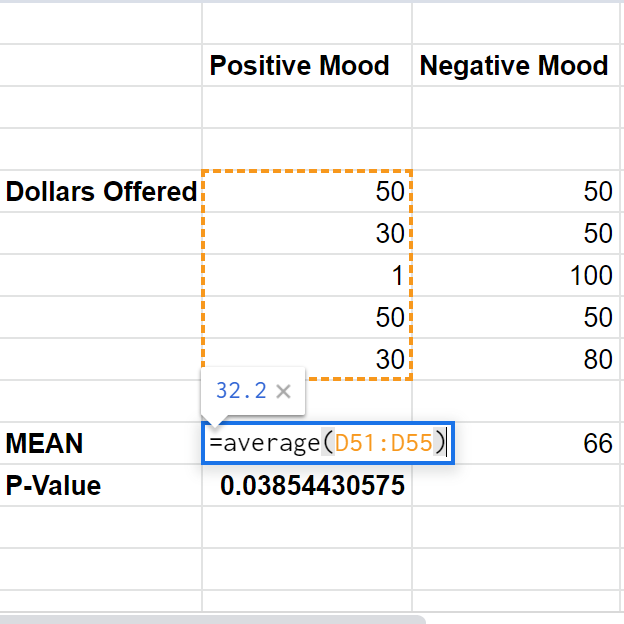
In Google Spreadsheet, I calculated the mean dollar amount for the “positive” and “negative” categories, equaling $32.2 and $66 respectively. The “equals” sign indicates a function, and D51:D55 corresponds to the cells containing the data for the “positive” category.
Like most students at Princeton, I am really looking forward to next semester. Having taken into account the pandemic and the Princeton community’s well-being, the university is offering all undergraduates the option to return to campus, even though most classes will still largely be held online. Consequently, Spring 2021 will be the second time since the pandemic began where we can experience a different side of Princeton – a hybrid semester, where there will be a mix of in-person and virtual classes. A hybrid semester presents a lot of opportunities to enhance the educational experience from a fully virtual semester like the one we had this fall. Next semester, I am looking forward to the small things — like seeing more students outside of classes and interacting with them as guidelines allow. However, it is likely that there will be new and old challenges for students on and off-campus. Although it is difficult to predict exactly how the semester will unfold, I outline three challenges that stand out to me, so that we can prepare for them beforehand.
As senior thesis season approaches, Haider Abbas offers advice that will help you produce a thoughtful, successful, and influential thesis.
Haider Abbas ‘17 is a Princeton alumni who recently published his inspirational senior thesis which he created while in the Princeton School of Public and International Affairs. Many Princeton seniors are now beginning to dive deeper into their theses, therefore I think that hearing from Abbas would be very helpful. Thankfully, a few weeks ago, I was able to interview Abbas and he offered key insight into why he chose his thesis topic, how he was able to produce his thesis, and most significantly the impact that his thesis will have beyond his years at Princeton. I hope that you can learn from his experience and develop a thesis that you feel passionate about!
This interview has been edited for length and clarity.
It’s said that a picture tells a thousand words; a map, however, can tell you a million.
To me, maps are not just tools for navigation. They have a variety of uses, enabling their creators to visualize a vast array of data efficiently and quickly. From questionable election forecasts to the location of monuments in a city, anything of your choosing can be mappable. Maps, in my experience, can be one of the most powerful tools in your research toolbox. Thus, I want to show you how you can use maps in your research, and the power they hold!
Oh, it’s unfortunate that your classes are all online now… But all the extra free time must be nice, right?
Actually, no. Somehow, I have ended up in a place where I’m busier than I was back when school was offline. And that’s without Powerlifting Team practices, the thirty-minute dinners that consistently turned into three-hour-long social gatherings, and all of the hours I spent working on-campus jobs.
I’ve realized it has to do with my relationship with time. In the past, I didn’t need to be very intentional with my free time: it always just happened. Nowadays I think back fondly to my naïve visits to the Rocky Common Room for pre-bedtime cereal-breaks, only to end up practicing handstands on the rug by the piano with my friends until 2 am.
Without spontaneous social interaction, I ended up filling up all of my time with work, clubs, projects, and research. Unfortunately for first-year students, these challenges are only compounded by the transition to college academics in general. Whether or not you feel like you’re busier this semester, I believe we can all benefit from evaluating how we make time for ourselves: below are five tips I’ve implemented to help facilitate a productive and sustainable semester this fall.
As an extension of last Spring, Princeton classes are once again remote for the Fall of 2020-2021.
When I first applied for departmental senior thesis funding early this spring, everyone was still uncertain about how long the effects of the COVID-19 pandemic would last. It seemed departmental administrators were optimistic: funding requests could still be made for summer travel. In my application, I detailed my intent to travel to university and state archives throughout the U.S. south for a thesis examining how antebellum Mississippi Valley planters conceptualized the idea of labor. But before I even heard back about whether I was to receive support, the department updated its funding parameters to prohibit summer travel and I had to redo my application in turn. My summer plans, of course, were not the first academic casualty of the strange 2020 world; nor would they be the last. Fortunately, though, there were ways to work around my newfound limitations: all of the archives that I wanted to visit offered services for resident librarians to scan and send materials from their collection, so I updated my application to ask for funds to pay for associated fees. Here, I’ll be sharing some tips for requesting archival materials to be scanned, which I hope will be helpful to any researcher unable to travel (pandemic or not).
This year, as we prepare to write our final papers in quarantine, it will be extra tough to locate the sources we need for our research. Without in-person access to campus libraries, this Dean’s Date will require some new strategies for accessing research materials. To help with this process, I’ve collected a few virtual research resources from my weeks of quarantine thesis work, as well as the beginnings of my Dean’s Date research (also check out Alec’s recent post for more tips):
Do not underestimate the library catalog. A lot of sources are available online, especially with the University’s new partnership with the HathiTrust Digital Library. Through this partnership, millions of scanned books have been made temporarily available to students—in addition to Princeton’s many existing online holdings. To see if a book is available online, just search for it in the Princeton library catalog. If you don’t see a digital edition listed, try clicking on a print edition and seeing if a scanned version is available through HathiTrust (if it is, there will be a link just below the book’s title and general information). You can also click the “Request” button under “Copies in the Library,” then “Help Me Get It” and a librarian will do their best to send you a digital copy—if it’s available—within a few days.
For one final paper this semester, I’m researching “Khush Khat,” a letter-writing program facilitated by a Bombay magazine in the 1990s. All of my sources are from the University’s online holdings: its digitized books and its digitized archives and databases.