The Princeton Index of Medieval Art used to be a physical register, much like this one.
Many academic disciplines engage with visual art, whether from the standpoint of art history, material culture, or even paleography. The Princeton Index of Medieval Art is a unique database well-suited to the needs of researchers across various fields. Whether history, comparative literature, art, or classics, the index gathers a vast amount of information on Late Antique and Medieval Artworks, neatly sorted in an accessible way.
Students collaborating in a molecular biology laboratory. Photo credit: Matt Raspanti.
Many students at Princeton spend their summers exploring a research project or a lab internship in their field of interest. But what’s next? Maybe you really enjoyed your experience and wanted to continue. Then, you come across the question: should I stay in the same lab or join a different lab?
This was the question I pondered when entering my sophomore year. I had an incredible summer experience as an High Meadows Environmental Institute intern in the Sigman Research Laboratory in the summer of 2023. I worked on a project that enabled my exploration of biogeochemical reconstruction via an investigation of the marine environment during a historical mass extinction through the use of a biological proxy known as foraminifera. But, where did I want to go from there? If you’re in a similar position, here are some things to keep in mind!
Trustee Reading Room, Firestone Library. Photo credit: Matt Raspanti.
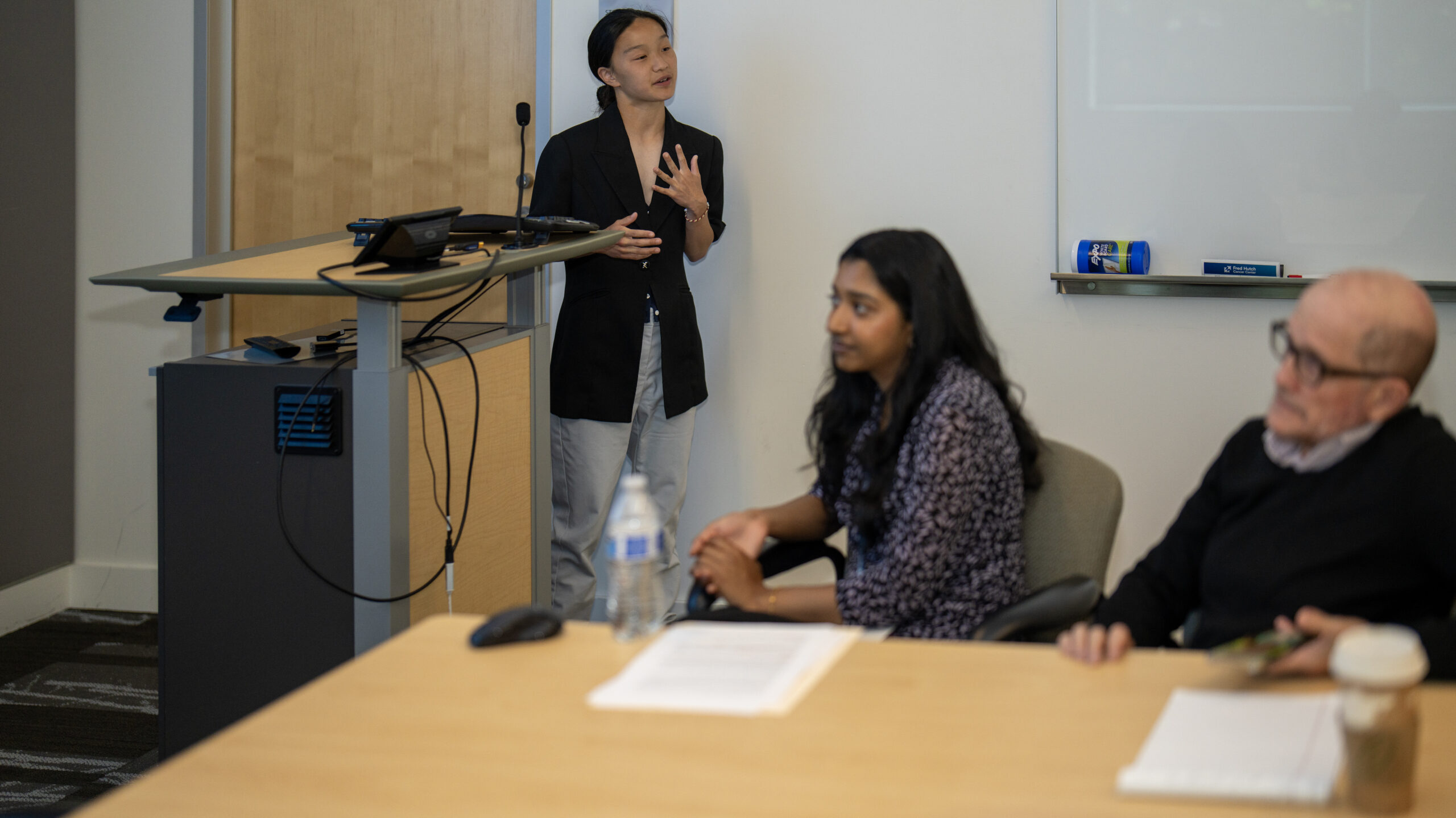
“So what does this data mean?” My professor asked, looking at me expectantly. What does the data mean? “What does this data tell you about the cancer cells?” If he thought rephrasing it made it any better, it didn’t. I am not quite sure what I said to save face (and frankly, I really do not want to remember), but I must have said something because my professor just nodded. “When you look at your data, I want you to create a story. It may be a mystery, but then you’d be providing a certain set of clues.”
It is very easy to get caught up in generating data, especially if the data is particularly tricky and you’re concerned about making sure it looks right, generating the right graphs, having the right axes, numbers and titles. It can be a headache. By the time the graphs are done, I would rather not look at it anymore or think too hard about the numbers. However, as lab reports and analysis questions stack up for our classes, it becomes prudent to know how to analyze these graphs. While I am not a seasoned veteran, I have a few tips that helped me approach these types of situations.
Princeton alumni P-rade, 2013. Photo credit: Daniel Day.
As Princeton students in 2024, we’ve all heard other students throwing around the terms “connections” and “networking.” Although I myself was eager to take advantage of Princeton’s vast resources, I didn’t quite know where to start, or how to start. To those of you who are facing a similar dilemma, let me introduce you to an incredible, vastly underutilized resource: our alumni network.
Students working in Firestone Library, perhaps sending an email to an adviser!
In a world where instant responses to messages are possible, it can be especially frustrating when, after several days, you’re still waiting for a response on a time-sensitive issue. Many of us have experienced this before: asking an adviser a question, checking with a teammate if they’ve completed their tasks, and so on. Yet even with conventional wisdom on how to receive a response (crafting a compelling subject line, personalizing a message, or keeping an email short and sweet), responses can be elusive.
The truth is, the people we work with as students, researchers, or employees often have busy schedules. They may have several responsibilities vying for their attention, and sometimes an email just falls lower on their list of priorities. We want to resolve our questions and continue making progress as quickly as possible, yet help does not always come that quickly. In this article, I share key tips I’ve learned through discussions with my managers, colleagues, and advisers over the course of my time as a student and working in industry.
Dr. Augustin Hennings and I in the MRI control room, C Level, PNI
It felt a little odd to begin an email with, “I wrote about your lab in my application to Princeton!” but it was the truth. Since high school, I had been fascinated by memory and its profound effects on shaping our lives, which motivated me to pursue a degree in neuroscience. Professor Kenneth Norman’s work in the Princeton Computational Memory Lab captured my attention while I was exploring Princeton’s resources for my application essays. I wrote about how I wanted to be a part of the lab and study human memory, specifically focusing on how the brain and mind can overcome the emotional consequences of trauma-based memories. After arriving at Princeton, I had been eagerly awaiting the right time to reach out to Professor Norman about getting involved in his research.
What is research? Perhaps we can ask the Internet…
If you’re anything like me, you first thought that “research” essentially amounted to surfing the Internet. Back in the glory days of middle school, “research” meant the rewarded privilege of getting to use the laptop carts, productively using class time on googling information about our various project topics (and definitely not secretly playing games). Now, as the mature, worldly college student you now are, perhaps you think you know better. “True” academic research, the clever reader now knowingly tells themselves, is historians dusting through archival documents and scientists mixing frothy chemicals in the lab.
Yet there’s a missing part here: a crucial element that takes us back to our elementary and middle days of excited googling. To make any significant intellectual contribution to any field, one first has to understand the current state of knowledge in that same field. To borrow the term favored by the Writing Program, we need to understand the scholarly conversation. How do we know if we’re making a contribution to something, if we don’t understand what that something is? Understanding the current state of research in a given field is a crucially important skill—really, a prerequisite—for conducting your own effective research in that field.
Photo of a chem-bioengineering lab, photo credit to Iris Rubinstein.
When I first walked into the lab this summer, I thought research was all about running experiments and gathering data. What I didn’t expect was how much the people around me—the mentorship and the shared triumphs and failures—would shape so much of my learning and how I view scientific research.
Starting a research position at a bioengineering lab over the summer was really intimidating for me, especially as an undergraduate. At the start, I felt like the most inexperienced person in a room full of graduate students, postdocs, and faculty who seem to have it all figured out. Although I’ve learned or at least seen a lot of the quantitative and qualitative components in my Chemical and Biological Engineering course, I did not have much hands-on experience and critical thinking that comes with actually doing experiments. That’s when I realized how big of a role a mentor plays.
Princeton moves fast. The semester is short, the classes are dense, and before you know it, you’re taking midterms and turning in papers for your writing sem. At least, that was my experience as a first year. Even now as a sophomore, it can feel hard trying to keep up with the pace of the orange bubble. Balancing the demands of coursework alongside the demands of work for research teams and professional clubs can limit how productive I feel at any given moment. Those moments, when I feel I’ve done all the readings I can do and written everything I can think about, are so challenging because it feels like I’ve hit an academic wall. That’s when I find ways to shake things up with a study break. For me, that looks like taking a walk. I know it sounds cliche, but taking a walk can be one of the best solutions because it’s so simple.
Spotlight on the Summer Internship Project of Princeton Politics Junior Mai Kasemsawade
Mai Kasemsawade at the All-Party Parliamentary Group Malaysia for Political Financing meeting at the Malaysian Parliament, which she helped to host with The Institute for Democracy and Economic Affairs.
Many students walk into Princeton intending to change the world, Mai Kasemsawade ’26 is an extraordinary example of how one’s summer research can kickstart global political change. This past summer, Mai worked within the The Institute for Democracy and Economic Affairs in Kuala Lumpur, Malaysia as an intern in the Princeton International Internship Program. She connected her interests in political science research and data science to pursue an ambitious project in advancing Malaysia’s laws on funding for political parties in order to encourage a more democratic political scene. Her experience meeting with Malaysian government leaders, hosting a political engagement workshop, writing articles on critical policy, and conducting interdisciplinary research exemplifies the multitude of eye-opening opportunities that a research experience can offer!