As I was reading through old PCUR posts, I came across PCUR Alumni Taylor Griffith’s 2017 post on Productivity Apps and managing your work. With the continuous development of new organization and productivity apps, it can be challenging to find what works best for you. Though some are fierce Google Calendar or sticky note users, I wanted to share three (free!) apps I’ve found to be incredibly useful.
Welcome back to PCUR! We are very excited to welcome back several correspondents from last year and introduce the new correspondents joining us! Posts will start up this week, so check your email Wednesday morning for the first post of the academic year.
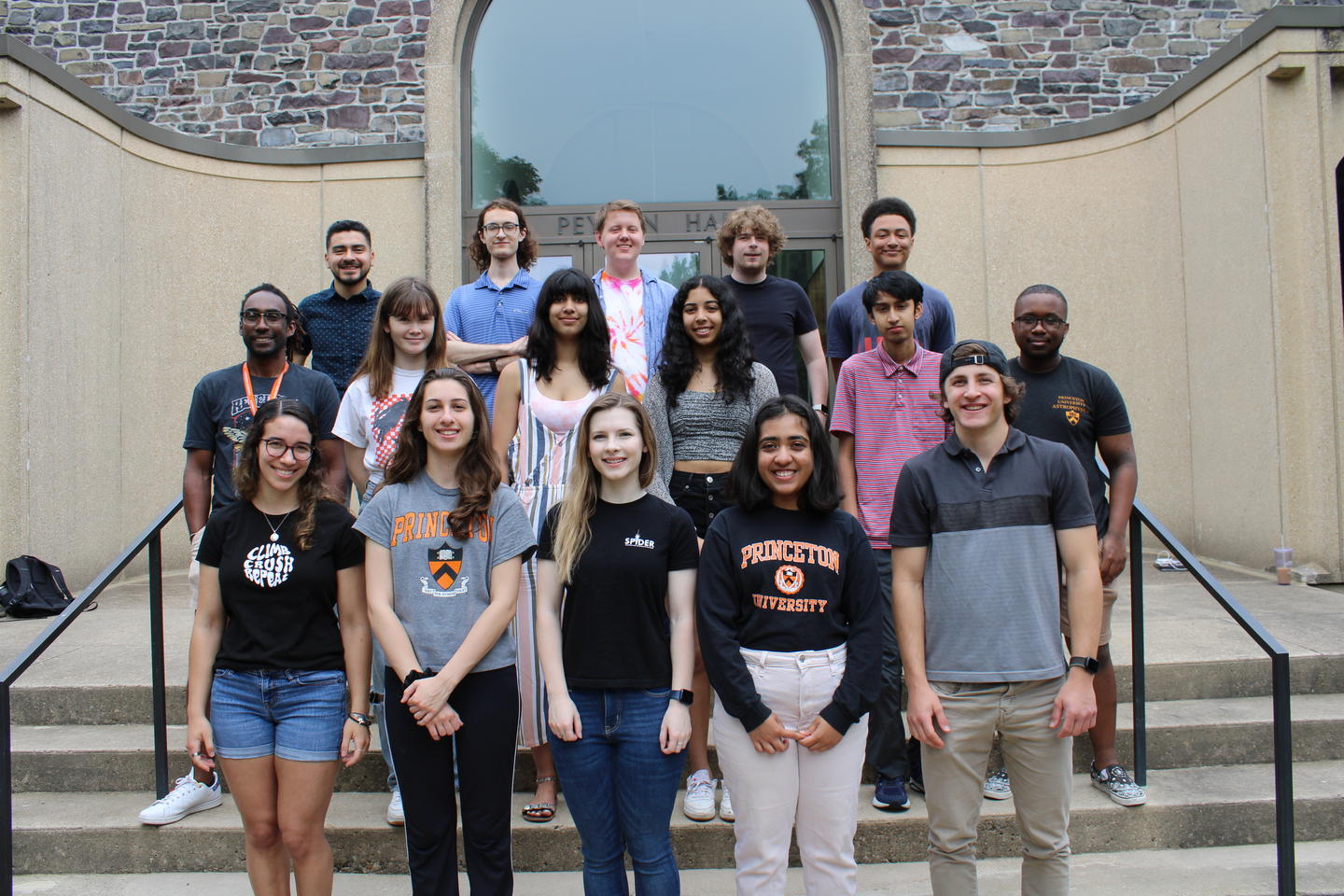
Top, Virginia Cobbs. Middle, from left to right: Rebecca Cho, Amaya Dressler, Xander Jenkin, and Yubi Mamiya. Bottom, from left to right: Shane Patrick, Kate Weseley-Jones, Alexis Wu, and Shannon Yeow
I have the pleasure of welcoming back PCURs Amaya Dressler ’25 (Amaya is abroad this semester so she’ll be back posting in the spring), Kate Weseley-Jones ’25, and Alexis Wu ’25 and introducing new members Rebecca Cho ’26, Xander Jenkin ’25, Yubi Mamiya ’26, and Shane Patrick ’24, and Shannon Yeow ’26. We’re also very grateful that Virginia Cobbs ’25, joins us again as the Chief Correspondent! I welcome you to engage with their perspectives on and experiences with research. You can learn a little more about each correspondent below and stay tuned for PCUR posts this week.
Rockefeller College in the summer.Photo Credits: Daniel A. Day (2014)
So you’ve been brave, reached out to that professor whose research you’ve always admired, and just confirmed a summer on campus doing the research of your dreams. Whether you’re a part of an on-campus research cohort (like ReMatch or HMEI) or starting up your own independent work, summer on-campus is a special, if not bewildering, experience. If you are anything like me, the first few weeks may be a little confusing as you figure out what is expected of you and what exactly you want for yourself. Even though you’re doing research full-time, you’ll likely find that you’re substantially less busy than you were during the school year. This raises some important questions about how you choose to spend your free time. Who are you outside of research? How do you navigate the campus when you’re no longer a full-time student? Beyond time-management, what else should you know about being on-campus in the summer? Below I’ve compiled a short list of advice I’ve found most helpful during my summers on campus.
The Princeton Perspective Project (PPP) is an initiative by Princeton students against the expectation of “effortless perfection.” Our seasonal series in partnership with PPP interviewed professors, undergraduate students, and graduate students to hear their thoughts on expectations, challenges, failures, and growth through it all. In this segment of our Seasonal Series, we hear from Cara Khalifeh, the Treasurer of the Princeton Perspective Project.
Organic Chemistry TA, RCA, and graduating senior Tom Silldorff ’23 reminds us that life is not about the outcome, but the fun we had getting there.
In partnership with the Princeton Perspectives Project (PPP), we’re back for Part 2 of our interview with Organic Chemistry TA Tom Silldorff ’23. While organic chemistry, or “Orgo,” may have earned its notoriety for its exceeding complexity, demanding exams, and time-intensive study, this does not mean that students have to struggle the whole way through. In our first interview, we discussed how Tom found his passion for Orgo and some of his key takeaways from tutoring on how students can grow throughout the course. This time, we’re tackling some of the deepest challenges students face while taking Orgo: What actually gives Orgo its difficult reputation? What can prospective Orgo students do now to prepare for the course? How did Tom face his own struggles with the demand for effortless perfection? If you’ve ever wondered how you can maximize your growth from Orgo or even academics more generally, then read on for one final reflection on fear, failure, and the beauty of Organic Chemistry with graduating senior, Tom Silldorff.
I really enjoyed Alexis Wu’s introduction to our seasonal series with the Princeton Perspective Project (PPP) – if you haven’t read it already, you should definitely check it out. Alexis was kind enough to agree to an interview to answer some further questions about her experiences as a member of PPP. Read more below!
I’ve always loved reading through senior thesis titles and thinking “Wow, that’s clever,” “That’s genius,” “I wonder how they came up with that.” The senior thesis, which many seniors refer to as a full-blown novel, is supposed to be a senior’s finest work and proudest possession. It looks impressive in its black book with gold font. It is 115 pages. It has fancy acknowledgments. As a first-year/sophomore, and even as a high schooler on tour, I was in awe at how seniors could create such a perfect paper. It isn’t until now that I know the answer: hard work.
For this post in our collaboration with Princeton Perspectives Project I dusted off my blog-writing skills and had the pleasure of interviewing 2nd year EEB PhD student Kelly Finke. She uses computational biology techniques to study collective human behavior in Professor Corina Tarnita’s lab.
Princeton Senior and Orgo TA Tom Silldorff offers numerous tutoring sessions in Choi Dining Hall (Yeh/NCW) for all students in Organic Chemistry.
As part of our collaboration with the Princeton Perspectives Project (PPP), we’re exploring how the idealized notion of “effortless perfection”—the idea that a path to success must be free of failure—obscures the reality of both the research process and mastering a new subject. For many students, there are few better examples of this phenomenon than the Organic Chemistry course. Almost regardless of who is teaching or how it is taught, “Orgo” has earned near-universal notoriety for its complicated labs, unconventional approach, and the immense, complex breadth of material that students must learn to conceptualize and then apply. Orgo students must learn to think in an entirely new way, and this process can be uncomfortable. Challenges, mistakes, and “failure” are bound to occur along the way. Yet, often, it is through confronting these very challenges that students grow not only as future academics, engineers, or doctors—but as people.
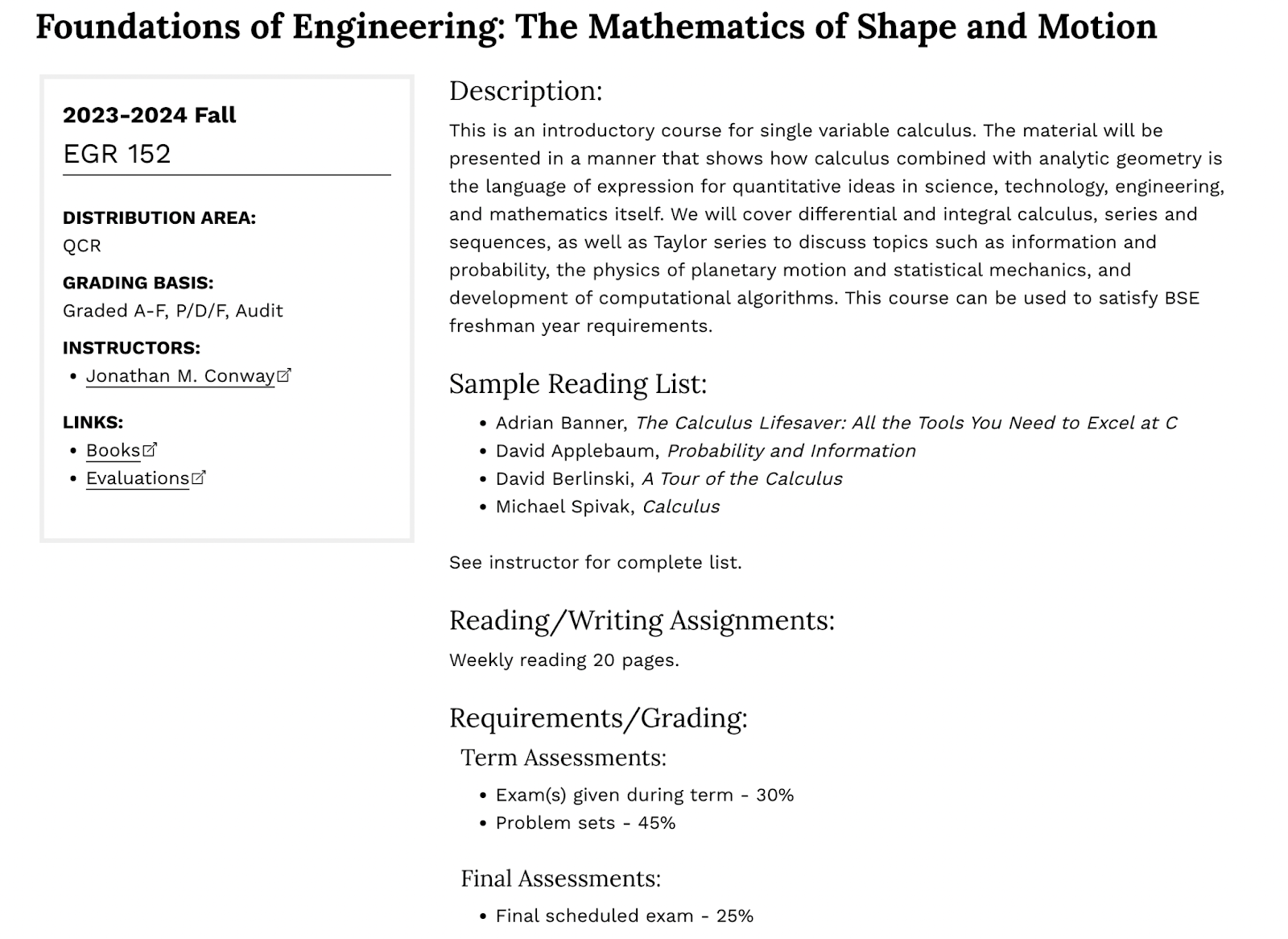
With course selection coming around the corner, the sheer number of opportunities can be overwhelming. Choosing courses can be doubly challenging for rising sophomores who are finishing up their prerequisite courses and trying to figure out what they even want to major in. I wanted to take this opportunity to introduce a new and exciting opportunity for students interested in research—the Sophomore Research Seminars.