In PSY/NEU 338, From Animal Learning to Changing People’s Minds, my group recently presented our capstone project for the course: we researched irrationality, trying to understand when humans make irrational decisions, how that is implemented in the brain, and if certain things might actually be incorrectly labeled as ‘irrational’. Our emotions are a leading example: although some call them irrational, in practice, they play a key role in fine-tuning our decision-making and reasoning abilities. When you’re happy, for example, everything might be going more positively than expected. Your mood is thus encouraging you to continue the behaviors that led to those rewards, since that positive trend might continue (for a neuroscientific discussion of this topic, see this paper).
To demonstrate this phenomenon first-hand, we had students in the class play what is known as the Ultimatum Game:
You are the proposer. You have been given $100. You are tasked with splitting your money with a stranger, the responder. If the responder accepts the split that you propose, you both keep the money after the game ends. If the responder does not accept, no one keeps the money.
The question: how much money do you decide to offer the responder?
After reading this, students had five seconds to provide their answer. They were then asked to report their mood. The question we wanted to answer was simple:
Is the amount of money people offered statistically different between those who reported “positive” versus “negative” moods?
In this post, I’ll explain some of the basic statistics I used to formally answer this question, bolding some key terms in the field along the way. In my next post, I’ll walk through the programming aspect for visualizing those statistics.
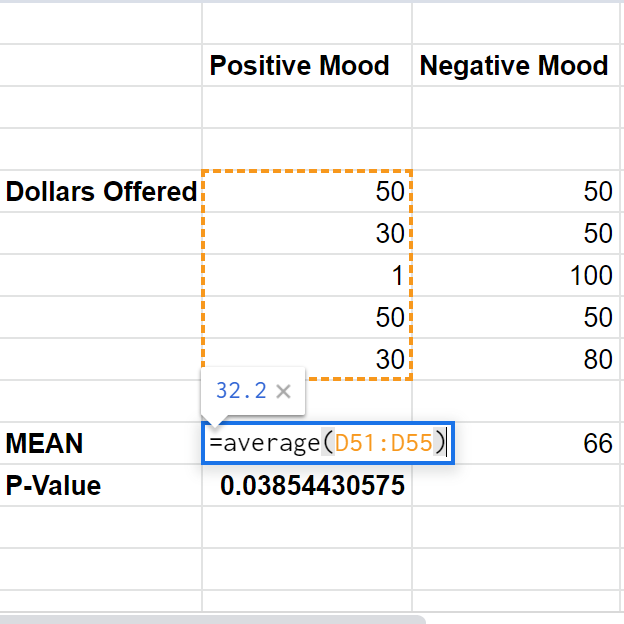
In Google Spreadsheet, I calculated the mean dollar amount for the “positive” and “negative” categories, equaling $32.2 and $66 respectively. The “equals” sign indicates a function, and D51:D55 corresponds to the cells containing the data for the “positive” category.
In the spring of 2019, I wrote a post highlighting my positive experience at the 2019 American Institute of Chemical Engineers (AIChE) Regional Conference. Specifically, I encouraged other students to attend conferences and seminars within their department even when they felt as if they were too busy to attend, as these events can strengthen your academic experience rather than interfere with it.
Throughout the COVID-19 pandemic, in-person conferences and academic events have been replaced with virtual experiences that are now even more accessible to students, as you can attend without traveling far distances and at reduced or no costs. Although the virtual conference was undoubtedly different than the in-person one, I still felt the same, if not more, benefits from attendance. In this post, I will give advice on how to navigate a virtual conference, as I reflect on my takeaways from this experience.
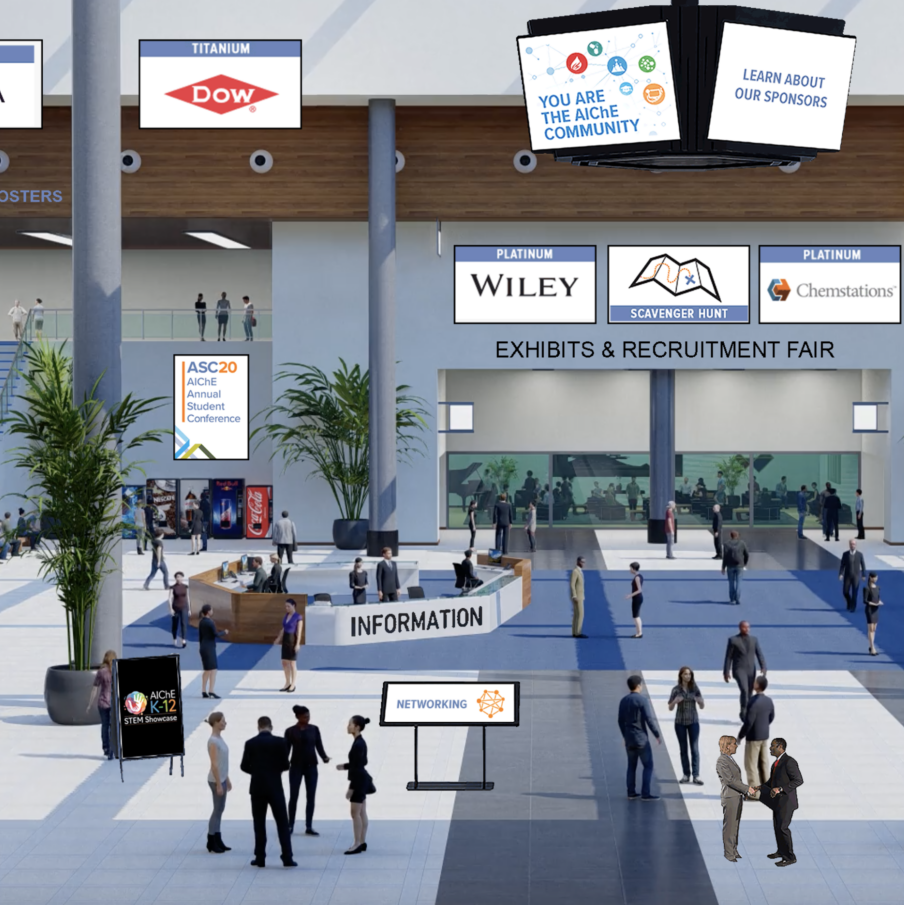
Screenshot of the virtual platform used for the 2020 AIChE Student Conference. This allowed attendees to navigate through different sessions.
Like most students at Princeton, I am really looking forward to next semester. Having taken into account the pandemic and the Princeton community’s well-being, the university is offering all undergraduates the option to return to campus, even though most classes will still largely be held online. Consequently, Spring 2021 will be the second time since the pandemic began where we can experience a different side of Princeton – a hybrid semester, where there will be a mix of in-person and virtual classes. A hybrid semester presents a lot of opportunities to enhance the educational experience from a fully virtual semester like the one we had this fall. Next semester, I am looking forward to the small things — like seeing more students outside of classes and interacting with them as guidelines allow. However, it is likely that there will be new and old challenges for students on and off-campus. Although it is difficult to predict exactly how the semester will unfold, I outline three challenges that stand out to me, so that we can prepare for them beforehand.
As a student studying history, my classes are essay heavy. Whether it’s a short, 5-page paper, or a longer 10-to-15-page paper, I write a lot. And surely, I’m not alone; as Princeton students, we are expected to write a lot, whether it be academically, extracurricularly, or professionally. With so much writing, it becomes easy to grow tired and forgo editing. After all, with an outline and ‘rough draft’ in hand, it’s easier to call it a day and pray for an A.
The rewriting process is perhaps the most underrated yet important step when it comes to essay writing. Rewriting is not just about catching misuse of the dastardly Oxford comma or misspellings of common words but finding out what fundamental aspects of the essay work and do not work. This is asking yourself the basic questions: Does the essay make sense? Does the structure create a naturally flowing, cohesive essay? Are my references in order? Is everything grammatically correct?
With a new semester coming up ahead, and those dreaded 5-page or 10-to-15-page papers coming along with it, I thought it was best to outline some of the strategies I use to rewrite my essays. These are strategies I took away from Writing Seminar (mine being WRI 146: Constructing the Past), some of my history classes (most notably HIS 281: Approaches to European History), and my own writing exercises to rewrite and edit my essays. This list is not exhaustive, not meant to be followed point-by-point nor used for every type of essay; in fact, I would take this list as blend of different strategies to mix-and-match. Nevertheless, here it is!
As senior thesis season approaches, Haider Abbas offers advice that will help you produce a thoughtful, successful, and influential thesis.
Haider Abbas ‘17 is a Princeton alumni who recently published his inspirational senior thesis which he created while in the Princeton School of Public and International Affairs. Many Princeton seniors are now beginning to dive deeper into their theses, therefore I think that hearing from Abbas would be very helpful. Thankfully, a few weeks ago, I was able to interview Abbas and he offered key insight into why he chose his thesis topic, how he was able to produce his thesis, and most significantly the impact that his thesis will have beyond his years at Princeton. I hope that you can learn from his experience and develop a thesis that you feel passionate about!
This interview has been edited for length and clarity.
Specializing in legal thought and critical theory, Daniela Gandorfer is a graduate of the doctoral program in Princeton’s Department of Comparative Literature, a postdoctoral scholar at UC Santa Cruz, and co-director and head of research at the Logische Phantasie Lab (LoPh). LoPh, a research collective recently founded by Princeton alumni and current students, describes itself as a “comprehensive research agency that actively challenges injustices resulting from political, legal, economic, social, physical, and environmental entanglements by means of specific investigations.”I want to thank former PCUR correspondent Rafi Lehman, now the Development Coordinator at LoPh, for putting me in touch with the research collective’s team.
Over email and Zoom, I was able to talk to Daniela about the critical methods employed by LoPh, its relationship with the established academy, and the benefits and limits of an interdisciplinary research approach.
This interview has been edited for length and clarity. Below is part one of a two-part interview.
Daniela Gandorfer, co-director and head of research at LoPh.
For most of us undergraduates, midterms tend to be a stressful time, even more demanding than finals or Dean’s Date. This is because we go through midterms while classes and assignments continue as usual. In contrast, we have a week-long reading period at the end of the semester to focus on writing papers and preparing for finals. If you are a first year–student, you have the additional stress of going through Princeton midterms for the first time and you might have realized that they can be quite different from exams in high school. Therefore, it is not unusual for first years to receive grades on midterms below their expectations. When I was a first year, I learned how I could use my midterm grades as guideposts to help me identify which courses I most needed to adjust to and improve my final grade. It is important to note that midterms scores will not always fully correlate with finals and that there are plenty of opportunities after midterms to adjust strategies and improve performance. Here are some of the strategies I have found helpful when looking to bounce back from a midterm.
Tiktok is more than just an addictive application. It can serve as a tool that helps you discover your academic interests.
Are you struggling to focus on your assignments because you can’t stop scrolling through TikTok? Do not stress! Although TikTok can be addictive, your For Your Page (FYP) may actually have an unintended positive academic side-effect. For those who aren’t familiar with TikTok, your FYP is your personalized feed of videos. Everyone has a different FYP according to their interests. I would like to suggest that your FYP can actually help you find spring courses that you are passionate about. Oftentimes, students aren’t sure which classes they should take because they don’t realize that non-academic interests can actually transfer into academic practice. So, I would like to help create this connection for you: think about what type of videos you see on your FYP (and if you don’t have TikTok then on social media in general) and I will suggest some courses that I think you would love.
TeaTok
Is your FYP full of the latest celebrity drama or “tea”? I think conducting research through certain psychology courses may satisfy your need for gossip. Through psychology, you can explore more deeply why the drama between your favorite celebrities happens and what they might be thinking and feeling. Furthermore, if you are a first year, then I suggest looking into WRI 153: The Meaning of Celebrity. In this course, you can conduct research on your favorite celebrities and also explore how they impact social values.
Political TikTok
If your FYP is full of politics, then you might consider taking an academic approach to this interest through taking a politics course. Two courses in which you can pursue political research are POL 316: Civil Liberties and POL 240: International Relations. In POL 316 you can explore the value of civil liberties through researching key topics such as abortion and discrimination and in POL 240 you can learn how the politics of international cooperation work. Furthermore, if you want to conduct a statistical analysis of the contemporary political events you learn about online, then I suggest taking POL 345: Introduction to Quantitative Social Science. In this course you analyze data using R and conduct a ton of applicable political research. For example, I am currently enrolled in POL 345 and we’ve been analyzing polling data leading up to the election to predict who the next President will be.
Artsy TikTok
If you often see make-up tutorials, dancing, or singing on your FYP, then think about how you might be able to engage with these arts beyond your phone screen. I suggest that you browse through the Lewis Center for the Arts course offerings. This spring they will have courses in photography, painting, sculpture, dancing, and more!
Gaming TikTok
Is your FYP full of Among Us or League of Legends streams? Princeton has an abundance of courses that will allow you to pursue research in technology or gaming. One course that I particularly recommend for first year students is WRI 185: Gamification. I took this writing seminar and absolutely loved it because through this course you can explore what makes up the essential elements of a game and also research games that you enjoy playing. Some other courses that gamers may like are COS 126: Computer Science: An Interdisciplinary Approach, through which you can begin to explore how coders actually program games, and MAT 378: Theory of Games, through which you can learn how to use mathematical concepts to solve games.
Fantasy TikTok
If your FYP is full of Draco Malfoy, Cinderella, or Star Wars scenes, then you should check out English courses such as ENG 385: Children’s Literature. Although this course won’t be offered this spring, I suggest looking out for it in the future because in this course you can analyze the novels you read as a child, including Harry Potter! I also think that a Creative Writing class would be a great fit for you. More specifically, you can take CWR 204: Creative Writing (Fiction) to learn how to actually write your own fantasy. Lastly, if you are interested in studying French FRE 207: Studies in French Language and Style centers around analyzing French fantasies. I am currently enrolled in FRE 207 and it’s one of the most interesting courses that I’ve taken at Princeton.
6. CuteTok
Do you love watching videos of adorable puppies and newborns? Developmental psychology would be an awesome course for you to take. In PSY 254: Developmental Psychology, you can discover what is actually happening within the brains of the cute little babies you see on TikTok. I also recommend looking out for PSY338: From Animal Learning to Changing People’s Minds in the future (as it is not offered this spring). In this course, you can learn more about the way the puppy on your For You Page thinks and makes decisions. One other course that I recommend for those who are interested in animals and would like to explore the relationship between animals and humans more deeply and in a religious context is REL 214: Religion, Ethics, and Animals. These courses will help you see the cute videos you view on TikTok through a new perspective and are definitely worth looking into.
Your TikTok FYP can tell you a lot about who you are and what you love. After spending countless hours on TikTok myself, I realized what I really enjoy watching and learning about. I now take courses in fields that are related to my FYP and feel so passionate about the topics that I’m able to research. I hope that you too can try linking your personal interests with your academic plans by taking courses this Spring that you truly feel are “For You”.
Although Spring plans are unclear, we can choose to take courses that we feel truly passionate about regardless of if we are back on campus or online.
It’s said that a picture tells a thousand words; a map, however, can tell you a million.
To me, maps are not just tools for navigation. They have a variety of uses, enabling their creators to visualize a vast array of data efficiently and quickly. From questionable election forecasts to the location of monuments in a city, anything of your choosing can be mappable. Maps, in my experience, can be one of the most powerful tools in your research toolbox. Thus, I want to show you how you can use maps in your research, and the power they hold!
One of the fascinating aspects of our education at Princeton is how we are encouraged every semester to take courses from a wide variety of disciplines. However, while that is intellectually stimulating, it can also be unnerving in the beginning – especially when you have to step away from analyzing a situation or a problem through the lens of a discipline of study that you are comfortable with and instead approach the issue from a completely different viewpoint. Case in point: last semester, at the recommendation of my academic adviser, I took Anthropology 203 (ANT 203): Economic Life in Cultural Context with Professor Rena Lederman. My adviser believed that the course would be useful for me as a prospective economics concentrator: it would give me the opportunity to examine the field from a different perspective and broaden my horizons. Conceptually, that made a lot of sense. Soon, however, I realized that trying to analyze economic situations without the economic tools and methods that I had grown accustomed to was rather disorienting. Nevertheless, despite the initial difficulty, I found that looking at questions I was familiar with in economics through an anthropological lens ended up being to be especially rewarding. Thankfully, that process became easier as I progressed through the course and learned the tools and methodologies specific to anthropological research.